
You sit down at your desk in the coworking space, ready to tackle your biggest project. Three hours later, you’ve checked email 47 times, scrolled through two social feeds, refilled your coffee cup four times, and somehow your to-do list looks exactly the same. Sound familiar?
Time wasting habits at work don’t announce themselves with flashing signs. They slip into your routine disguised as “just checking something” or “taking a needed break.” In shared workspaces, where the energy buzzes and distractions multiply, these habits can derail even your best intentions.
Most professionals waste 2-3 hours daily on avoidable habits like excessive email checking, unstructured breaks, and digital distractions. Breaking these patterns requires identifying your specific triggers, implementing structured work blocks, and creating environmental boundaries. Small changes to your workspace routine can reclaim 10-15 productive hours weekly without requiring superhuman willpower or complete isolation.
Why shared workspaces amplify time wasting behaviors
Coworking environments offer incredible benefits for focus and community. They also create unique challenges for time management.
The open layout means you see other people moving around. Someone walks to the kitchen. Another member takes a phone call. Your brain registers each movement as potential information worth processing.
You’re not weak-willed. You’re human.
Traditional offices condition workers to ignore background activity through repetition and familiarity. In coworking spaces, the variety of people, businesses, and schedules keeps your environment perpetually novel. Your attention system stays partially activated, scanning for relevant signals.
This doesn’t mean coworking spaces hurt productivity. It means you need different strategies than you’d use at home or in a private office.
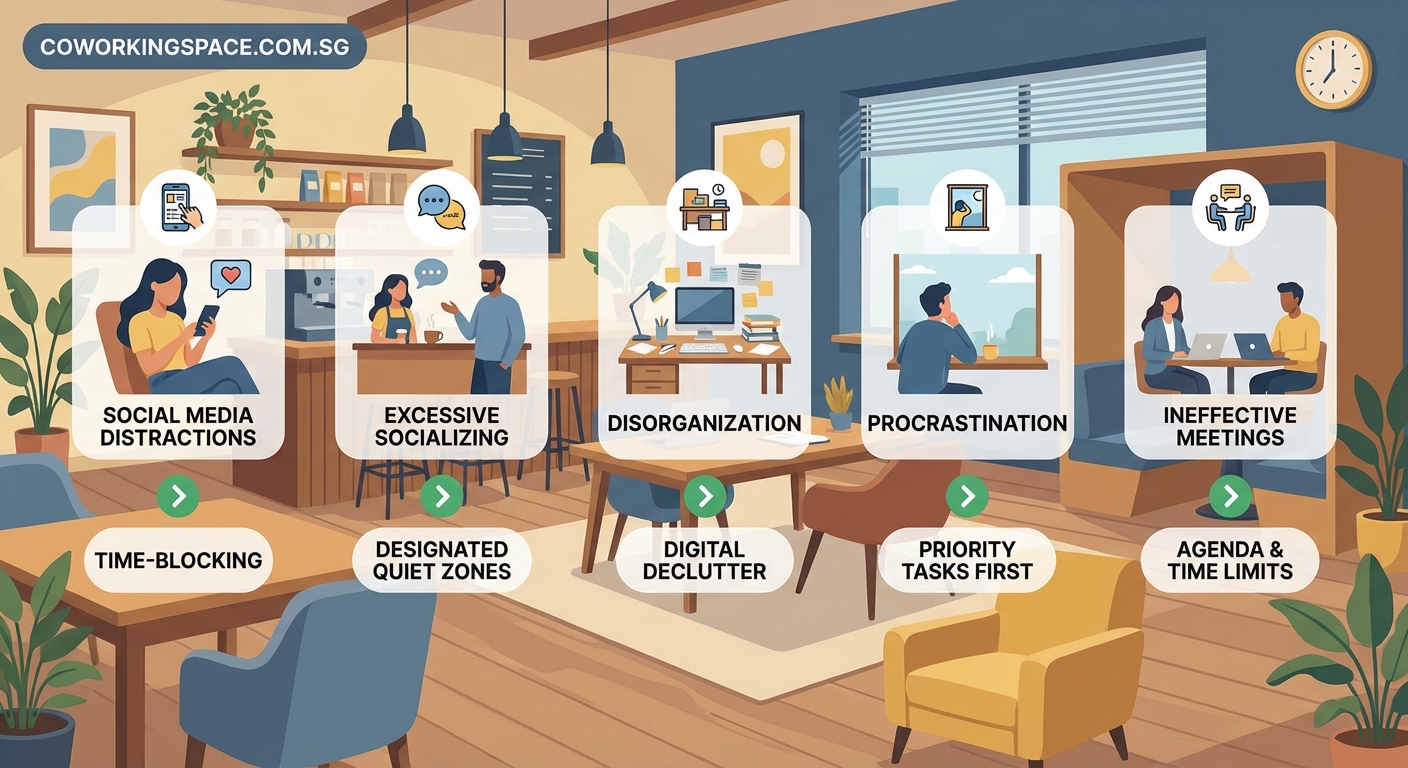
The five habits stealing your productive hours
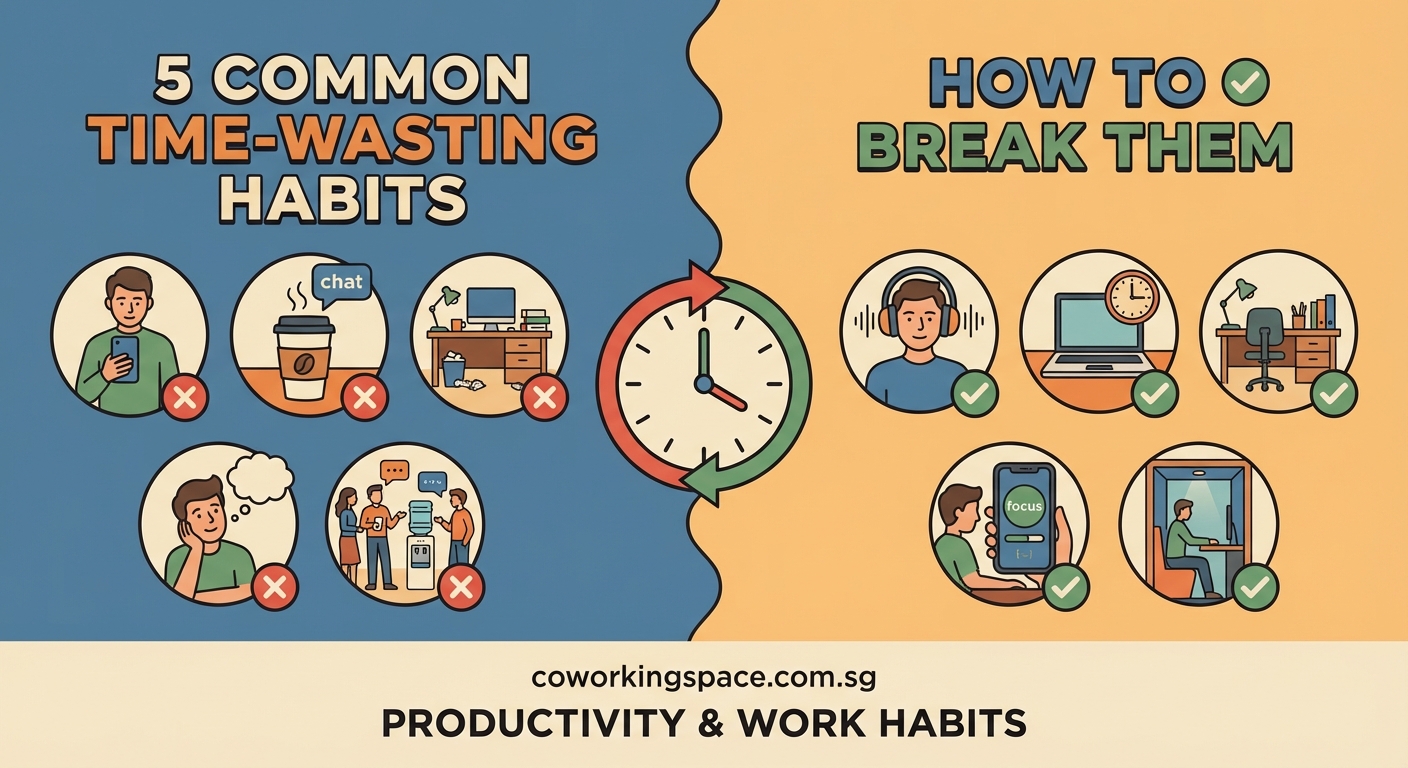
Constant email and message checking
You open your inbox “just to see if anything urgent came in.” Twenty minutes vanish as you read, sort, and mentally catalog messages that could wait until your designated communication block.
Research shows the average professional checks email every six minutes. Each check costs you more than the 30 seconds spent scanning. Your brain needs 15-25 minutes to fully re-engage with complex work after an interruption.
Do the math. If you check email 10 times per hour, you never achieve deep focus.
Unstructured “networking” conversations
Coworking spaces thrive on community connections. That’s part of their value. But conversations without boundaries consume entire mornings before you notice.
A five-minute chat about weekend plans stretches to 20 minutes discussing startup strategies, then 15 more minutes on restaurant recommendations. You return to your desk feeling social and accomplished, but your deadline hasn’t moved.
The problem isn’t networking itself. The problem is treating every conversation as equally important and letting social momentum override your schedule.
Perfectionism disguised as quality control
You revise the same paragraph seven times. You adjust slide layouts for 40 minutes. You research three additional sources for a point that’s already well-supported.
Perfectionism feels productive because you’re actively working. You’re thinking hard, making decisions, and improving your output. But past a certain point, you’re polishing instead of progressing.
In shared workspaces, perfectionism often intensifies. You imagine other members judging your work. You want to prove you belong in this professional environment. So you over-refine deliverables that clients would happily accept three drafts earlier.
Digital rabbit holes masquerading as research
You need one piece of information. You open a browser tab. Fifteen tabs later, you’ve read four tangentially related articles, watched two videos, and bookmarked six resources you’ll “definitely review later.”
The internet rewards curiosity with infinite pathways. Each link promises relevant information. Each article suggests three more worth reading. Before you know it, your “five-minute fact check” consumed an hour.
This habit particularly affects knowledge workers in coworking spaces. You’re surrounded by other people apparently working hard. Your screen shows work-related content. It feels legitimate. But you’re consuming information instead of creating output.
Phone as security blanket
Your phone sits within arm’s reach. You check it between tasks. You check it during tasks. You check it when you feel stuck, bored, or uncertain about your next move.
Each glance takes seconds. The cumulative impact spans hours.
Phones provide instant relief from discomfort. Difficult problem? Check your phone. Unclear next step? Check your phone. Feeling isolated in a room full of strangers? Check your phone.
The device isn’t the villain. Your relationship with it is. You’ve trained yourself to reach for distraction whenever work feels hard.
Breaking the cycle with structured systems
Recognizing time wasting habits matters less than building systems that make better choices automatic.
Willpower fails. Systems succeed.
Create decision-free communication windows
Set three specific times daily for email and messages. Morning check-in, midday review, and end-of-day wrap-up. Outside these windows, close your email client completely.
Tell colleagues and clients about your communication schedule. Most people respect boundaries when you clearly state them. Those who don’t respect boundaries weren’t going to respect your time anyway.
Use your email client’s scheduling features to send messages during your communication windows, even if you draft them earlier. This prevents the habit of “just sending one more thing” that spirals into inbox management.
Implement the two-minute networking rule
When someone initiates a conversation, decide within two minutes whether to continue now or schedule it for later.
If the topic matters to your work or relationships, suggest a specific time: “This sounds valuable. Can we grab coffee at 2 PM to discuss it properly?”
If the conversation is pleasant but non-essential, set a soft boundary: “I’m in the middle of focused work right now, but let’s catch up at the community event Thursday.”
Most people appreciate directness. They’d rather know you’re genuinely interested in talking later than half-listening while mentally calculating how to escape.
Apply the “good enough” threshold
Before starting any task, define what “done” looks like. Write it down. Be specific.
For a client proposal: “Three service options with pricing, two case studies, and a clear next-step process.”
For a blog post: “1,200 words, three examples, one actionable takeaway.”
When you hit your definition of done, stop. Resist the urge to “just make it a little better.” Ship it. Move to the next task.
You can always improve something. The question is whether that improvement creates proportional value. Usually, it doesn’t.
Set research time limits with alarms
When you need to look something up, set a timer for 10 minutes. When the alarm sounds, you must either close all tabs or explicitly decide to invest another timed block.
This creates a decision point. Instead of drifting from article to article, you consciously choose whether the research justifies more time.
Keep a “research parking lot” document. When you find interesting tangents, paste the link there with a one-sentence note. Review this list during designated learning time, not during production hours.
Build phone-free focus blocks
Choose your most important work block each day. For that period, put your phone in your bag, in a locker, or with the coworking space reception desk.
Physical distance matters more than notifications settings. If your phone sits on the desk, you’ll check it. If retrieving it requires standing up and walking across the room, you’ll check it less.
Start with one 90-minute block. Once that becomes routine, add a second. Most people find two phone-free focus periods sufficient to complete their critical work.
Practical implementation for coworking environments
Theory helps. Application in real workspace conditions matters more.
Here’s how to implement these changes when you’re surrounded by other people, limited by shared space rules, and working without a private office door.
Choosing your workspace zone strategically
Most coworking spaces offer different areas with varying energy levels. Map your tasks to appropriate zones.
Deep focus work belongs in quiet areas or private pods. Communication tasks fit in common areas where interruptions won’t derail concentration. Creative brainstorming works well in social zones where ambient energy sparks ideas.
Selecting the right workspace type for each task type reduces the friction of fighting against your environment.
Move between zones as your work changes. Don’t try to force deep focus in a social area or creative collaboration in a silent room.
Using visual signals to manage interruptions
Headphones signal “focused work mode” even if you’re not playing music. Most coworking members respect this boundary.
Some spaces use colored cards or desk flags to indicate availability. Green means “happy to chat,” yellow means “only interrupt if urgent,” red means “deep focus, come back later.”
If your space doesn’t have a system, create your own. A simple sign that says “Focused work until 11:30” communicates clearly without seeming antisocial.
Scheduling social time intentionally
Block 30 minutes daily for unstructured networking. During this time, actively seek conversations. Join the lunch table. Ask about other members’ projects. Be fully present.
This scheduled social time satisfies your connection needs without letting networking consume your entire day. You can politely defer conversations outside this window because you know you’ll have dedicated time later.
Building genuine community connections matters for your business and mental health. Structure ensures networking enhances rather than replaces your productivity.
Tracking your time honestly for one week
Before implementing major changes, track exactly how you spend your time for five workdays. Use a simple spreadsheet or time-tracking app.
Record every activity in 15-minute blocks. Be honest. Nobody else needs to see this data.
You’ll discover patterns you didn’t know existed. Maybe you’re productive until 2 PM, then waste the entire afternoon. Maybe Mondays work well but Fridays disintegrate. Maybe you’re most distracted right after lunch.
These patterns reveal where to focus your intervention efforts.
Common mistakes when breaking time wasting habits
| Mistake | Why it fails | Better approach |
|---|---|---|
| Trying to change everything at once | Overwhelm leads to abandoning all changes | Pick one habit, master it for two weeks, then add another |
| Relying purely on willpower | Willpower depletes throughout the day | Build environmental systems that make good choices automatic |
| Not communicating boundaries | Others unknowingly disrupt your focus time | Clearly state your schedule and availability expectations |
| Beating yourself up for slip-ups | Guilt creates stress that triggers more time wasting | Track progress over weeks, not individual days |
| Ignoring energy patterns | Fighting your natural rhythm wastes effort | Schedule demanding work during your peak energy hours |
| Setting unrealistic standards | Failure becomes inevitable | Start with achievable goals and gradually increase difficulty |
Tools that support better time management
The right tools reduce friction for good habits and increase friction for time wasting behaviors.
Time-blocking apps
Digital calendars like Google Calendar or Outlook work well for basic time blocking. Color-code different activity types: blue for deep work, green for communication, yellow for meetings, red for breaks.
Apps like Clockwise or Reclaim.ai automatically defend your focus time by moving flexible meetings away from your most productive hours.
Website blockers
Freedom, Cold Turkey, or browser extensions like StayFocusd prevent access to distracting sites during designated work blocks.
Configure these tools the night before. When you’re fresh and motivated, you’ll set reasonable restrictions. If you wait until you’re already distracted, you’ll find reasons to skip the blocking.
Task management systems
Todoist, Asana, or Notion help externalize your task list. When everything lives in your head, you waste mental energy remembering and prioritizing.
A good task system shows you exactly what to work on next. No decision fatigue. No wondering if you’re forgetting something important.
Pomodoro timers
The Pomodoro Technique structures work into 25-minute focus blocks followed by 5-minute breaks. Apps like Focus Booster or Tomato Timer track these intervals.
This approach works particularly well in coworking spaces. The frequent breaks let you stretch, refill coffee, or have brief social interactions without derailing your entire morning.
Analytics tools
RescueTime runs in the background and tracks how you actually use your computer. The weekly reports show exactly where your time goes.
Seeing data often motivates change more effectively than vague feelings of being unproductive. When you discover you spent 4.5 hours on social media last Tuesday, you can’t pretend the problem doesn’t exist.
Building sustainable routines that stick
Short-term behavior changes feel good. Long-term habit transformation requires different strategies.
Starting smaller than feels necessary
You want to reclaim three hours daily. Start by protecting 30 minutes. Master that. Then expand.
Ambitious goals create motivation. Sustainable goals create results.
When you successfully defend 30 minutes of focused work for two weeks straight, your brain builds confidence. You prove to yourself that you can control your attention. That proof makes expanding easier.
Linking new habits to existing routines
Habit stacking works. After you grab your morning coffee at the coworking space, you immediately start your first focus block. After you return from lunch, you review your afternoon priorities before checking email.
These links create automatic triggers. You don’t need to remember or decide. The existing routine cues the new behavior.
Celebrating small wins
When you complete a full focus block without checking your phone, acknowledge it. When you defer a conversation to your networking time, notice that success.
Your brain responds to positive reinforcement. Celebration releases dopamine, which strengthens the neural pathways associated with the behavior.
You don’t need elaborate rewards. Simple recognition works: “I did the thing I said I’d do.”
Adjusting based on what actually works
Your first system won’t be perfect. That’s expected.
After two weeks, review your time tracking data. What improved? What didn’t? Where do you still struggle?
Adjust one variable. Test for another two weeks. Repeat.
Building a personal productivity system requires experimentation. What works for other people might not work for you. What works for you in one season might need adjustment later.
Addressing the underlying causes of time wasting
Surface-level tactics help. Understanding why you waste time helps more.
Procrastination from unclear next steps
You avoid starting because you don’t know exactly what “starting” means. The project feels big and amorphous.
Solution: Break every task into specific, physical actions. Not “work on proposal” but “write three bullet points describing the client’s main problem.”
When you know exactly what to do, starting becomes easier.
Distraction as escape from difficult emotions
Work triggers frustration, anxiety, or self-doubt. Checking your phone provides immediate relief from those uncomfortable feelings.
Solution: Notice the emotion before reaching for distraction. Name it. “I’m feeling anxious about this deadline.” Then decide consciously whether to address the emotion or continue working despite it.
Awareness interrupts the automatic response pattern.
Perfectionism rooted in fear of judgment
You over-polish because you’re afraid of criticism or rejection. If you never finish, nobody can judge the final product.
Solution: Ship imperfect work intentionally. Choose low-stakes projects where mistakes won’t create major consequences. Practice receiving feedback without personalizing it.
The more evidence you gather that imperfect work still creates value, the easier it becomes to release things before they’re perfect.
Social media as substitute for genuine connection
You scroll because you feel isolated in a room full of strangers. Digital interaction feels safer than real conversation.
Solution: Engage with your coworking community through structured events. Attend workshops. Join interest groups. Real connection satisfies the need that social media only temporarily numbs.
When time wasting signals deeper problems
Sometimes persistent time wasting indicates issues beyond habit formation.
Chronic overwhelm from too many commitments
If you can’t focus because you’re constantly juggling competing priorities, you don’t have a time management problem. You have a commitment problem.
Solution: Audit your obligations. What can you eliminate, delegate, or postpone? Productivity systems can’t compensate for fundamentally unsustainable workloads.
Burnout masquerading as distraction
When you’ve pushed too hard for too long, your brain protects you by making focus impossible. Time wasting becomes a survival mechanism.
Solution: Recognize burnout symptoms early and take genuine recovery time. A week of forced rest beats six months of diminished capacity.
Work that doesn’t align with your values
If you’re constantly distracted, maybe the work itself is the problem. You can’t force yourself to care about projects that feel meaningless.
Solution: Have an honest conversation with yourself about whether your current work serves your larger goals. Sometimes the best productivity strategy is changing what you’re producing.
“The most productive people aren’t those who do more things. They’re those who do the right things with full attention. Time wasting often signals misalignment between your activities and what actually matters to you.”
Making your coworking space work for you
Your environment shapes your behavior more than you realize. Small adjustments to how you use your coworking space create significant productivity gains.
Arriving with a plan
Before you walk into the coworking space, know your top three priorities for the day. Write them down. Decide which tasks happen when.
This prevents the “let me just check what needs doing” trap that leads to 30 minutes of email before you’ve accomplished anything substantive.
Creating location-based triggers
Always do your first focus block in the same seat or area. Your brain begins associating that physical location with concentrated work.
Use different areas for different work types. This geographical separation helps your brain shift modes more easily.
Using amenities strategically
Coworking spaces offer various amenities. Use them as rewards after completing focus blocks, not as procrastination tools.
Finished your morning deep work? Now you’ve earned the good coffee from the café area. Completed your afternoon priorities? Now you can enjoy the recreational facilities.
Respecting your energy cycles
Don’t fight your natural rhythms. If you’re sharpest from 9 to 11 AM, protect that time fiercely for your most important work.
Use lower-energy periods for administrative tasks, email, and social activities. Morning routines matter, but so does working with rather than against your biology.
Measuring progress without obsessing over metrics
Track enough to know if you’re improving. Don’t track so much that measurement becomes another time wasting habit.
Simple weekly reviews
Every Friday, ask three questions:
- Did I complete my most important tasks this week?
- What patterns helped my productivity?
- What patterns hurt my productivity?
Write brief answers. Look for trends over multiple weeks.
Focusing on outcomes over hours
You don’t need to work more hours. You need to produce better results during the hours you work.
Judge your week by what you shipped, not how busy you felt. Busy and productive aren’t the same thing.
Celebrating capacity gains
Notice when tasks that used to take three hours now take 90 minutes. Acknowledge when you can focus for longer periods without breaks.
These capacity improvements compound over time. Small gains accumulate into dramatically different work patterns.
Your next 48 hours
You’ve read about time wasting habits and strategies to break them. Now what?
Don’t try to implement everything. Pick one habit that costs you the most time. Choose one strategy from this article to address it.
For the next two days, focus exclusively on that single change. Notice what happens. Adjust as needed.
After 48 hours, decide whether to continue with that strategy, modify it, or try something different.
Eliminating distractions in shared workspaces doesn’t require superhuman discipline. It requires honest self-awareness, practical systems, and patience with the process.
Your coworking space provides the environment and community. You provide the intention and structure. Together, they create conditions where focused work becomes your default rather than your exception.
Start small. Start today. Your future self will thank you for the hours you’re about to reclaim.