
Your morning sets the tone for everything that follows. The difference between a scattered, reactive workday and a focused, intentional one often comes down to what you do in the first 90 minutes after waking up.
For remote workers and coworking space members, mornings matter even more. Without the built-in structure of a traditional office commute, you need to create your own transition between home life and work mode. A solid morning routine for productivity doesn’t require waking at 5 AM or following someone else’s rigid schedule. It’s about finding habits that work for your brain, your schedule, and your workspace.
A morning routine for productivity combines physical movement, mental preparation, and intentional planning. The most effective routines include waking at a consistent time, hydrating immediately, moving your body, planning your top three tasks, protecting your first work hour from distractions, and using your workspace environment strategically. These habits create structure without rigidity, helping remote workers transition into focused work mode.
Why Morning Habits Matter More in Flexible Work Environments
Traditional office workers get automatic structure. The commute, the desk, the scheduled meetings, all of it creates boundaries between personal time and work time.
Remote workers and coworking members don’t have that luxury.
You need to manufacture your own structure. Your morning routine becomes the bridge between waking up and doing your best work. Without it, you risk starting your day in reactive mode, responding to emails and messages before you’ve even decided what matters most.
Research on circadian rhythms shows that most people experience peak cognitive function in the late morning. But that window closes fast if you waste your early hours scrolling through notifications or jumping straight into low-value tasks.
The goal isn’t to become a morning person if you’re naturally a night owl. It’s about using whatever morning hours you have more strategically.
The Foundation: Consistent Wake Times Beat Early Wake Times
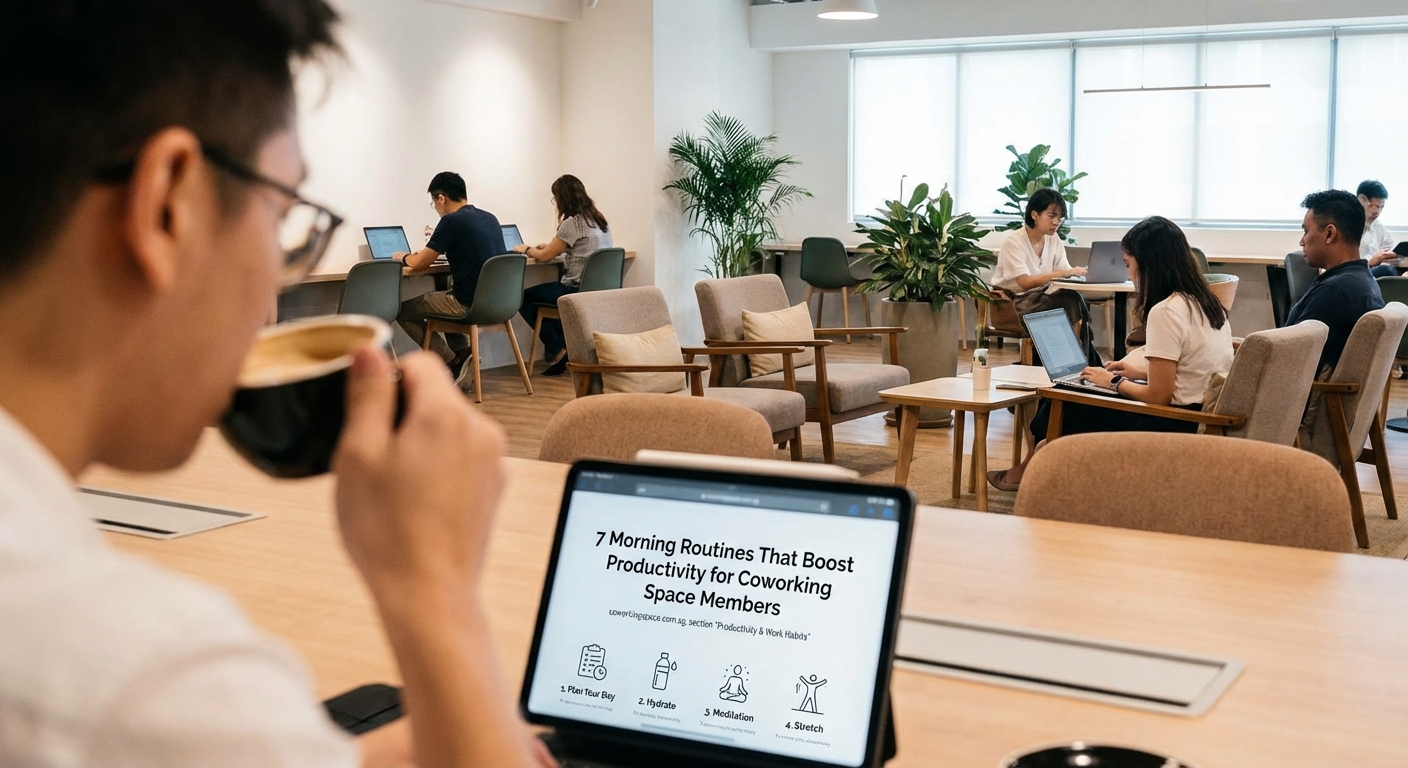
Forget the 5 AM club hype.
Consistency matters more than the actual time you wake up. Your body’s internal clock thrives on predictability. When you wake at roughly the same time each day, even on weekends, you train your brain to expect alertness at that hour.
Here’s what happens when you maintain consistent wake times:
- Your cortisol naturally peaks at the right time, giving you natural energy
- You fall asleep more easily at night because your circadian rhythm stabilizes
- You avoid the grogginess that comes from constantly shifting sleep schedules
- Your hunger patterns normalize, making it easier to eat at consistent times
Pick a wake time that gives you at least 90 minutes before you need to be fully productive. That buffer lets you ease into your day without rushing.
If you’re working from a coworking space, factor in travel time. If you’re working from home, you still need transition time between waking and working.
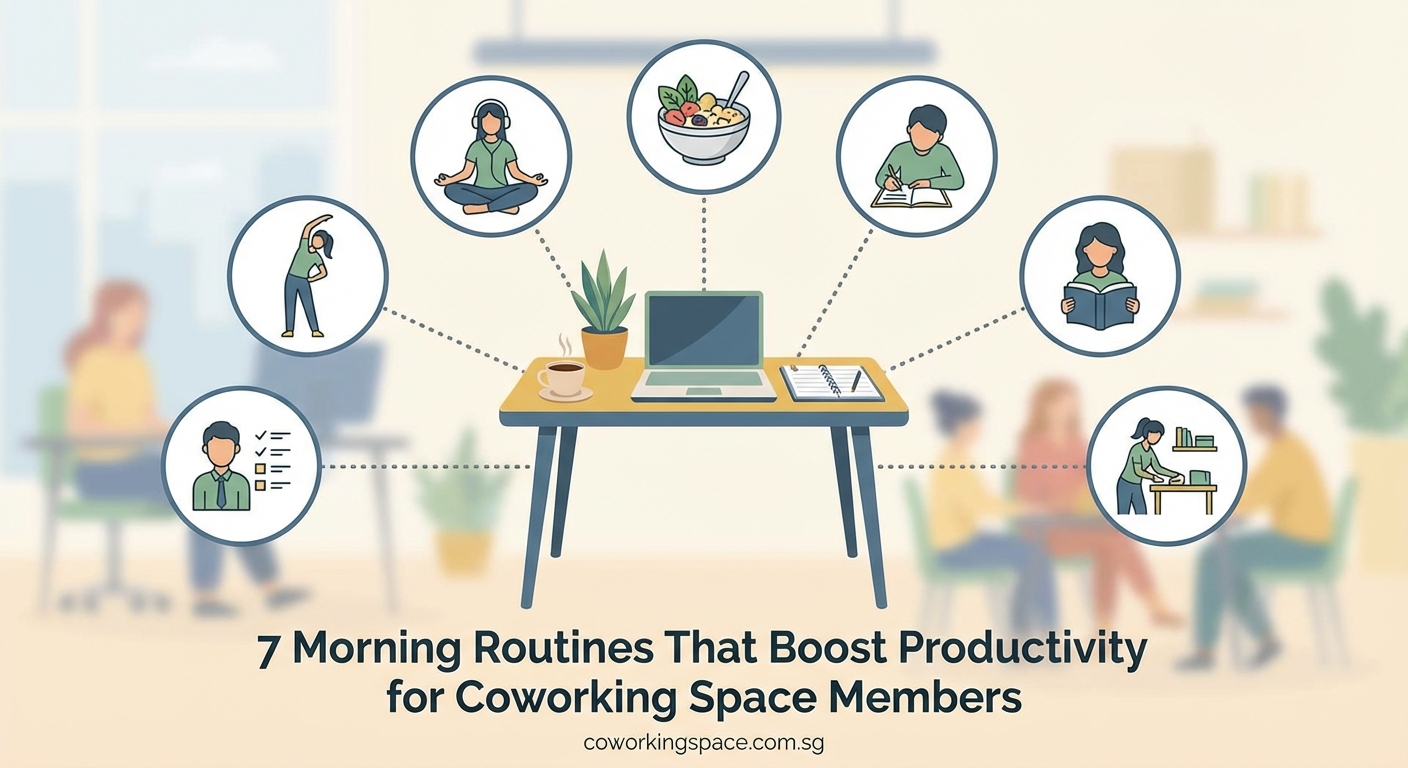
Seven Morning Habits That Actually Move the Needle
1. Hydrate Before Caffeine
Your body loses water overnight through breathing and metabolism. You wake up mildly dehydrated, which impairs cognitive function before you even start your day.
Drink 16 to 24 ounces of water within 15 minutes of waking. Room temperature works fine. Add lemon if you want, but the water itself matters most.
This simple habit:
- Kickstarts your metabolism
- Improves mental clarity
- Reduces morning fatigue
- Primes your digestive system
Wait 30 to 60 minutes before coffee. This delay prevents the afternoon crash that comes from drinking caffeine while your cortisol is naturally high.
2. Move Your Body for 10 to 20 Minutes
You don’t need a full workout. Light movement signals to your brain that it’s time to be awake and alert.
Options that work:
- A walk around your neighborhood
- Simple stretching or yoga
- Bodyweight exercises like pushups and squats
- Dancing to a favorite song
The key is getting your heart rate up slightly and moving your joints through their full range of motion. This increases blood flow to your brain and releases endorphins that improve mood.
Many coworking spaces in Singapore offer recreational facilities that make coworking spaces stand out, making it easier to incorporate movement before settling into work.
3. Plan Your Top Three Tasks Before Checking Email
This habit alone can transform your productivity.
Before you look at email, Slack, or any other communication tool, write down the three most important tasks you need to complete today. Not urgent tasks. Not easy tasks. Important tasks that move your projects forward.
Use this framework:
- One task that requires deep focus and creative thinking
- One task that involves communication or collaboration
- One task that clears a bottleneck or prevents future problems
Writing these down creates commitment. You’re declaring intent before the world starts making demands on your attention.
Keep this list visible throughout your day. When distractions arise, and they will, you can glance at your list and ask: “Is this more important than my top three?”
4. Protect Your First Work Hour
The first 60 to 90 minutes of focused work time are your most valuable. Your willpower is highest. Your mental energy is freshest. Interruptions haven’t fragmented your attention yet.
Treat this time as sacred.
- Turn off all notifications
- Close email and messaging apps
- Use website blockers if needed
- Put your phone in another room
Work on your most cognitively demanding task during this window. The one that requires sustained concentration and creative problem solving.
If you’re in a coworking space, choosing between open workspace and quiet zones for maximum productivity becomes essential. Use quiet zones or private areas during this protected time.
5. Use Time Blocking, Not To-Do Lists
To-do lists create anxiety because they’re endless. Time blocking creates clarity because it’s finite.
After identifying your top three tasks, assign each one a specific time block on your calendar. Treat these blocks like appointments you can’t miss.
A sample morning schedule:
- 9:00 to 10:30: Deep work on primary project
- 10:30 to 10:45: Break and movement
- 10:45 to 11:30: Communication tasks and email
- 11:30 to 12:00: Planning and admin work
The Pomodoro technique works perfectly in coworking spaces because the environment naturally supports focused work intervals.
Time blocking forces you to confront reality. You can’t fit eight hours of tasks into a four-hour workday. This constraint helps you prioritize ruthlessly.
6. Establish a Workspace Ritual
Your brain needs a clear signal that work mode has begun. A workspace ritual provides that trigger.
This could be:
- Making a specific type of tea or coffee at your desk
- Putting on a particular playlist
- Lighting a candle or using a specific scent
- Arranging your desk in a precise way
- Putting on “work clothes” even if you’re at home
The ritual itself doesn’t matter. The consistency does. When you perform the same actions in the same order each morning, your brain learns to associate those actions with focused work.
Coworking spaces naturally support this transition. The act of traveling to the space, checking in, and settling at your desk creates a built-in ritual. Understanding what makes a coworking space different from a traditional office helps you leverage this environmental advantage.
7. Review Your Energy Patterns
Not all morning hours are created equal for everyone. Some people peak at 8 AM. Others don’t hit their stride until 11 AM.
Track your energy levels for two weeks. Note when you feel most alert, most creative, and most capable of handling complex problems. Then structure your morning routine around these natural peaks.
If you’re naturally slow to wake up, don’t schedule important meetings or deep work first thing. Give yourself time to ramp up with easier tasks.
If you’re a true morning person, protect those early hours fiercely. Don’t waste your peak energy on email or administrative work.
Common Morning Routine Mistakes to Avoid
| Mistake | Why It Hurts | Better Approach |
|---|---|---|
| Checking phone immediately after waking | Floods your brain with other people’s priorities before you’ve set your own | Leave phone in another room overnight; check only after morning routine |
| Skipping breakfast or eating sugar-heavy foods | Causes energy crashes mid-morning | Eat protein and healthy fats within two hours of waking |
| Starting work without a clear plan | Leads to reactive, scattered work patterns | Spend 10 minutes planning before opening any work tools |
| Trying to do too much | Creates pressure and guilt when you can’t maintain it | Start with one or two habits; add more only after those stick |
| Copying someone else’s routine exactly | Ignores your natural rhythms and preferences | Experiment to find what actually works for your brain and schedule |
Adapting Your Routine for Coworking Spaces
Working from a coworking space adds variables to your morning routine. You need to account for travel time, desk selection, and the social dynamics of a shared environment.
Build in buffer time. If your space opens at 8 AM and you want to start focused work at 9 AM, arrive by 8:30. This gives you time to settle, grab coffee, and transition into work mode without rushing.
Choose your location strategically. Many coworking spaces offer different zones for different work styles. Eliminating distractions and staying focused in a shared workspace requires intentional choices about where you sit.
Some members prefer arriving early to secure their favorite spot and enjoy the quiet before the space fills up. Others thrive on the energy of a bustling environment and time their arrival accordingly.
Consider whether hot desking actually improves your work performance or if you need the consistency of a dedicated desk to maintain your routine.
Building Your Personal System
The routines that stick are the ones you design yourself. Start with these steps:
-
Audit your current morning. Track what you actually do for one week without changing anything. Notice patterns, energy levels, and time wasters.
-
Identify one bottleneck. What single change would have the biggest impact on your productivity? Start there.
-
Test for two weeks. Commit to your new habit for 14 consecutive days. This is long enough to get past the initial resistance but short enough to feel manageable.
-
Adjust based on results. If something isn’t working, modify it. There’s no prize for suffering through a routine that doesn’t serve you.
-
Add gradually. Once one habit feels automatic, layer in another. Building a complete morning routine takes months, not days.
Building a personal productivity system that works in any coworking environment means creating flexibility within structure. Your routine should adapt to different contexts while maintaining core principles.
The Psychology of Morning Momentum
Productivity isn’t just about tactics. It’s about psychology.
“The way you start your morning sets the emotional tone for your entire day. Small wins early create momentum that carries through to larger challenges.” – Dr. BJ Fogg, Behavior Scientist
When you complete your morning routine successfully, you prove to yourself that you’re capable of following through. This builds self-efficacy, the belief in your ability to accomplish what you set out to do.
Each small win compounds. Drinking water leads to feeling more alert. Feeling more alert makes exercise easier. Exercise improves your mood. Better mood makes planning feel less overwhelming. Planning creates clarity. Clarity leads to focused work.
The opposite spiral happens when you skip your routine. Sleeping late leads to rushing. Rushing creates stress. Stress impairs decision-making. Poor decisions lead to reactive work. Reactive work feels unproductive. Feeling unproductive damages motivation.
Understanding the psychology behind coworking and why shared spaces boost productivity reveals how environment and routine work together to create optimal conditions for focused work.
Troubleshooting Common Challenges
Challenge: “I can’t wake up at the same time every day because my schedule varies.”
Solution: Define a wake time window instead of an exact time. Aim to wake within a 30-minute range most days. Even this level of consistency helps stabilize your circadian rhythm.
Challenge: “I feel guilty taking time for a morning routine when I have so much work to do.”
Solution: Reframe the routine as work preparation, not time away from work. The 60 minutes you spend on your morning routine can save you three hours of scattered, unfocused effort later.
Challenge: “My routine works great until something disrupts it, then I can’t get back on track.”
Solution: Create a minimal viable routine for disrupted days. What’s the absolute smallest version that still provides value? Maybe it’s just water, five minutes of movement, and identifying your top task. Do that when the full routine isn’t possible.
Challenge: “I work from home and struggle to separate personal time from work time.”
Solution: Create physical separation even in a small space. Change locations for your morning routine versus work. Wear different clothes. Use different lighting. These environmental cues help your brain switch modes.
For those considering whether a coworking membership might solve this problem, understanding whether coworking spaces are worth the cost helps make an informed decision.
Measuring What Matters
You can’t improve what you don’t measure. Track these metrics to assess whether your morning routine actually boosts productivity:
- Time to first focused work session: How long after waking do you start meaningful work?
- Deep work hours per day: How many uninterrupted hours do you achieve?
- Task completion rate: What percentage of your top three tasks do you finish?
- Energy levels throughout the day: When do you feel most alert? When do you crash?
- Sleep quality: Are you falling asleep easily and waking refreshed?
Review these weekly. Look for patterns. Adjust your routine based on data, not feelings.
Some coworking spaces offer productivity tracking tools or accountability partnerships that make measurement easier. Knowing what to expect at Singapore coworking spaces helps you take advantage of these resources.
Making It Stick Beyond the First Month
Most people abandon new routines within three weeks. Here’s how to beat those odds:
Anchor new habits to existing ones. Instead of “I’ll exercise in the morning,” try “After I brush my teeth, I’ll do ten pushups.” The existing habit triggers the new one.
Reduce friction. Lay out workout clothes the night before. Pre-fill your water bottle. Queue up your morning playlist. Every obstacle you remove increases the chance you’ll follow through.
Track visually. Put a calendar on your wall and mark each day you complete your routine. The visual chain of successful days creates motivation to keep the streak alive.
Find accountability. Share your routine with a coworking buddy or join a morning routine challenge group. Social pressure works when willpower fails.
Celebrate small wins. Acknowledge when you follow through, especially on difficult days. This positive reinforcement strengthens the habit loop.
Those struggling with consistency might benefit from learning about common time-wasting habits in coworking spaces and how to break them.
Your Morning Routine as a Competitive Advantage
In a world where everyone has access to the same tools and information, your edge comes from execution. How consistently you show up. How focused you are when you work. How intentionally you use your peak energy hours.
Your morning routine for productivity isn’t about optimization for its own sake. It’s about creating the conditions where your best work becomes possible more often.
Remote workers and freelancers who master their mornings report higher income, better client relationships, and more career satisfaction. Not because they work more hours, but because they work better hours.
Coworking members with strong morning routines make better use of their memberships. They arrive with clear intentions, work with greater focus, and build stronger professional relationships because they’re not constantly scattered or reactive.
The routine itself becomes a form of professional development. Each morning you practice discipline, planning, and self-awareness. These skills compound over time, improving not just your productivity but your entire approach to work.
For those new to coworking, learning how to choose your first coworking space in Singapore can help you find an environment that supports your morning routine and productivity goals.
Starting Tomorrow Morning
You don’t need to overhaul your entire life tonight. Start with one change tomorrow morning.
Pick the habit that feels most achievable and most impactful. Maybe it’s drinking water first thing. Maybe it’s planning your top three tasks before checking email. Maybe it’s protecting your first work hour from interruptions.
Do that one thing consistently for two weeks. Notice what changes. Build from there.
Your morning routine for productivity is personal. What works for someone else might not work for you. The framework matters more than the specific tactics. Consistency beats intensity. Small improvements compound into significant results.
The best time to start building better morning habits was six months ago. The second best time is tomorrow morning.