
You’re looking at the monthly coworking fee and wondering if it makes financial sense. The spreadsheet shows rent, utilities, and amenities. But the real value doesn’t appear on any invoice.
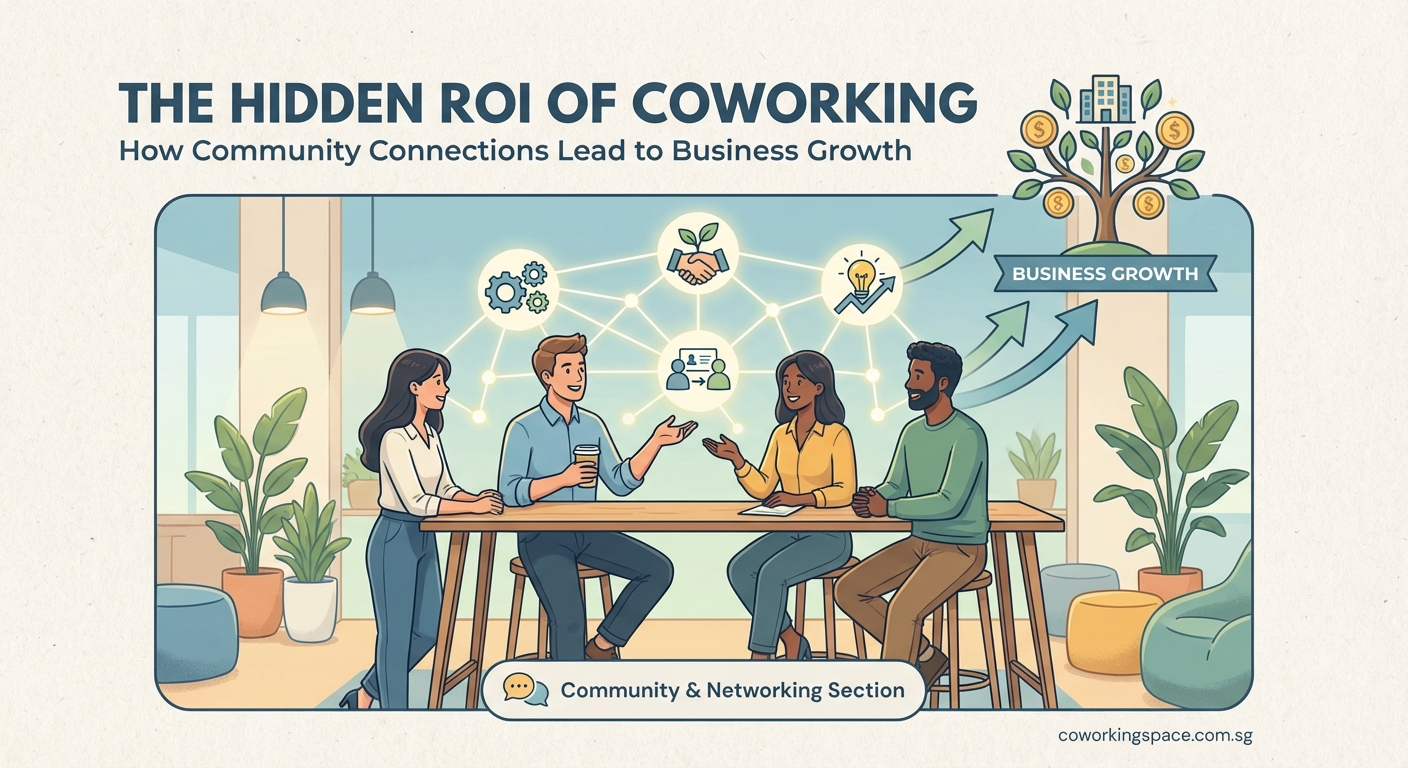
The hidden ROI of coworking comes from conversations that turn into partnerships, skills learned from neighboring desks, and opportunities that emerge when creative professionals share the same space. These returns compound over time, creating business value that far exceeds the membership cost.
Coworking spaces generate unmeasured returns through community connections, spontaneous collaboration, skill exchange, and business referrals. These intangible benefits often deliver more long-term value than the tangible amenities included in membership fees. Understanding these hidden returns helps business owners make smarter workspace decisions that support growth beyond basic operational needs.
Community connections translate to real revenue
Most business owners track obvious expenses. Rent goes on the balance sheet. Internet costs appear in monthly reports. But how do you measure the value of sitting next to someone who becomes your biggest client?
A graphic designer working from a coworking space in Singapore met a startup founder at the coffee station. Three months later, that casual conversation resulted in a $15,000 branding project. That single connection paid for an entire year of membership.
These interactions happen constantly in shared workspaces. They don’t appear in your accounting software, but they directly impact your bottom line.
The value compounds when you consider:
- Referrals from other members who understand your work quality
- Collaborative projects that expand your service offerings
- Knowledge sharing that improves your business operations
- Partnership opportunities with complementary businesses
- Access to expertise you couldn’t afford to hire full-time
Traditional offices isolate you from this ecosystem. Home offices eliminate it entirely. The membership fee buys you access to a professional network that actively generates opportunities.
Skill development without training budgets

Coworking spaces function as informal universities. You learn by proximity.
The developer at the next desk might show you a productivity tool that saves you five hours weekly. The marketing consultant in the phone booth shares insights about platform changes affecting your industry. The accountant working late explains a tax strategy you hadn’t considered.
This knowledge transfer happens organically. No registration fees. No course schedules. No travel costs.
“I learned more about scaling my business in six months at a coworking space than I did in two years working alone. The casual conversations during lunch breaks gave me insights I would have paid thousands for in consulting fees.” – Sarah Chen, E-commerce Consultant
Consider what you’d pay for equivalent education:
| Learning Method | Typical Cost | Time Investment | Practical Application |
|---|---|---|---|
| Formal courses | $500-$3,000 | 20-40 hours | Often theoretical |
| Private coaching | $150-$500/hour | Scheduled sessions | Limited to coach expertise |
| Industry conferences | $1,000-$5,000 | 2-3 days | Once or twice yearly |
| Coworking osmosis | Included in membership | Continuous | Immediately applicable |
The learning happens while you work. You absorb industry knowledge, technical skills, and business strategies without dedicating separate time or budget.
This educational value alone can justify the membership cost for many professionals. When you factor in the time saved avoiding costly mistakes, the ROI becomes even clearer.
Business credibility that opens doors
Your business address matters more than you think.
Clients search for your address before meetings. Potential partners evaluate your professionalism based on your workspace. Investors notice where you operate.
A prestigious coworking address in Raffles Place or Paya Lebar signals legitimacy. It suggests you’re serious enough to invest in professional infrastructure but smart enough to avoid unnecessary overhead.
This credibility translates to tangible benefits:
- Higher conversion rates on proposals when clients see a professional business address
- Increased confidence from vendors offering better payment terms
- Stronger negotiating position with larger corporate clients
- Enhanced credibility for media opportunities and speaking engagements
- Better first impressions during video calls with professional backgrounds
The perception shift affects your entire business trajectory. Freelancers report charging 20-30% higher rates after moving from home offices to professional coworking spaces. The work quality didn’t change. The perceived value did.
Understanding the differences between coworking spaces and traditional offices helps you appreciate how shared workspaces deliver professional credibility without corporate overhead.
Mental health returns that protect productivity
Working alone damages mental health. The isolation compounds over months and years.
Coworking spaces provide social infrastructure that prevents burnout. The casual interactions break up intense focus periods. The ambient energy motivates you during low-energy days. The human connection reminds you that you’re part of something larger.
These psychological benefits have direct financial implications:
- Fewer sick days from stress-related illness
- Sustained productivity without burnout crashes
- Better decision-making from diverse perspectives
- Increased motivation that prevents project delays
- Reduced anxiety about business challenges
Home workers often struggle with boundary issues. Work bleeds into personal time. Personal distractions interrupt work time. The physical separation of a coworking space creates clear boundaries that protect both productivity and personal life.
The psychological benefits of shared workspaces extend beyond simple focus improvements. They create sustainable work patterns that protect long-term business viability.
Flexibility that reduces financial risk
Traditional office leases lock you into rigid commitments. Three-year contracts. Personal guarantees. Significant deposits.
Coworking memberships offer month-to-month flexibility. You can scale up when business grows. You can scale down during slow periods. You can test new markets without long-term commitments.
This flexibility has hidden financial value:
- Reduced risk during business experiments
- Ability to redirect capital to growth initiatives
- Protection during economic uncertainty
- Freedom to pivot without lease penalties
- Option to expand geographically without major investments
A startup founder testing the Singapore market can join a coworking space for three months. If the market responds well, they expand. If not, they exit without penalty. Traditional office space would require a multi-year commitment before knowing if the market works.
The various membership options available let you match your workspace investment to your current business stage without overcommitting resources.
Infrastructure access without capital expenditure
Building a professional office requires significant upfront investment. Furniture. Technology. Meeting rooms. Kitchen facilities. Reception services.
Coworking spaces provide enterprise-grade infrastructure through membership fees. You access amenities that would cost tens of thousands to purchase and maintain.
Consider the capital you avoid deploying:
- High-speed internet infrastructure: $500-$2,000 setup plus monthly fees
- Professional meeting rooms: $10,000-$50,000 per room
- Reception and mail handling: $30,000-$60,000 annual salary
- Office furniture and equipment: $5,000-$15,000 per person
- Kitchen and break room facilities: $3,000-$10,000
- Cleaning and maintenance services: $500-$2,000 monthly
That capital remains available for business growth. You can invest in marketing, product development, or talent acquisition instead of office infrastructure.
The amenities modern coworking spaces provide often exceed what small businesses could afford independently. You get Fortune 500 infrastructure at a fraction of the cost.
Serendipity that creates unexpected opportunities
The most valuable coworking benefits can’t be planned. They emerge from random encounters and unexpected conversations.
You overhear someone discussing a challenge you’ve solved. You offer insight. They introduce you to their network. Six months later, you’re working on projects you never imagined.
These serendipitous moments happen because coworking spaces concentrate diverse professionals in shared environments. The probability of valuable random encounters increases dramatically compared to isolated work settings.
Real examples from Singapore coworking communities:
- A content writer overheard a conversation about video production needs and introduced two members who formed a successful partnership
- A software developer debugging code out loud received help from a passing member, leading to a collaborative project
- A business consultant met their future co-founder while waiting for the coffee machine
- A designer’s portfolio review by a neighboring member led to a complete business pivot and tripled revenue
You can’t budget for serendipity. You can’t schedule it. But you can position yourself where it’s most likely to occur.
The community events that successful spaces organize create additional opportunities for these valuable random connections beyond daily workspace interactions.
Professional development through peer accountability
Working alongside ambitious professionals creates natural accountability. You see others executing. You witness their work ethic. You absorb their standards.
This peer pressure (in the best sense) elevates your performance. You arrive earlier. You focus harder. You ship projects faster. The ambient professionalism raises your baseline.
The accountability manifests in several ways:
- Social pressure to maintain professional appearance and behavior
- Motivation from seeing others accomplish difficult tasks
- Standards elevation from exposure to high-quality work
- Deadline adherence when others observe your patterns
- Reduced procrastination in a focused environment
A freelancer working from home might start work at 10 AM. The same person in a coworking space arrives by 9 AM because others are already working. That extra hour compounds to 250 hours annually. At a $100 hourly rate, that’s $25,000 in additional productive time.
The productivity systems that work well in coworking environments leverage this peer accountability effect to maximize output without requiring additional willpower.
Market intelligence from industry proximity
Coworking spaces cluster professionals from various industries. This concentration creates information flow that keeps you current on market trends, competitive movements, and emerging opportunities.
You hear about:
- Platform changes affecting your industry before they’re widely known
- Hiring trends that signal market shifts
- Client budget patterns indicating economic changes
- Technology adoptions gaining traction
- Regulatory changes impacting your sector
This intelligence has direct business value. You adapt faster than competitors working in isolation. You spot opportunities earlier. You avoid mistakes others make.
The information asymmetry gives you competitive advantages that compound over time. You make better strategic decisions because you have better information inputs.
Testing ground for business ideas
Coworking communities provide safe environments for testing concepts before major investments.
You can float ideas during lunch conversations. You can get feedback on positioning. You can validate assumptions with potential customers who happen to be members.
This informal market research saves money and reduces risk:
- Test messaging with diverse audiences before expensive marketing campaigns
- Validate product concepts with potential users before development costs
- Refine service offerings based on immediate feedback
- Identify positioning problems before they affect real clients
- Adjust pricing strategies using community input
A software developer considering a new app shared the concept during a coworking happy hour. The feedback revealed a fundamental flaw in the business model. That conversation saved six months of development time and thousands in wasted investment.
When you’re choosing your first coworking space, consider the diversity of the community. Varied perspectives provide better testing grounds for business concepts.
Reduced overhead through shared resources
Coworking spaces achieve economies of scale that individual businesses can’t match. They negotiate bulk rates for services. They spread fixed costs across many members. They invest in quality infrastructure that serves everyone.
You benefit from these efficiencies:
- Enterprise internet speeds at consumer prices
- Professional-grade coffee equipment and supplies
- Bulk purchasing power for office supplies
- Shared administrative staff for reception and support
- Negotiated rates with service providers
The cost savings extend beyond obvious categories. You avoid the hidden expenses of traditional offices: maintenance emergencies, equipment repairs, utility fluctuations, and vendor management time.
These operational efficiencies free your attention for revenue-generating activities. You focus on your business instead of facility management.
Long-term network effects that appreciate over time
The value of coworking membership increases the longer you participate. Your network expands. Your reputation strengthens. Your community integration deepens.
This appreciation differs from most business expenses, which provide one-time value. Coworking investments compound.
Consider a member’s network growth over time:
- Month 1: Meet 5-10 people, establish basic connections
- Month 6: Know 30-40 members, participate in community events
- Month 12: Strong relationships with 15-20 professionals, regular collaborations
- Month 24: Deep network of 50+ contacts, reputation as community contributor
- Month 36: Extensive referral network, multiple ongoing partnerships, community leadership
Each connection creates potential for future opportunities. Each collaboration builds reputation. Each year multiplies the network effects.
The networking strategies that work for different personality types help you build these valuable long-term relationships regardless of your natural communication style.
Measuring what matters beyond monthly fees
Traditional ROI calculations miss most coworking value. You need different metrics to capture the real returns.
Track these indicators instead:
| Traditional Metric | Hidden ROI Metric | Why It Matters |
|---|---|---|
| Monthly membership cost | Revenue from member referrals | Measures network value |
| Desk rental rate | Skills learned from community | Tracks educational benefit |
| Square footage per person | Collaboration projects initiated | Quantifies partnership opportunities |
| Amenity checklist | Professional connections made | Evaluates relationship building |
| Location convenience | Business credibility improvement | Assesses perception value |
Start documenting the intangible returns. Note when conversations lead to opportunities. Track skills you learn from other members. Record introductions that create value.
After six months, review your documentation. You’ll likely find that the hidden returns significantly exceed the visible costs.
Understanding whether coworking spaces justify their cost requires looking beyond simple cost comparisons to these harder-to-measure but more valuable returns.
Building sustainable business growth through community
The hidden ROI of coworking ultimately comes down to one principle: sustainable business growth requires more than just a desk and internet connection.
You need community. You need serendipity. You need the energy that comes from working alongside other ambitious professionals. You need the accountability, the learning, the connections, and the opportunities that emerge when creative people share space.
These benefits don’t appear on invoices. They don’t fit neatly into spreadsheets. But they create the conditions for business success that isolated work environments can’t match.
The membership fee isn’t just buying workspace. It’s buying access to an ecosystem that actively supports your growth. That’s the hidden ROI that makes coworking spaces valuable investments for business owners who understand that success comes from connections as much as from hard work.
Start tracking the intangible returns from your coworking membership. Document the conversations, the learning, the opportunities. Six months from now, you’ll have clear evidence of value that no traditional office could provide.