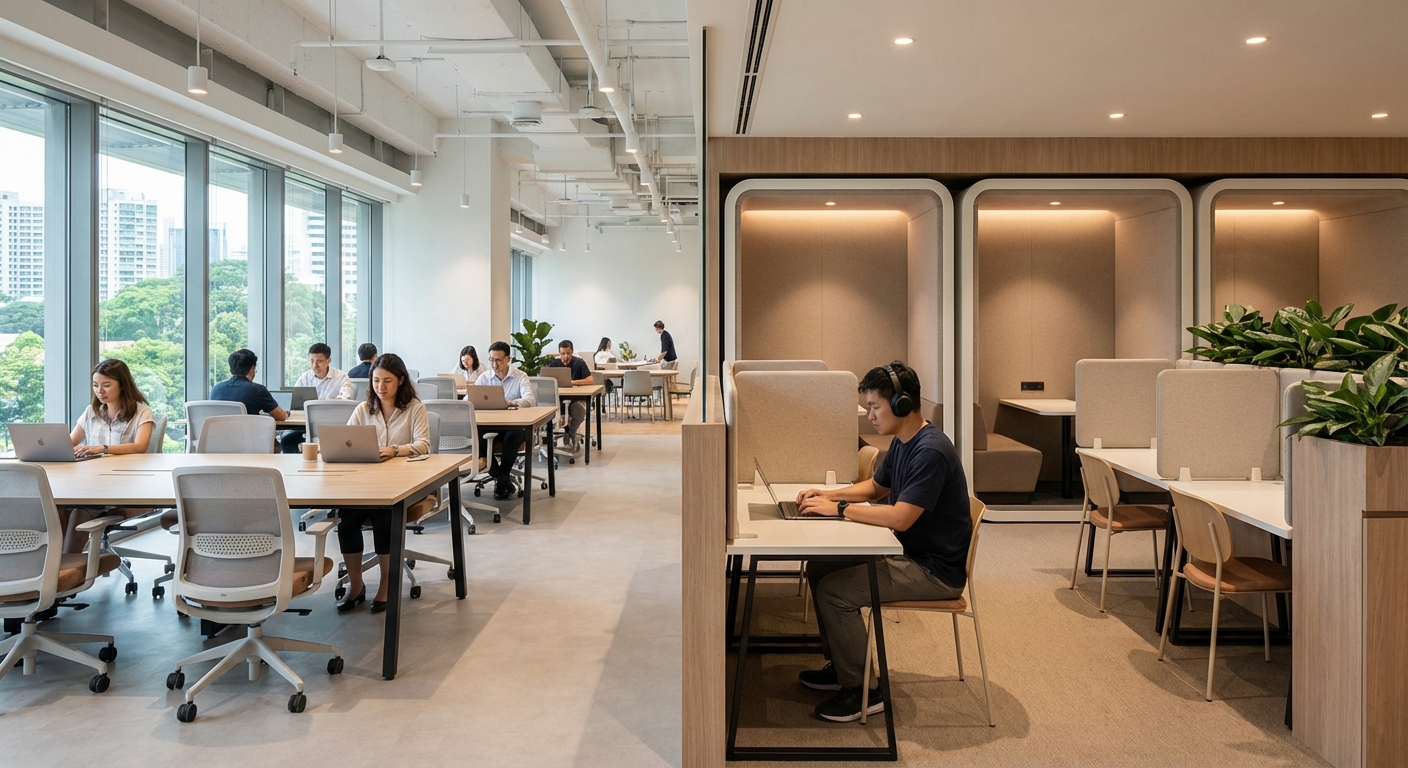
Walking into a coworking space for the first time, you’ll notice something interesting. Half the room buzzes with energy, phone calls, and collaboration. The other half sits in near silence, headphones on, focused on individual work. Both groups are productive, but they need completely different environments to get there. This isn’t about personal preference. It’s about matching work types to the right physical space. And if you’re designing an office or choosing a coworking membership, getting this balance wrong costs your team real productivity.
Open workspaces excel at collaboration, spontaneous problem solving, and team building, but they introduce noise and distraction. Quiet zones support deep focus work, complex analysis, and creative tasks requiring uninterrupted concentration. Most productive offices combine both, letting employees choose based on their current task. The ratio depends on your team’s work type: creative agencies need more open space, while developers and analysts need more quiet zones.
Understanding the Real Difference Between Open and Quiet Spaces
Open workspaces remove physical barriers between team members. You’ll see long tables, bench seating, and minimal partitions. Sound travels freely. People can see each other working. Conversations happen naturally.
Quiet zones add back those barriers intentionally. Think individual booths, sound dampening materials, and strict noise policies. Some spaces use phone booth style pods. Others create library like sections with soft furniture and acoustic panels.
The difference isn’t just about noise levels. It’s about cognitive load. Open spaces increase ambient stimulation. Your brain processes background movement, conversations, and visual activity even when you’re trying to focus on your laptop. Quiet zones reduce that input, letting your brain dedicate more resources to the task at hand.
Neither option is universally better. Both serve specific purposes. The mistake happens when organizations pick one approach and force it on every employee and every task type.
When Open Workspaces Actually Boost Productivity
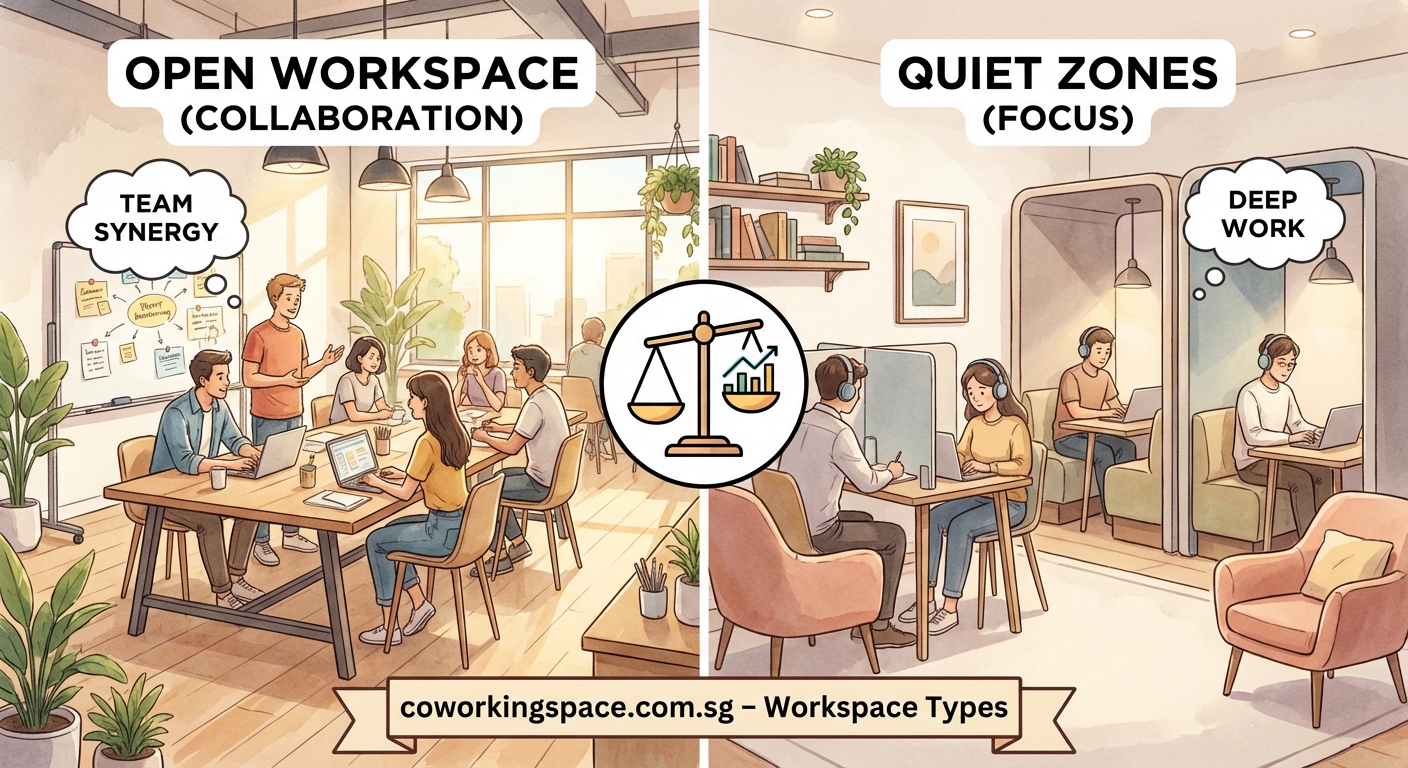
Open layouts work best for specific work modes. Brainstorming sessions benefit from seeing other people’s reactions in real time. Sales teams need to overhear each other’s calls to learn new approaches. Junior employees absorb knowledge faster when they can watch senior team members solve problems.
Here’s what works well in open spaces:
- Team based project planning and coordination
- Client facing roles that require frequent communication
- Training new employees through observation
- Building company culture and social connections
- Tasks that benefit from immediate feedback
- Work that requires frequent collaboration tools
Marketing teams often thrive in open environments. A designer can turn around and ask a copywriter about headline options. A social media manager can share a competitor’s campaign with the team instantly. These micro interactions speed up decision making.
Understanding coworking membership types helps you match workspace style to your team’s collaboration needs.
The energy in open spaces also combats isolation. Remote workers who join coworking spaces specifically seek this ambient productivity. Seeing others work creates accountability and motivation that’s hard to replicate at home.
Why Quiet Zones Matter More Than Most Offices Realize
Deep work requires sustained attention without interruption. Writing code, analyzing financial models, writing reports, or designing complex systems all demand this focus. Even a brief interruption can cost 20 minutes of recovery time as your brain rebuilds its mental model of the problem.
Quiet zones protect this cognitive state. They signal to your brain that this space is for concentration. The environmental cues help you enter flow states faster and maintain them longer.
Tasks that benefit from quiet zones:
- Programming and technical development
- Financial analysis and modeling
- Legal document review and drafting
- Content writing and editing
- Research and data analysis
- Strategic planning requiring deep thought
Accountants working on month end close need absolute focus. One distraction during a complex reconciliation can introduce errors that take hours to find. The same applies to developers debugging code or lawyers reviewing contracts.
“We measured productivity before and after adding quiet zones to our office. Engineers completed complex features 30% faster, and bug rates dropped by 15%. The difference wasn’t subtle.” – Workplace productivity consultant
How to eliminate distractions and stay focused in a shared workspace offers practical techniques for maintaining concentration even in challenging environments.
Measuring Your Team’s Actual Workspace Needs
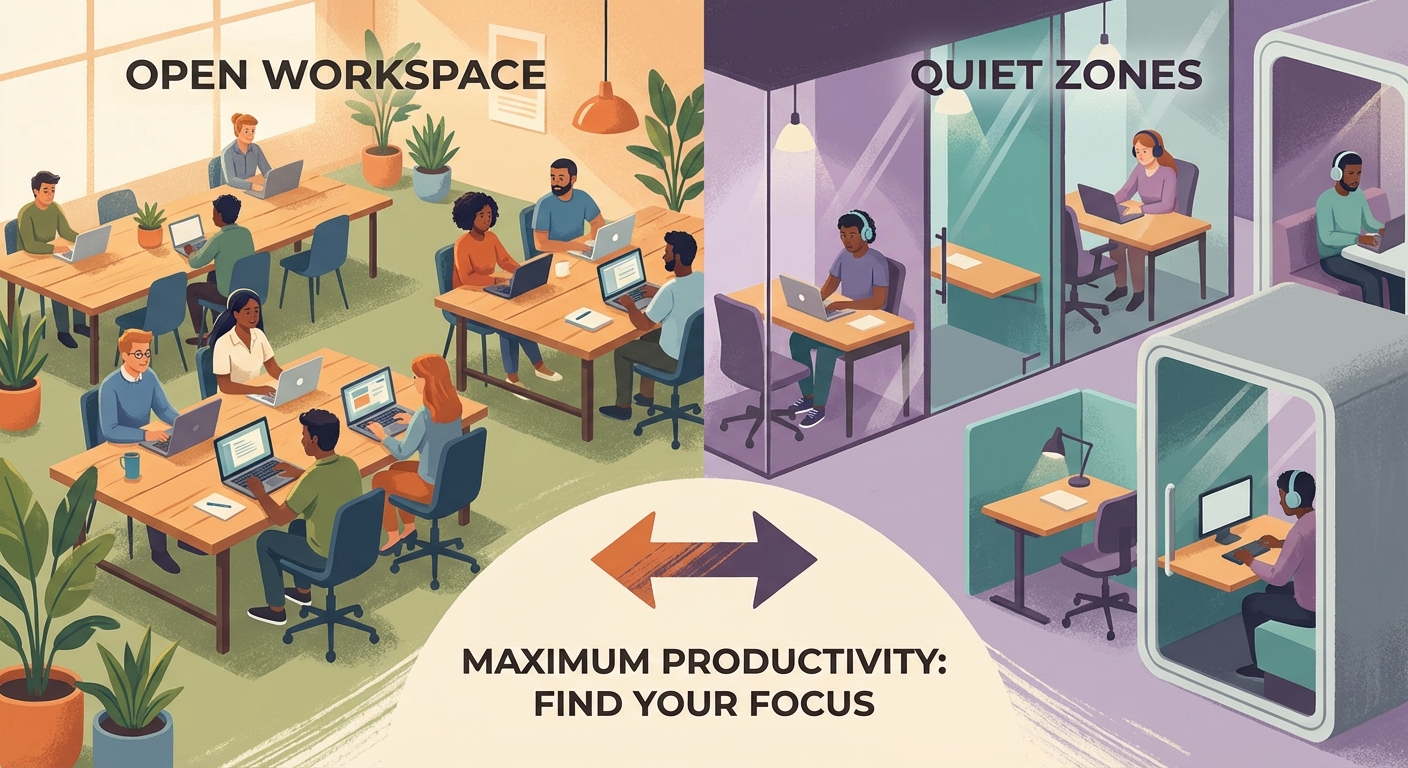
Start by tracking how your team actually spends their time. Don’t guess based on job titles. A software developer might spend 60% of their time coding alone and 40% in meetings and pair programming. That split determines their workspace needs.
Follow this process:
- Survey your team about their typical daily activities and time allocation
- Categorize tasks as collaborative, focused, or mixed
- Calculate the percentage of time spent in each mode
- Map current workspace availability against actual usage patterns
- Identify gaps where employees lack appropriate space for their work type
- Test changes with a small pilot group before full implementation
One Singapore fintech company discovered their analysts spent 70% of their time in focused work but only had access to open seating. Productivity jumped 25% after they converted one floor section into quiet zones with bookable focus rooms.
Track workspace utilization with simple observation. Walk through your office at different times. Note which areas sit empty and which are overcrowded. Booking data for quiet rooms shows demand. If rooms are booked solid weeks in advance, you need more quiet space.
The psychology behind coworking explains how different workspace types affect mental performance and team dynamics.
Creating Effective Zones Within Limited Space
Small offices face real constraints. You can’t dedicate entire floors to different work modes. But you can create distinct zones even in 1,000 square feet.
Use furniture and layout to define spaces without building walls. Bookshelves create visual barriers. Rugs signal zone boundaries. Different lighting temperatures separate areas. A brighter, cooler lit section feels more energetic. Warmer, dimmer lighting encourages focus.
Sound management matters more than physical separation. Acoustic panels on walls and ceilings absorb noise. Carpet reduces footstep sounds. White noise machines mask conversations without adding distraction. Plants provide natural sound dampening while improving air quality.
| Strategy | Implementation Cost | Effectiveness | Best For |
|---|---|---|---|
| Acoustic panels | Medium | High | Reducing echo and ambient noise |
| Furniture placement | Low | Medium | Creating visual boundaries |
| White noise systems | Low | Medium | Masking conversations |
| Bookable quiet rooms | High | Very High | Guaranteed focus time |
| Headphone culture | Very Low | Medium | Individual noise control |
| Designated quiet hours | Free | Medium | Temporary deep work periods |
Are standing desks and ergonomic chairs worth it in coworking spaces addresses another critical workspace design element that affects productivity across both zone types.
Setting and Enforcing Zone Policies That Actually Work
Rules without enforcement create resentment. Your policy document means nothing if people regularly violate it without consequences.
Start with clear, specific guidelines:
- Open zones: Normal conversation volume allowed, phone calls permitted, music through speakers at low volume
- Quiet zones: Headphones required for audio, phone calls in designated areas only, conversations limited to whispers
- Hybrid zones: Moderate noise acceptable, phone calls discouraged, collaborative work permitted with awareness
Post these rules visibly in each zone. Use simple icons showing acceptable and prohibited activities. Language barriers disappear with visual communication.
Designate zone ambassadors. These aren’t enforcers. They’re helpful team members who gently remind people about zone expectations. “Hey, this is a quiet zone. There’s a phone booth around the corner if you need to take that call.” Most violations happen from forgetfulness, not defiance.
Create feedback channels. If someone consistently disrupts a quiet zone, other employees need a way to report it without confrontation. Anonymous feedback forms or a designated workspace manager can address patterns privately.
Building a personal productivity system that works in any coworking environment helps individuals adapt their work habits to different zone types.
Hybrid Approaches That Maximize Flexibility
The best offices don’t force binary choices. They create a spectrum of spaces from completely silent to actively collaborative.
Consider this layout progression:
- Silent focus rooms: Individual booths, no talking, strict policies
- Quiet work areas: Soft conversation allowed, headphones encouraged
- Moderate zones: Normal work volume, brief discussions permitted
- Collaboration spaces: Full conversation, whiteboard sessions, team meetings
- Social areas: Casual interaction, coffee breaks, relationship building
This gradient lets employees match their current task to the right environment. Writing a proposal? Head to a focus room. Need to check something with a colleague? Use a moderate zone. Planning next quarter’s strategy? Book a collaboration space.
Time based zoning adds another dimension. Some offices designate morning hours as quiet time when most people do focused work. Afternoons open up for collaboration and meetings. This rhythm matches natural energy patterns.
How to build an effective hybrid work schedule in a coworking space explores how to coordinate workspace usage across distributed teams.
Technology That Supports Both Workspace Types
The right tools bridge the gap between open and quiet zones. Video conferencing lets someone in a quiet zone join a team discussion happening in an open area without disrupting either space.
Booking systems prevent conflicts. Employees can reserve quiet rooms for deep work sessions or collaboration spaces for team meetings. Real time availability displays show which zones have capacity.
Noise monitoring sensors provide objective data. They measure decibel levels and alert zone managers when areas exceed target thresholds. This removes subjective judgment from enforcement.
Communication tools reduce unnecessary verbal interruptions. Slack or Teams messages let someone ask a question without breaking another person’s focus. They can respond when they reach a natural stopping point.
How high speed internet in coworking spaces boosts your productivity covers another essential technology consideration for modern workspaces.
Common Mistakes That Undermine Workspace Design
Organizations repeatedly make the same errors when implementing open workspace vs quiet zones strategies.
Mistake one: Assuming all employees need the same environment. Your sales team and your development team have opposite workspace requirements. One size fits nobody well.
Mistake two: Creating too few quiet spaces. Most offices overestimate collaboration needs and underestimate focus time. Start with a 50/50 split and adjust based on utilization data.
Mistake three: Poor acoustic design. Open spaces without sound dampening become echo chambers. Conversations bounce off hard surfaces and spread throughout the entire floor.
Mistake four: Inconsistent policy enforcement. When leadership holds loud conversations in quiet zones, employees stop respecting boundaries. Rules apply to everyone or they apply to no one.
Mistake five: No transition spaces. People need buffer zones between high energy collaboration and deep focus. Sudden shifts between extremes reduce productivity in both modes.
5 common coworking mistakes that new members make highlights other workspace pitfalls that affect individual productivity.
Adapting Your Approach for Different Team Sizes
Small teams (5 to 15 people) can usually self regulate. Everyone knows each other. Social pressure maintains appropriate behavior. You might only need one small quiet room and one main collaborative area.
Medium teams (15 to 50 people) require more structure. Designate specific zones clearly. Create booking systems for quiet spaces. Establish written policies.
Large teams (50+ people) need dedicated workspace management. Hire someone to monitor utilization, enforce policies, and adjust layouts based on data. Survey employees quarterly about workspace satisfaction.
Remote first teams using coworking spaces need different considerations. They’re choosing workspace daily based on tasks. Provide guidance about which space types support which work modes. Why coworking spaces are perfect for hybrid teams in Singapore addresses this specific scenario.
Budget Considerations for Different Workspace Configurations
Open workspaces cost less initially. You fit more people per square foot. Furniture is simpler. No construction required.
But hidden costs emerge. Productivity losses from distraction outweigh rent savings. Turnover increases when employees can’t find space to focus. Health insurance claims rise as stress levels climb.
Quiet zones require upfront investment. Sound dampening materials, individual workstations, and dedicated rooms all cost money. But they pay back through higher output per employee.
Calculate the true cost per productive hour, not just cost per desk. An open desk at $300 monthly that reduces productivity by 20% costs more than a quiet workspace at $450 monthly with no productivity loss.
Hot desking vs dedicated desks breaks down another cost comparison relevant to workspace planning.
Testing and Iterating Your Workspace Design
Don’t commit to permanent changes immediately. Test layouts for three months before making expensive modifications.
Use temporary partitions to create zones. Rent modular furniture that you can reconfigure. Try different policies and measure results.
Collect quantitative data: project completion times, meeting frequency, space utilization rates, and employee satisfaction scores. Combine this with qualitative feedback through regular surveys and informal conversations.
Watch for unexpected patterns. Maybe your quiet zones stay empty during certain hours. Perhaps collaboration spaces overflow on specific days. Adjust based on actual behavior, not assumptions.
10 must have amenities every modern coworking space should offer provides a broader checklist for evaluating workspace quality.
Industry Specific Workspace Recommendations
Creative agencies need 60 to 70% open collaborative space. Designers, copywriters, and strategists benefit from constant interaction. Reserve quiet zones for detailed production work.
Technology companies should flip that ratio. Developers need 60 to 70% quiet space for coding. Reserve open areas for standups, planning sessions, and code reviews.
Professional services firms (legal, accounting, consulting) need balanced splits with heavy emphasis on private meeting rooms. Client confidentiality requires enclosed spaces.
Sales organizations thrive in almost entirely open environments. Energy feeds off team success. Quiet zones serve administrative tasks only.
Research and development teams need the most quiet space, often 80% or more. Deep analytical work dominates their time.
Making the Transition From Your Current Setup
Moving from fully open to mixed zones creates anxiety. People worry about losing their current spots or access to colleagues.
Communicate changes early. Explain the reasoning. Share data about productivity challenges in the current setup. Let people test new zones before making them permanent.
Involve employees in the design process. Ask which tasks they struggle to complete in current spaces. Let teams vote on zone locations and policies.
Phase changes gradually. Convert one section at a time. Gather feedback. Make adjustments. Then expand successful approaches to other areas.
Expect a two month adjustment period. Initial resistance fades as people experience the benefits firsthand. Productivity metrics typically dip slightly during transition, then rise above previous levels.
Finding the Right Balance for Your Organization
Open workspace vs quiet zones isn’t an either or decision. It’s a spectrum requiring constant calibration based on your team’s actual work patterns.
Start by observing how your employees currently work. Measure time spent in different work modes. Survey satisfaction with existing spaces. Identify specific productivity pain points.
Design a mixed environment that supports the full range of work your team performs. Create clear zones with distinct purposes. Set reasonable policies and enforce them consistently. Use technology to manage bookings and monitor utilization.
Test your approach for at least three months before making permanent changes. Collect both quantitative metrics and qualitative feedback. Adjust ratios based on real usage patterns, not theoretical ideals.
Remember that workspace needs evolve as your organization grows and work patterns shift. Review your setup annually. Stay flexible. The goal isn’t creating the perfect static layout. It’s building an adaptive environment that continues meeting your team’s changing needs.
Your workspace directly impacts how well your team performs. Get this balance right, and you’ll see measurable improvements in both productivity and employee satisfaction. Get it wrong, and you’ll fight an uphill battle against environmental factors that undermine even your best people’s efforts.