
The flexible workspace industry is experiencing a significant shake-up. Large operators are merging, others are closing locations, and the landscape you knew six months ago might look completely different today. For professionals managing corporate real estate portfolios or investing in flex space, understanding these shifts isn’t optional anymore.
Coworking space consolidation reshapes pricing, lease flexibility, and member experience as operators merge or exit markets. Understanding these changes helps real estate professionals protect client interests, negotiate better terms, and identify stable providers. This guide covers merger impacts, warning signs of operator distress, and strategies for managing workspace transitions during industry consolidation.
Understanding the Current Wave of Market Consolidation
The coworking industry grew explosively between 2015 and 2019. Now it’s contracting.
Major operators are combining operations, selling portfolios, or simply walking away from unprofitable locations. This isn’t a sign of industry failure. It’s market correction.
WeWork’s bankruptcy proceedings in late 2023 sent ripples through the entire sector. Regus parent company IWG has been acquiring distressed assets. Smaller regional players are either getting absorbed or shutting down.
For corporate real estate managers, this creates both risk and opportunity. Your team’s workspace agreement might suddenly belong to a different operator with different policies. Or your preferred location might close with 90 days notice.
The consolidation affects three main groups:
- Existing members facing potential service changes or relocations
- Landlords with coworking tenants at risk of default
- Investors evaluating which operators will survive the next three years
Understanding what makes a coworking space different from a traditional office helps explain why some operators thrive while others collapse under their lease obligations.
What Actually Happens When Two Operators Merge
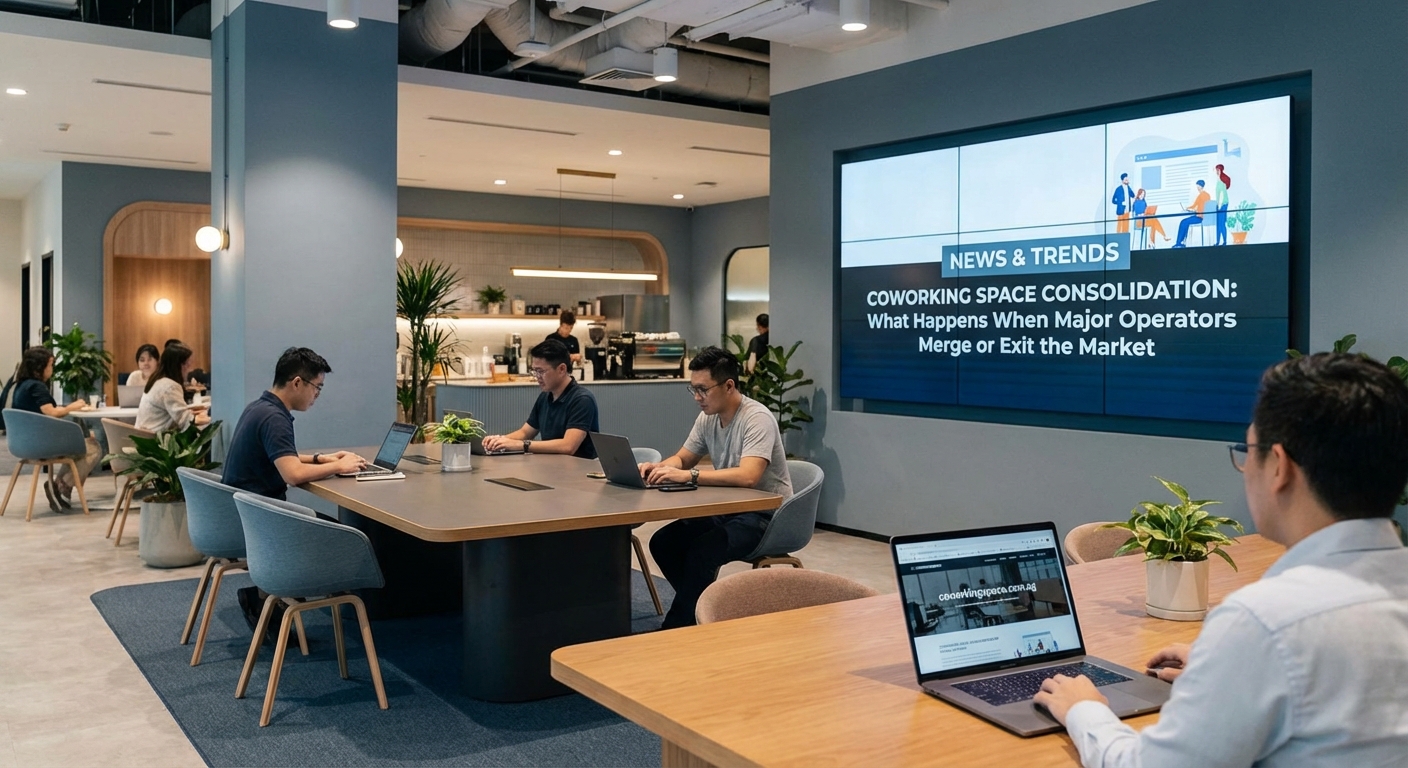
Mergers sound clean on paper. The reality for members is messier.
When Operator A acquires Operator B, your membership agreement transfers to the new entity. But the terms don’t always stay the same.
Here’s the typical timeline:
- Announcement phase (Week 1-2): Both companies issue press releases emphasizing “seamless transition” and “enhanced member experience.”
- Assessment period (Month 1-3): The acquiring operator evaluates which locations to keep, which to rebrand, and which to close.
- Integration phase (Month 3-6): Billing systems merge, access cards change, and staff turnover begins.
- Stabilization (Month 6-12): The dust settles, but the space might look and feel completely different.
During integration, expect these changes:
- New pricing structures that might not honor your original rate
- Different amenity access policies
- Altered community events or networking programs
- Staff replacements as duplicate roles get eliminated
The most significant impact hits members with multi-location access. Your network of 50 available locations might drop to 35 if the acquiring operator closes redundant sites in the same neighborhoods.
Smart corporate real estate teams start contingency planning the moment merger news breaks. Waiting until you receive a relocation notice leaves you scrambling.
Five Warning Signs Your Coworking Operator Might Exit the Market
Some operators announce closures with plenty of notice. Others disappear overnight.
Learning to spot financial distress early gives you time to secure alternative workspace before your team loses access.
Maintenance neglect appears first. Broken coffee machines stay broken. Cleaning schedules slip. Minor repairs pile up. These aren’t just operational hiccups. They signal cash flow problems.
Staff turnover accelerates when operators can’t make payroll consistently. If you’re seeing your third community manager in four months, something’s wrong behind the scenes.
Amenity cutbacks come next. The free beer Fridays stop. Printing credits get reduced. Conference room booking windows shrink. Each cut saves small amounts but signals larger financial stress.
Lease renegotiation attempts become visible when landlords start showing the space to potential replacement tenants. You might notice property tours during business hours or see commercial real estate brokers measuring the floor plan.
Payment processing issues are the final red flag. If your credit card gets charged twice, refunds take weeks, or billing inquiries go unanswered, the operator is likely juggling creditor demands.
Members who track these signals can usually secure 60-90 days of lead time before formal closure announcements. That window makes the difference between orderly transition and chaotic scrambling.
How Consolidation Changes Pricing and Contract Terms

Market consolidation puts upward pressure on pricing. Less competition means less incentive to discount.
When operators merge, they eliminate duplicate locations in the same market. This reduces supply while demand stays constant. Basic economics predicts what happens next.
| Market Condition | Typical Price Impact | Contract Flexibility |
|---|---|---|
| Pre-consolidation | High competition, aggressive discounting | Month-to-month common, easy negotiations |
| Active consolidation | Price freezes during transition | Existing terms honored temporarily |
| Post-consolidation | 15-30% rate increases at renewal | Longer minimum terms, fewer concessions |
The pricing impact varies by market density. Singapore’s CBD has enough operators that single mergers don’t dramatically shift pricing. But in secondary markets with only two or three major players, consolidation can eliminate your negotiating leverage completely.
Contract terms tighten after consolidation. The month-to-month flexibility that attracted many corporate clients gets replaced with six or twelve-month minimums. Early termination penalties increase. Deposit requirements go up.
Operators with strong balance sheets use consolidation periods to clean up unprofitable contract structures. If you’re paying below-market rates under a legacy agreement, expect pressure to renegotiate at renewal.
For teams currently evaluating whether coworking spaces are worth the cost, factor in likely price increases over the next 18-24 months as consolidation continues.
Managing Member Experience During Operator Transitions
Your team doesn’t care about industry consolidation. They care about showing up Monday morning and having a functional workspace.
Maintaining productivity during operator transitions requires proactive communication and contingency planning.
Start by documenting your current setup completely:
- Access card numbers and activation dates
- Locker assignments and combinations
- Conference room booking credentials
- Printing account balances
- Mail handling procedures
- Parking space assignments
This inventory becomes critical if systems get wiped during integration. You’ll need these details to restore access or claim refunds for prepaid services.
Establish direct contact with the transition team. Don’t rely on general member support emails. Get a name and direct phone number for someone managing the integration.
Create a backup workspace plan before you need it. Identify two alternative locations your team could use on short notice. Understanding different membership types helps you evaluate options that match your current setup.
Communicate proactively with your team. Don’t let them hear about potential disruptions through rumor or social media. Regular updates reduce anxiety even when you don’t have complete information.
Budget for duplicate costs during transition periods. You might need to maintain your existing membership while securing backup space, creating 30-60 days of double payments.
The Impact on Landlords and Property Owners
Coworking operators typically sign long-term leases while offering short-term flexibility to members. This mismatch creates risk.
When operators exit the market, landlords face sudden vacancy in spaces built out for flexible workspace. Converting back to traditional office use costs money and time.
Smart landlords are adding protection clauses to new coworking leases:
- Personal guarantees from operator principals
- Higher security deposits (6-12 months vs traditional 3 months)
- Restrictions on sublease arrangements
- Restoration obligations if tenant defaults
These protections make sense for landlords but increase operator costs. Those costs eventually flow through to member pricing.
Property owners should monitor operator financial health as actively as they track any major tenant. Request quarterly financial statements. Watch for late rent payments. Notice maintenance request patterns.
Some landlords are shifting to revenue-share models instead of fixed rent. The operator pays a base rate plus percentage of member revenue. This aligns incentives and gives landlords more visibility into operator performance.
For investors evaluating flex space opportunities, landlord protections matter as much as operator brand recognition. A strong operator with a weak lease structure creates unnecessary risk.
Strategies for Corporate Real Estate Managers
Your job is protecting your organization’s workspace needs regardless of operator instability.
Build relationships with multiple operators in your key markets. Don’t put all locations with a single provider, even if the volume discount looks attractive. Diversification protects against single-operator failure.
Negotiate exit clauses that activate during ownership changes. Your contract should let you terminate without penalty if your operator gets acquired or files bankruptcy. Most standard agreements don’t include this protection, but it’s negotiable.
Maintain a current inventory of alternative workspace options. Update this quarterly, not when crisis hits. Track pricing, availability, and lead times for activating new locations.
“We learned this lesson the hard way. Our primary operator closed three locations with 60 days notice. Having pre-negotiated terms with two backup providers meant our teams stayed productive. The companies that waited until closure announcements faced 90-day gaps in workspace availability.”
Consider hybrid workspace memberships that spread your team across multiple providers. This increases administrative complexity but reduces concentration risk.
Build workspace contingency costs into your annual budget. Plan for 10-15% of your coworking spend going toward transition expenses, duplicate memberships during changeovers, and setup costs at replacement locations.
Regional Variations in Consolidation Patterns
Market consolidation doesn’t happen uniformly across geographies.
Singapore’s coworking market shows different patterns than London, New York, or Sydney. Understanding regional dynamics helps predict local impacts.
Asian markets generally have:
- More local operators relative to international chains
- Shorter average lease terms (3-5 years vs 10-15 years in Western markets)
- Higher density of locations in CBD areas
- Less institutional investment capital
These factors make Asian markets more volatile but also more adaptable. Operators can exit unprofitable locations faster. New entrants can launch with lower capital requirements.
Singapore specifically benefits from strong commercial real estate fundamentals and government support for flexible workspace. This creates more stability than other Southeast Asian markets.
But even stable markets aren’t immune to consolidation. Understanding what’s happening in different Singapore neighborhoods reveals that consolidation hits some districts harder than others.
CBD locations with high rents face more pressure than suburban or fringe locations with lower occupancy costs. Operators often keep their affordable locations while closing premium sites that can’t sustain high rents.
Technology’s Role in Consolidation Outcomes
Operators with modern technology platforms survive consolidation better than those running on spreadsheets and manual processes.
Member management systems, automated billing, and integrated access control reduce operational costs. These savings matter more as competition intensifies.
When operators merge, technology integration determines how smoothly the transition goes. Companies using compatible platforms can merge member databases in weeks. Incompatible systems take months and create more service disruptions.
For members, technology sophistication signals operator stability. Companies investing in AI and smart technology are usually better capitalized and more focused on long-term sustainability.
Watch for these technology indicators:
- Mobile app functionality and update frequency
- Automated billing and invoice generation
- Digital access control vs physical keys
- Real-time space availability tracking
- Integrated meeting room booking
Operators running on outdated technology are acquisition targets or closure candidates. Their operational costs are too high to compete long-term.
Future Outlook for the Flexible Workspace Sector
Consolidation will continue through 2026 and likely into 2027. But it’s not eliminating the flexible workspace sector.
The industry is maturing. The explosive growth phase is over. What remains will be more stable, better capitalized, and more professionally managed.
Expect these trends:
- Fewer total operators but larger average operator size
- More corporate ownership and less venture capital funding
- Tighter integration with traditional commercial real estate
- More specialized or industry-specific coworking spaces
- Better financial transparency and reporting
For corporate real estate professionals, this means your coworking strategy needs updating. The assumptions that worked in 2019 don’t apply in 2026.
Traditional office space isn’t disappearing, but it’s sharing the market with flexible workspace in a more permanent way. Companies that understand this hybrid model will have advantages in talent attraction and cost management.
The question isn’t whether to use flexible workspace. It’s how to use it strategically while managing consolidation risk.
What Smart Operators Are Doing Differently
Surviving operators share common characteristics that distinguish them from failing competitors.
Conservative lease commitments top the list. Successful operators match lease terms to realistic occupancy projections instead of betting on explosive growth. They negotiate tenant-friendly exit clauses and avoid overcommitting to expensive locations.
Diversified revenue streams provide stability. The best operators generate income from enterprise clients, retail members, meeting room rentals, and event hosting. Single-revenue-source operators are vulnerable to market shifts.
Strong unit economics matter more than growth rate. Operators focused on profitability per location outperform those chasing location count. Each space should generate positive cash flow within 12-18 months.
Professional management replaces the startup mentality. Successful operators hire experienced commercial real estate professionals instead of relying on entrepreneurial enthusiasm. They track metrics, manage costs, and make data-driven decisions.
Member retention focus costs less than new member acquisition. Operators investing in community management, service quality, and member experience maintain higher occupancy with lower marketing costs.
These operational differences aren’t visible from member-facing marketing. But they determine which operators will still be operating in three years.
Making Consolidation Work for Your Organization
Market consolidation creates challenges but also opportunities for prepared organizations.
Less competition means less innovation in some markets. But it also means more stable operators with better service quality and longer planning horizons.
Your strategy should balance flexibility with stability:
- Diversify across multiple operators to reduce single-provider risk
- Negotiate contracts that protect you during ownership changes
- Build relationships with backup providers before you need them
- Monitor operator financial health through public signals
- Budget for transition costs as normal business expenses
The coworking industry isn’t dying. It’s evolving from a startup sector into a mature commercial real estate category. That evolution includes consolidation, just like every maturing industry experiences.
Organizations that treat flexible workspace as a strategic asset rather than a temporary cost-saving measure will navigate consolidation successfully. Those that view it as a short-term solution will face repeated disruptions as operators merge, exit, or restructure.
Your workspace strategy needs the same attention you give to technology infrastructure or talent management. The companies getting this right are building competitive advantages that extend beyond real estate costs into productivity, talent attraction, and operational flexibility.
Navigating the New Workspace Reality
The coworking landscape looks different than it did 24 months ago. It will look different again 24 months from now.
But the fundamental value proposition remains solid. Flexible workspace solves real problems for real organizations. Consolidation is cleaning out operators who couldn’t deliver that value profitably.
For commercial real estate professionals, this means staying informed, maintaining options, and building relationships across multiple providers. The days of set-it-and-forget-it coworking arrangements are over.
Active management of your flexible workspace portfolio is now standard practice. Monitor your operators. Track market changes. Update your contingency plans. And remember that the lowest price today might cost more tomorrow if that operator can’t sustain their business model.
The organizations that thrive through this consolidation period will be those that view workspace as a strategic capability requiring ongoing attention and investment. Your competitors are figuring this out. Make sure you’re ahead of them.