
Corporate real estate is undergoing its biggest transformation in decades. Companies that once viewed traditional office leases as status symbols are now rethinking everything. The shift isn’t just about saving money. It’s about building workplaces that actually work for modern teams.
Companies are moving to coworking spaces to reduce fixed costs, gain flexibility, attract talent, and support hybrid work models. This shift allows businesses to scale quickly, avoid long-term lease commitments, and provide employees with professional environments that boost productivity and collaboration while maintaining lower overhead than traditional office spaces.
The Real Cost Difference Between Traditional Offices and Coworking
Traditional office leases lock companies into multi-year commitments. You’re paying for space whether you use it or not.
The math tells a clear story. A traditional office in Singapore’s CBD costs around $8 to $15 per square foot monthly, before factoring in utilities, maintenance, furniture, internet, cleaning, and security. For a 5,000 square foot space, that’s $40,000 to $75,000 monthly, plus setup costs that can exceed $200,000.
Coworking spaces flip this model completely. You pay for what you actually use. Need 20 desks this month and 30 next month? Done. Scaling down for a slow quarter? No problem.
Here’s what traditional offices hide in their costs:
- Furniture depreciation and replacement
- IT infrastructure and maintenance
- Reception staff
- Cleaning services
- Utility bills that spike unpredictably
- Building management fees
- Insurance premiums
- Security systems
Coworking memberships bundle everything into one predictable monthly fee. The financial team loves this. No surprise expenses. No capital expenditure approvals. Just operational expenses that scale with your actual needs.
Companies moving from traditional offices to coworking spaces typically see 30% to 50% cost reductions in their first year. That’s real money that can fund growth, hiring, or product development instead of going to landlords and facility management.
Flexibility Matters More Than Ever
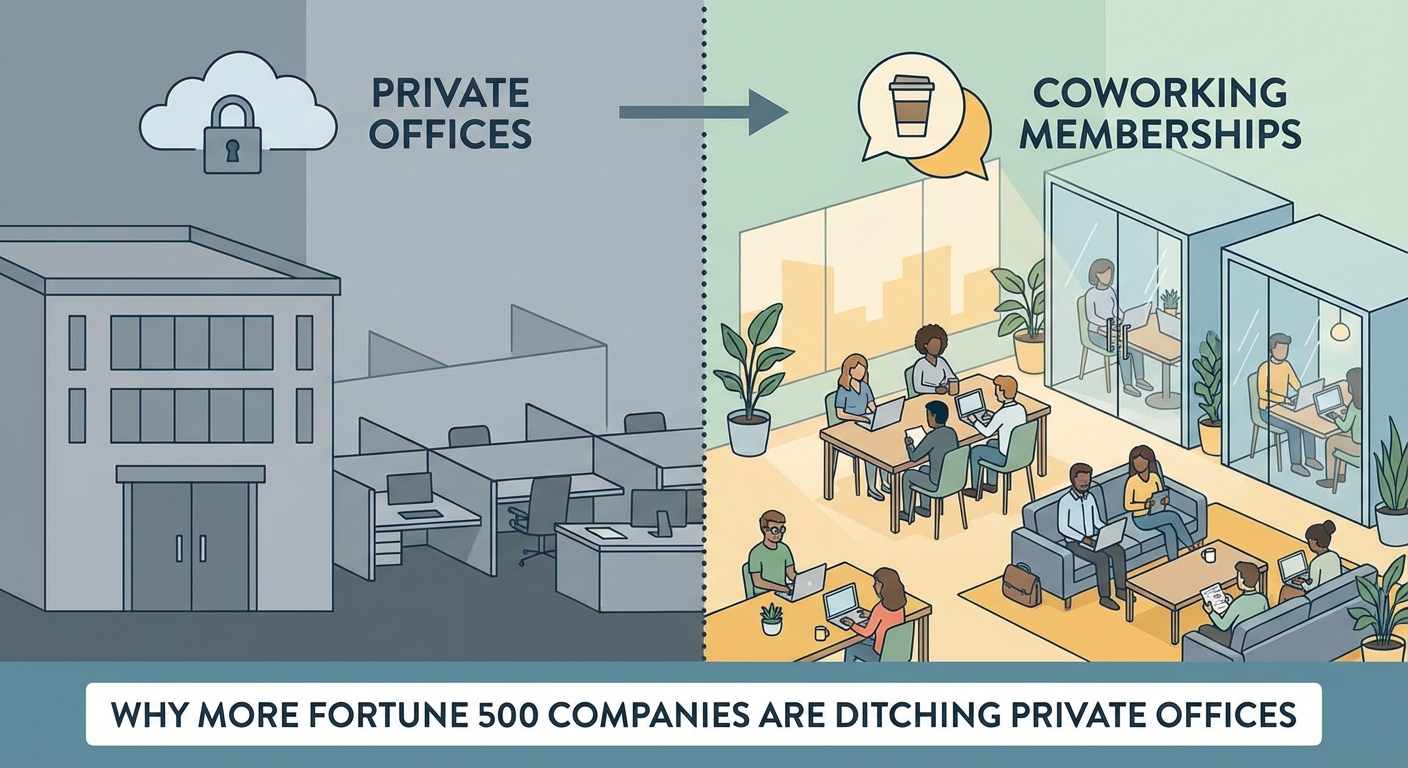
Business conditions change fast. A pandemic proved that. Economic shifts, market opportunities, and team size fluctuations happen constantly.
Traditional leases trap you. Signed a five-year lease and need to expand in year two? You’re stuck renegotiating or finding additional space. Need to downsize? You’re still paying for empty desks.
Coworking spaces solve this with month-to-month or annual agreements that allow scaling. Add team members without lease amendments. Reduce your footprint without penalty clauses. Open a temporary office in a new market without committing to a ten-year lease.
Consider a tech startup that grows from 15 to 45 people in eighteen months. In a traditional office, they’d need to:
- Predict their space needs years in advance
- Sign a new lease or expand their current one
- Wait for build-out and furniture delivery
- Hope they got the projections right
With coworking, they add desks as they hire. If growth slows, they scale back. If they need a Singapore presence for six months to test a market, they can do that without betting the company on a long-term commitment.
Understanding coworking membership types gives companies the flexibility to match workspace to actual needs rather than guessing years ahead.
How Hybrid Work Changed Everything
Remote work isn’t going away. But full remote isn’t the answer for most companies either.
Hybrid work emerged as the middle ground. Employees work from home some days and come to the office for collaboration, meetings, and team building. This model requires a completely different approach to office space.
Why pay for 100 desks when only 40 people come in on any given day? Traditional offices force this waste. You need enough space for everyone, even though everyone is never there at once.
Coworking spaces embrace this reality. Hot desking means multiple employees can share the same workspace on different days. A company with 80 hybrid employees might only need 35 dedicated spaces, dramatically reducing costs while still providing professional work environments when needed.
The data backs this up. Studies show that traditional offices sit empty 50% to 70% of the time in hybrid models. That’s thousands of dollars monthly for vacant chairs and dark computer screens.
Companies implementing hybrid policies need workspace solutions that match their actual usage patterns. Why coworking spaces are perfect for hybrid teams in Singapore explains how this model supports modern work arrangements better than traditional leases.
Attracting Talent in a Competitive Market
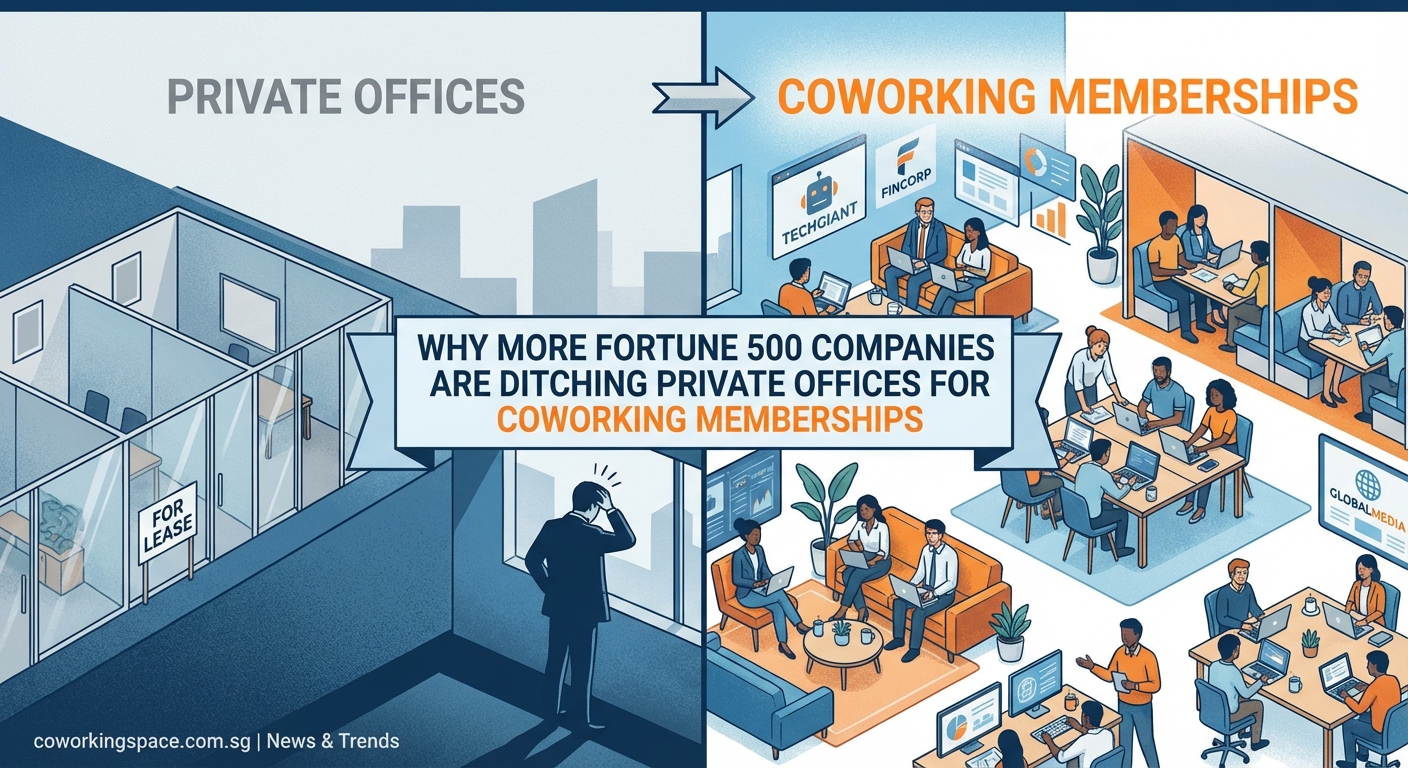
Job candidates care about where they’ll work. A lot.
Young professionals, especially those in tech, creative, and professional services, actively seek companies offering flexible work arrangements. They want options, not mandates. They want professional environments, not corporate rigidity.
Coworking spaces signal that your company understands modern work culture. They show you’re willing to invest in employee experience without wasting money on unnecessary overhead.
The amenities matter too. High-quality coworking spaces offer:
- Professional meeting rooms for client presentations
- Private phone booths for confidential calls
- Comfortable common areas for informal collaboration
- High-speed internet that actually works
- Coffee and refreshments
- Ergonomic furniture
- Natural light and good design
These aren’t luxuries. They’re expectations. Companies competing for talent can’t afford to offer cramped, outdated, or poorly equipped workspaces.
Location flexibility also helps with hiring. Instead of requiring everyone to commute to one central office, companies can offer memberships at multiple coworking locations. An employee in the east can work near home. Someone in the west has their own nearby option. This reduces commute times and improves work-life balance without fragmenting the team across separate offices.
The Community and Networking Advantage
Traditional offices isolate you. Your team works with your team. That’s it.
Coworking spaces create accidental collisions. You meet people from other companies, industries, and backgrounds. These connections lead to partnerships, client relationships, and knowledge sharing that would never happen in a private office.
A fintech startup working near a design agency might discover collaboration opportunities. A consultant might find their next client over coffee in the common area. A developer might solve a technical problem by chatting with someone from a completely different company.
This isn’t networking for networking’s sake. It’s genuine relationship building that happens naturally when diverse professionals share space.
“We’ve closed three major deals directly through connections we made at our coworking space. The ROI on our membership paid for itself within the first year just from those relationships, not counting all the cost savings.” – CFO, Singapore-based SaaS company
Many coworking spaces also organize events, workshops, and social gatherings. These create structured opportunities for professional development and relationship building without the forced awkwardness of traditional networking events.
How coworking spaces help freelancers build professional networks in Singapore shows how this community aspect benefits individuals and companies alike.
Comparing Workspace Options for Growing Companies
Different workspace solutions serve different needs. Here’s how they stack up:
| Option | Best For | Cost Range | Flexibility | Setup Time |
|---|---|---|---|---|
| Traditional Office | Large stable teams, 50+ people | $40k-$100k+ monthly | Very low | 3-6 months |
| Coworking Private Office | Growing teams, 10-30 people | $5k-$25k monthly | High | 1-7 days |
| Dedicated Desks | Small teams, 5-15 people | $2k-$8k monthly | Very high | Immediate |
| Hot Desks | Hybrid teams, flexible workers | $300-$800 per person | Maximum | Immediate |
| Virtual Office | Remote teams needing address | $100-$500 monthly | Maximum | Immediate |
The right choice depends on your specific situation. A 200-person corporation might still need a traditional office. A 25-person startup probably doesn’t.
Common Mistakes Companies Make When Evaluating Coworking
Decision-makers often approach coworking with traditional office thinking. This leads to poor choices.
Mistake 1: Comparing only monthly costs
A $500 per desk coworking membership looks expensive compared to a $300 per square foot traditional office calculation. But that $300 doesn’t include furniture, internet, utilities, cleaning, maintenance, or any of the dozens of hidden costs that make traditional offices expensive.
Mistake 2: Not testing before committing
Many coworking spaces offer day passes or trial periods. Use them. Bring your team. See how the space actually works for your specific needs. What looks good on a website tour might not function well for your work style.
Mistake 3: Choosing based on price alone
The cheapest option rarely delivers the best value. Poor internet, limited meeting rooms, uncomfortable furniture, or inadequate amenities will hurt productivity more than you save on monthly fees.
Mistake 4: Ignoring location and accessibility
A great coworking space that’s hard to reach won’t get used. Consider transit access, parking, and proximity to where your team actually lives. How to choose your first coworking space in Singapore covers the evaluation process in detail.
Mistake 5: Underestimating space needs
Calculate realistically. How many people will be in the office on peak days? Do you need private offices for sensitive work? How many meeting rooms do you actually use weekly?
Steps to Transition Your Company to Coworking
Making the switch requires planning. Here’s a practical approach:
-
Audit your current space usage. Track how many people actually come to the office daily for two weeks. Note peak days, slow days, and patterns. This data drives your space requirements.
-
Calculate your true office costs. Add up rent, utilities, furniture, maintenance, supplies, and every other expense related to your current space. Many companies discover they’re spending 40% more than they thought.
-
Define your requirements. List must-haves versus nice-to-haves. Do you need private offices? How many meeting rooms? What about phone booths, printing, or storage?
-
Research and visit spaces. Tour at least five different coworking locations. Bring team members. Ask about member experiences, not just amenities lists.
-
Run a pilot program. Test coworking with a small team or department before moving everyone. Get real feedback about what works and what doesn’t.
-
Plan the transition carefully. Coordinate lease end dates, furniture disposal, address changes, and communication with clients and partners. Poor planning creates unnecessary stress.
-
Set clear expectations with your team. Explain the why behind the move. Address concerns. Create guidelines for booking spaces and using shared amenities.
-
Measure and adjust. Track costs, employee satisfaction, and productivity for the first six months. Be willing to change providers or adjust your membership if needed.
What This Means for Corporate Real Estate Strategy
The shift to coworking represents more than cost cutting. It’s a fundamental rethinking of how companies view workspace.
Progressive companies now treat real estate as a variable expense that scales with business needs rather than a fixed asset that drains capital. This mindset shift enables faster growth, easier market testing, and better risk management.
CFOs love the financial flexibility. HR directors appreciate the employee satisfaction benefits. CEOs value the ability to expand or contract quickly based on business conditions.
The trend isn’t temporary. Companies that moved to coworking during economic uncertainty discovered benefits that extend far beyond crisis management. They’re staying because the model simply works better for how modern businesses operate.
Are coworking spaces worth the cost breaks down the financial analysis in detail, showing how smart companies are calculating ROI on workspace decisions.
Making the Right Decision for Your Company
Every company’s situation differs. A law firm with strict confidentiality requirements has different needs than a creative agency. A financial services company faces different regulations than a tech startup.
But the questions remain the same. Are you paying for space you don’t use? Could you scale faster with more flexible arrangements? Would your team be happier with better amenities and location options? Does your current office support or hinder your hybrid work policies?
The companies moving to coworking spaces aren’t abandoning professionalism or cutting corners. They’re making strategic decisions that align workspace costs with actual usage, improve employee satisfaction, and free up capital for growth.
Traditional offices still serve important purposes for certain organizations. But for many companies, especially those with 5 to 100 employees, coworking offers a better solution. Lower costs, higher flexibility, professional environments, and built-in community create value that traditional leases can’t match.
The shift is happening now. The question isn’t whether flexible workspace solutions will play a role in your company’s future. It’s whether you’ll adapt proactively or get left behind paying for empty desks while your competitors move faster with lower overhead.