
Singapore doesn’t offer a dedicated digital nomad visa. That reality surprises many remote workers who assume this tech-forward nation would embrace location-independent professionals with open arms. The truth is more nuanced. While you can’t simply apply for a “digital nomad visa Singapore,” several legal pathways exist for remote workers who want to base themselves in this vibrant city-state.
Singapore lacks a specific digital nomad visa, but remote workers can legally stay through tourist visas (up to 90 days), Employment Passes (requiring local sponsorship), EntrePass (for entrepreneurs), or dependent passes. Working remotely for foreign clients on a tourist visa exists in a legal gray area. Long-term stays require proper work authorization, and coworking spaces provide professional infrastructure without addressing visa status.
Why Singapore doesn’t have a digital nomad visa program
Most Southeast Asian countries have launched specialized visas for remote workers. Thailand, Indonesia, and Malaysia all offer dedicated programs. Singapore has chosen a different approach.
The government prioritizes attracting talent through employment-based schemes. They want workers who contribute directly to the local economy, pay taxes here, and integrate into the workforce. A digital nomad earning income from overseas clients doesn’t fit that model.
Singapore’s immigration framework focuses on skills-based entry. You need either a job offer from a local company, significant investment capital, or specialized expertise that benefits Singapore directly.
This doesn’t mean remote workers can’t spend time here. It just means you need to work within existing visa categories.
Tourist visa limitations for remote work
Most passport holders receive a 30 to 90-day visa-free entry stamp. Citizens from the US, UK, EU, Australia, and many other countries fall into this category.
Can you work remotely during this period?
Technically, Singapore’s immigration laws prohibit any work without proper authorization. The reality is more complex. Checking emails, attending virtual meetings, or writing code for a foreign employer from your hotel room rarely triggers enforcement.
Immigration authorities focus on local employment. If you’re not taking a job from a Singaporean resident or operating a business that serves local clients, you typically won’t face scrutiny.
That said, this exists in a legal gray area. You’re not explicitly permitted to work, even remotely. Some remote workers accept this ambiguity for short stays. Others prefer clear legal standing.
What you can and cannot do on a tourist visa
Activities generally considered acceptable:
– Attending online meetings with your remote team
– Responding to work emails
– Completing projects for overseas clients
– Managing your existing business operations
Activities that cross the line:
– Meeting local clients for paid work
– Providing services to Singapore-based companies
– Conducting business development in Singapore
– Hiring local staff or opening an office
The distinction matters. If immigration officers suspect you’re engaging in local business activities, they can deny entry or cancel your visa.
Employment Pass requirements for remote workers
The Employment Pass (EP) represents Singapore’s primary work visa. It requires a local employer to sponsor you.
This creates a challenge for traditional digital nomads. If you work for yourself or foreign clients exclusively, you can’t get an EP.
Some remote workers solve this by securing employment with a Singapore-based company. Tech firms, financial services, and multinational corporations frequently hire remote workers and provide EP sponsorship.
Minimum salary and qualification standards
As of 2026, EP applicants must earn at least SGD 5,000 per month. Higher thresholds apply for older workers:
– Age 23-29: SGD 5,000
– Age 30-39: SGD 5,500
– Age 40+: SGD 6,000
You also need acceptable qualifications. A degree from a recognized university helps significantly. Extensive work experience in a specialized field can compensate for educational gaps.
The Ministry of Manpower uses a points-based system called COMPASS. It evaluates salary competitiveness, qualifications, diversity, and support for local employment.
Getting an EP as a remote worker typically requires finding a Singapore company willing to employ you, even if you work remotely most of the time. This might mean hybrid arrangements where you spend some time in Singapore and some abroad.
EntrePass for entrepreneurs and startup founders
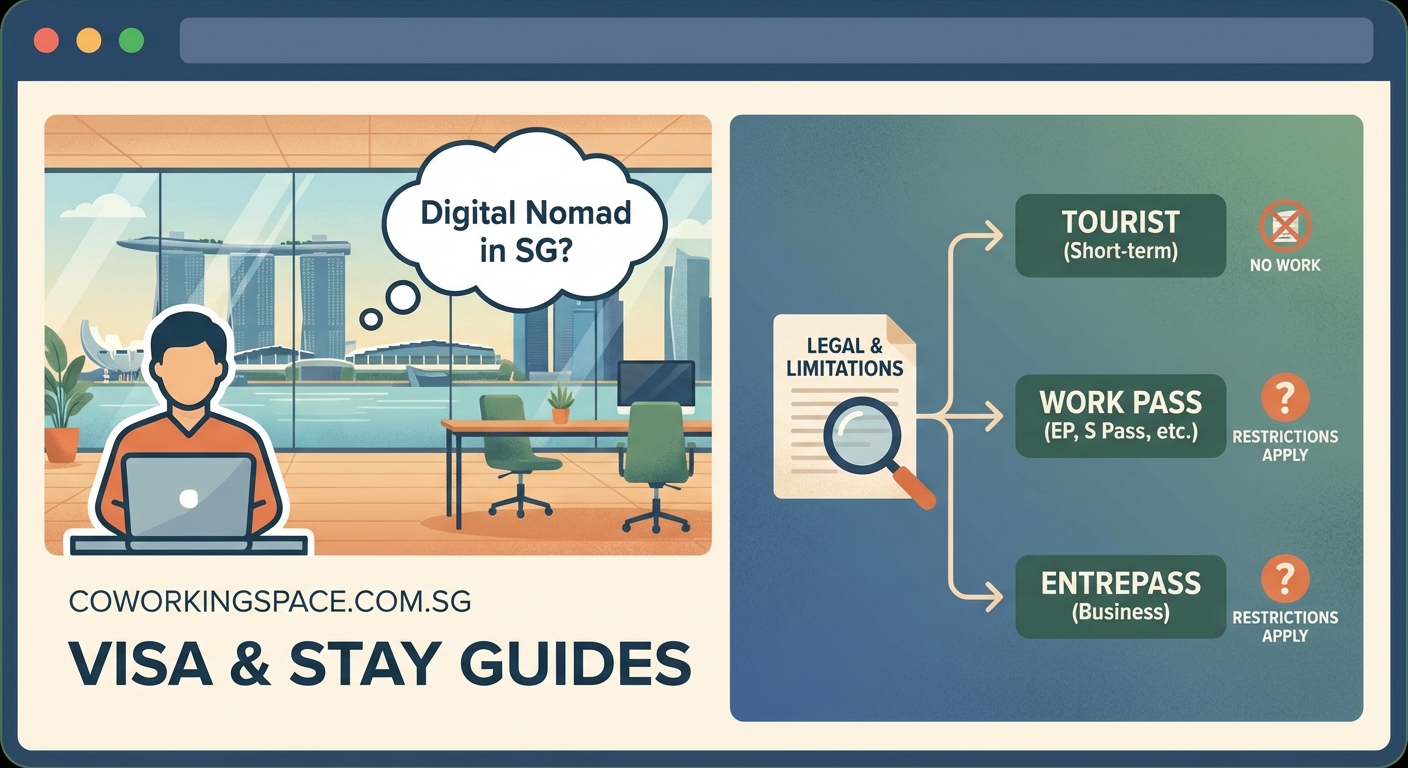
The EntrePass targets entrepreneurs who want to establish businesses in Singapore. If you run a legitimate business with growth potential, this could work.
You’ll need to meet specific criteria:
1. Register a private limited company in Singapore
2. Hold at least 30% equity
3. Demonstrate funding (minimum SGD 50,000 in paid-up capital)
4. Present a viable business plan
5. Show innovation or technology focus
The government evaluates applications based on business viability, innovation potential, and economic contribution. Simply registering a company isn’t enough. You need a genuine business operation.
Many digital entrepreneurs use this route. If you run a software company, consulting firm, or online business with real revenue and growth trajectory, EntrePass becomes viable.
How to apply for Singapore’s EntrePass visa as a startup founder covers the detailed application process and documentation requirements.
Common EntrePass mistakes to avoid
| Mistake | Why it fails | Better approach |
|---|---|---|
| Vague business plan | Lacks concrete metrics and timelines | Include specific revenue targets, customer acquisition strategy, and 3-year projections |
| Insufficient funding | SGD 50,000 minimum not demonstrated | Show bank statements, investment agreements, or committed capital |
| No Singapore connection | Business could operate anywhere | Demonstrate why Singapore specifically benefits your business model |
| Solo freelancing | Doesn’t show scalability or job creation | Position as agency or platform with growth potential |
The EntrePass gets reviewed annually. You need to show progress toward your business goals to maintain it.
Dependent passes for spouses and family members
If your partner has an EP, S Pass, or is a permanent resident, you might qualify for a Dependent’s Pass (DP).
DP holders can work in Singapore after obtaining a Letter of Consent from the Ministry of Manpower. This provides legitimate work authorization without needing separate sponsorship.
Many remote workers use this pathway. One partner secures employment in Singapore while the other continues remote work for overseas clients under a DP with Letter of Consent.
The process involves:
1. Your sponsor (spouse/parent) applies for your DP
2. Once approved, you apply for Letter of Consent
3. MOM evaluates your qualifications and intended work
4. If approved, you can work legally
This works well for couples where one person wants traditional employment and the other prefers remote work flexibility.
Long-term visitor passes and alternatives
Singapore offers several other visa categories, though most don’t suit typical digital nomads:
Personalised Employment Pass (PEP): For high-earning professionals (minimum SGD 22,500 monthly). Allows job changes without new sponsorship but still requires employment.
Training Employment Pass: For on-the-job training attachments up to three months. Not suitable for ongoing remote work.
Miscellaneous Work Pass: For short-term work assignments. Requires local sponsorship.
Long-Term Visit Pass: Granted at immigration’s discretion for compelling reasons. Not a standard application pathway.
None of these directly address the digital nomad use case. They’re designed for different circumstances.
Practical strategies for remote workers in Singapore
Given the visa landscape, remote workers typically choose one of these approaches:
Short-term stays on tourist visas
Stay up to 90 days, work remotely for foreign clients, and leave before your visa expires. Many digital nomads rotate through Southeast Asian countries this way.
Risks include the legal gray area and lack of long-term stability. You can’t establish residency or access certain services.
Secure local employment with remote flexibility
Find a Singapore company willing to hire you with flexible work arrangements. You get proper EP sponsorship while maintaining some remote work freedom.
This requires finding the right employer. Tech companies and multinational firms often accommodate hybrid or remote arrangements.
Launch a qualifying business
If you have entrepreneurial ambitions, structure your work as a scalable business and apply for EntrePass. This works best if you already have revenue and growth potential.
Partner sponsorship route
If your spouse can secure Singapore employment, use the DP pathway. This provides the most flexibility for continuing existing remote work.
Where coworking spaces fit into your visa strategy
Coworking spaces solve the workspace problem but don’t address visa status. You still need legal authorization to work in Singapore.
That said, quality coworking environments provide essential infrastructure. Reliable internet, professional meeting rooms, and networking opportunities matter for remote workers.
Best coworking spaces in Singapore for digital nomads on short-term stays highlights flexible options for those on tourist visas or short-term passes.
Many spaces offer day passes or weekly memberships. This flexibility suits remote workers testing Singapore before committing to longer-term arrangements.
“I spent three months rotating between coworking spaces while on a tourist visa. It gave me time to network, understand the market, and eventually land a local role that sponsored my EP. The coworking community made that transition possible.” – Sarah Chen, Product Designer
Professional workspace access also helps if you’re applying for EntrePass. Showing you have proper business infrastructure strengthens your application.
Tax implications for remote workers
Working in Singapore, even remotely for foreign clients, can create tax obligations.
Singapore taxes based on tax residency. You become a tax resident if you work or stay in Singapore for 183 days or more in a calendar year.
Tax residents pay progressive income tax on Singapore-sourced income. Income from overseas employment while physically in Singapore may be considered Singapore-sourced.
This creates complexity for digital nomads. If you spend significant time here working remotely, you might owe Singapore taxes even if your employer is overseas.
Key considerations:
– Days spent in Singapore count toward residency
– Remote work performed while physically in Singapore may be taxable
– Tax treaties with your home country might provide relief
– Proper documentation of income sources matters
Consult a tax professional familiar with Singapore’s rules. The Inland Revenue Authority of Singapore (IRAS) provides guidance, but individual situations vary.
Banking and financial services access
Opening a Singapore bank account as a tourist is difficult. Most banks require proof of residency or employment.
If you have an EP or EntrePass, banking becomes straightforward. You can open accounts, access credit, and use full financial services.
Some banks offer accounts for non-residents with minimum deposits (often SGD 200,000 or more). These cater to wealthy individuals rather than typical digital nomads.
Financial access limitations affect daily life. You might rely on international cards, which incur foreign transaction fees. Money transfers become more complicated.
This practical reality pushes many remote workers toward proper visa solutions rather than extended tourist stays.
Healthcare considerations for extended stays
Singapore has excellent healthcare but can be expensive without insurance.
Tourist visa holders pay full private rates. A simple clinic visit costs SGD 50-150. Hospital stays run thousands of dollars daily.
EP and EntrePass holders must contribute to MedisShield Life and can access subsidized public healthcare. Employers typically provide additional private insurance.
For remote workers on tourist visas, international health insurance becomes essential. Policies designed for digital nomads cover medical expenses across multiple countries.
5 best short-term housing options for remote workers visiting Singapore discusses accommodation that sometimes includes healthcare guidance or insurance recommendations.
Housing and rental market realities
Renting accommodation ties closely to visa status.
Most landlords prefer tenants with work passes or long-term visas. Tourist visa holders struggle to sign lease agreements.
Short-term options include:
– Serviced apartments (expensive but flexible)
– Coliving spaces (growing market for remote workers)
– Airbnb rentals (viable for 1-3 months)
– Hotel stays (costly for extended periods)
Proper work authorization opens access to the full rental market. You can sign standard leases, often with better rates than short-term alternatives.
Housing costs in Singapore are significant. Budget SGD 1,500-3,000 monthly for a room in a shared apartment, or SGD 3,000-6,000 for a one-bedroom unit.
Comparing Singapore to other digital nomad destinations
Understanding Singapore’s position among remote work destinations helps set realistic expectations.
Thailand: Offers a dedicated Long-Term Resident Visa for remote workers. More affordable cost of living but less developed business infrastructure.
Indonesia (Bali): Second Home Visa allows 5-10 year stays. Very affordable but less stable internet and professional services.
Malaysia: Digital Nomad Pass launched in 2022. Lower costs than Singapore, decent infrastructure, but less international business presence.
Portugal: Digital Nomad Visa with clear remote work authorization. EU access but different time zone challenges for Asian clients.
Singapore excels in infrastructure, safety, connectivity, and business environment. It lacks the explicit visa pathway and affordability of competitors.
Is Singapore worth it for digital nomads? A complete cost-benefit analysis weighs these factors in detail.
Steps to take before arriving in Singapore
If you’re serious about remote working from Singapore, prepare thoroughly:
-
Research visa options based on your situation. Determine which pathway suits your circumstances best.
-
Connect with potential employers or business partners. If pursuing EP or EntrePass routes, start networking before arrival.
-
Secure international health insurance. Don’t arrive without coverage.
-
Arrange temporary accommodation. Book at least your first month before landing.
-
Understand tax implications. Consult with professionals about your specific situation.
-
Join online communities. Facebook groups and forums for expats and remote workers provide valuable insights.
-
Budget realistically. Singapore is expensive. Ensure you have sufficient funds for several months.
Legal risks of working on tourist visas
Immigration violations carry serious consequences in Singapore. The government enforces rules strictly.
Penalties for working without authorization include:
– Fines up to SGD 20,000
– Imprisonment up to two years
– Deportation and future entry bans
– Blacklisting from future visa applications
While enforcement against remote workers doing overseas work remains rare, the legal risk exists. Immigration officers have discretion to investigate and prosecute.
Some indicators that might trigger scrutiny:
– Frequent back-to-back tourist entries
– Carrying extensive business materials or equipment
– Mentioning work during immigration interviews
– Social media posts suggesting local business activities
The safest approach involves obtaining proper authorization for any extended stay involving work.
Building a sustainable remote work presence
For those committed to Singapore as a base, think long-term.
How to build a sustainable digital nomad career while based in Singapore explores career development strategies that align with Singapore’s visa framework.
Consider these progressive steps:
Months 1-3: Test Singapore on a tourist visa. Use coworking spaces, network actively, and assess fit.
Months 4-6: Pursue proper authorization. Apply for roles offering EP sponsorship, or develop your EntrePass business plan.
Months 7-12: Establish yourself legally. Secure work pass, set up banking, find permanent housing.
Year 2+: Build toward permanent residency. After several years on an EP, you may qualify for PR status.
This gradual approach balances exploration with legal compliance.
Making the most of short-term stays
If long-term settlement isn’t your goal, maximize shorter Singapore visits.
Focus on:
– Networking: Singapore’s business community is remarkably accessible. Attend events, join coworking communities, and build relationships.
-
Skill development: Use Singapore’s excellent educational resources. Workshops, conferences, and training programs abound.
-
Client acquisition: Meet potential clients face-to-face. Singapore serves as a gateway to Asian markets.
-
Infrastructure leverage: Enjoy world-class internet, coworking facilities, and business services while here.
Three months on a tourist visa, used strategically, can significantly advance your remote career even without long-term residency.
Finding your path forward as a remote worker
Singapore won’t hand you a digital nomad visa. That’s the reality.
But remote workers who genuinely want to base themselves here have options. They require more effort than simply applying for a dedicated visa program, but the pathways exist.
Your best route depends on your specific situation. Freelancers with scalable businesses might pursue EntrePass. Those with in-demand skills could seek EP sponsorship. Partners of working professionals can use dependent passes.
The key is matching your circumstances to available visa categories rather than expecting Singapore to create a category for you.
Start by honestly assessing your situation. What can you offer Singapore? How long do you want to stay? What legal status makes sense for your goals?
Then take concrete steps toward that pathway. The city-state rewards those who work within its systems rather than around them.