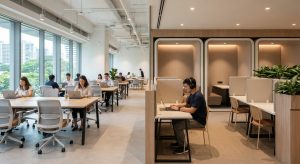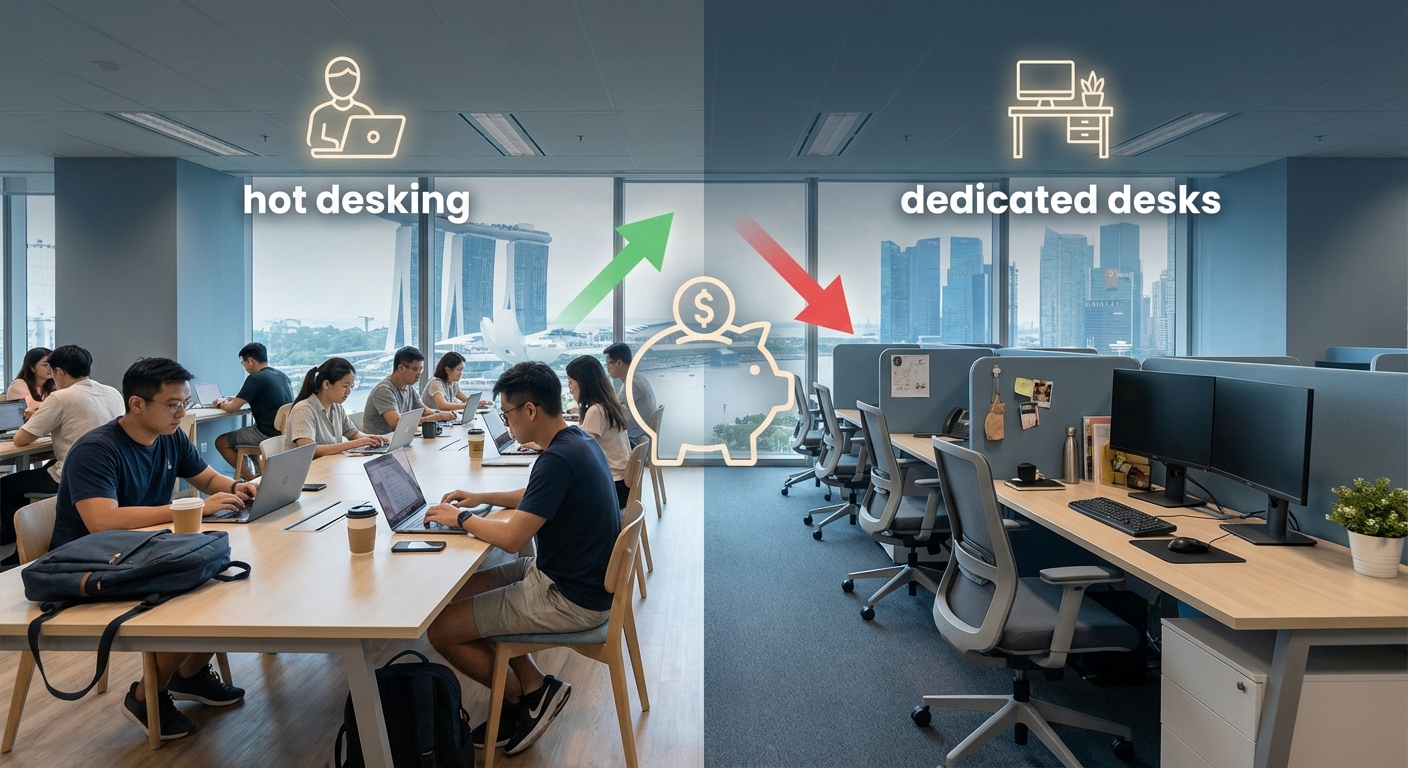
Choosing between a hot desk and a dedicated desk can make or break your coworking budget in Singapore. The difference isn’t just about having your own spot. It’s about understanding how your work patterns translate into real dollars saved or wasted each month.
Hot desks in Singapore cost $200 to $400 monthly, while dedicated desks range from $450 to $800. Hot desking saves money for workers using spaces under 15 days monthly. Dedicated desks become cost-effective for daily users who need consistent storage, privacy, and professional setup. Your actual savings depend on work frequency, equipment needs, and client meeting requirements.
Understanding the real price difference between hot desks and dedicated desks
Hot desks operate on a first-come, first-served basis. You walk in, grab any available seat, and start working. Most Singapore coworking spaces price hot desk memberships between $200 and $400 per month for unlimited access.
Dedicated desks give you the same spot every time. Your monitor stays plugged in. Your notebooks remain on the desk. Your ergonomic chair settings don’t reset daily. These memberships typically cost $450 to $800 monthly in Singapore’s central business district.
The $250 to $400 price gap seems straightforward. But the actual cost comparison gets more interesting when you factor in how often you’ll actually use the space.
A freelance graphic designer working from home three days per week and needing a professional space twice weekly might find hot desking perfect. That’s roughly eight visits monthly. At $25 per day pass, you’d spend $200. A monthly hot desk membership at $300 covers unlimited access, giving flexibility for extra days.
Compare that to a startup founder meeting clients daily, hosting team calls, and needing consistent access to stored materials. Paying $600 for a dedicated desk suddenly makes sense when the alternative involves lugging equipment daily or paying for storage lockers separately.
Breaking down what you actually get with each option
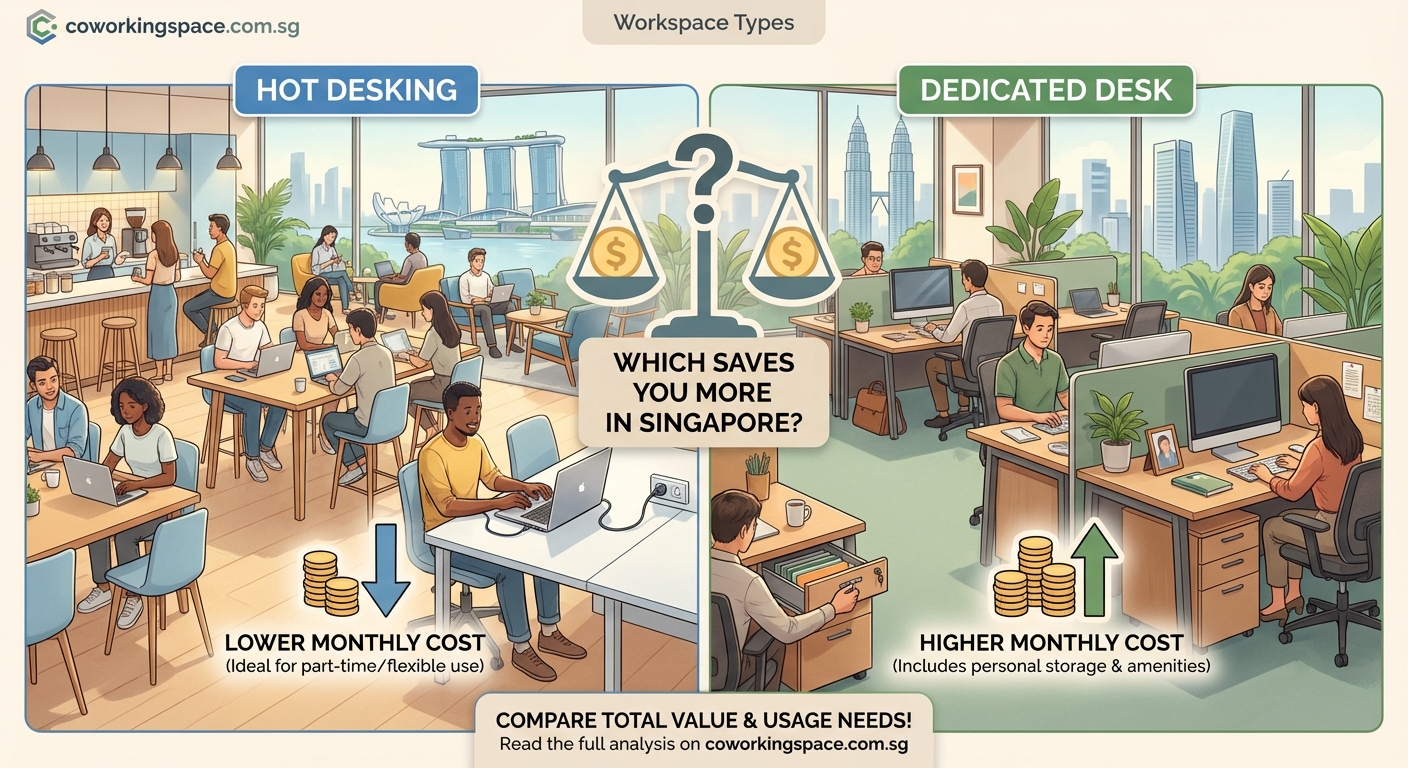
Hot desk memberships include basic access to communal seating areas. You get WiFi, printing credits, and access to common spaces like kitchens and lounges. Some spaces offer phone booths for private calls.
What you don’t get: storage beyond a small locker, the same desk twice, or any guarantee of available seating during peak hours (typically 9 AM to 3 PM on weekdays).
Dedicated desk memberships bundle everything from hot desks, plus your permanent spot, usually more generous storage (often a full pedestal drawer), and the ability to leave equipment overnight. Many spaces throw in a few meeting room hours monthly.
The less obvious benefits matter too. With a dedicated desk, you can set up dual monitors without packing them away. You can leave reference books. Your workspace photos look consistent for video calls. These small conveniences add up for people working with clients who expect professional presentation.
Calculating your break-even point for each membership type
Start by counting how many days monthly you’ll realistically use a coworking space. Be honest. Don’t count the days you’ll work from cafes or stay home.
If you work from a coworking space fewer than 12 days monthly, day passes often cost less than monthly memberships. At $25 per day, 12 visits cost $300. Many hot desk memberships start at $280 to $350, making them worthwhile at 13+ days monthly.
For dedicated desks, the calculation shifts. You’re not just paying for access. You’re paying for consistency and convenience. If you’re using the space 15+ days monthly and need to bring equipment, dedicated desks start making financial sense around the $500 mark.
Here’s a practical example. Sarah, a content strategist, initially chose a hot desk at $320 monthly. She visited 18 days per month but spent 20 minutes daily finding available seating. She also paid $15 monthly for a storage locker to avoid carrying her laptop stand and notebooks daily. After three months, she switched to a $580 dedicated desk. Her effective hourly rate improved because she stopped wasting six hours monthly on setup logistics.
Hidden costs that change the real price comparison
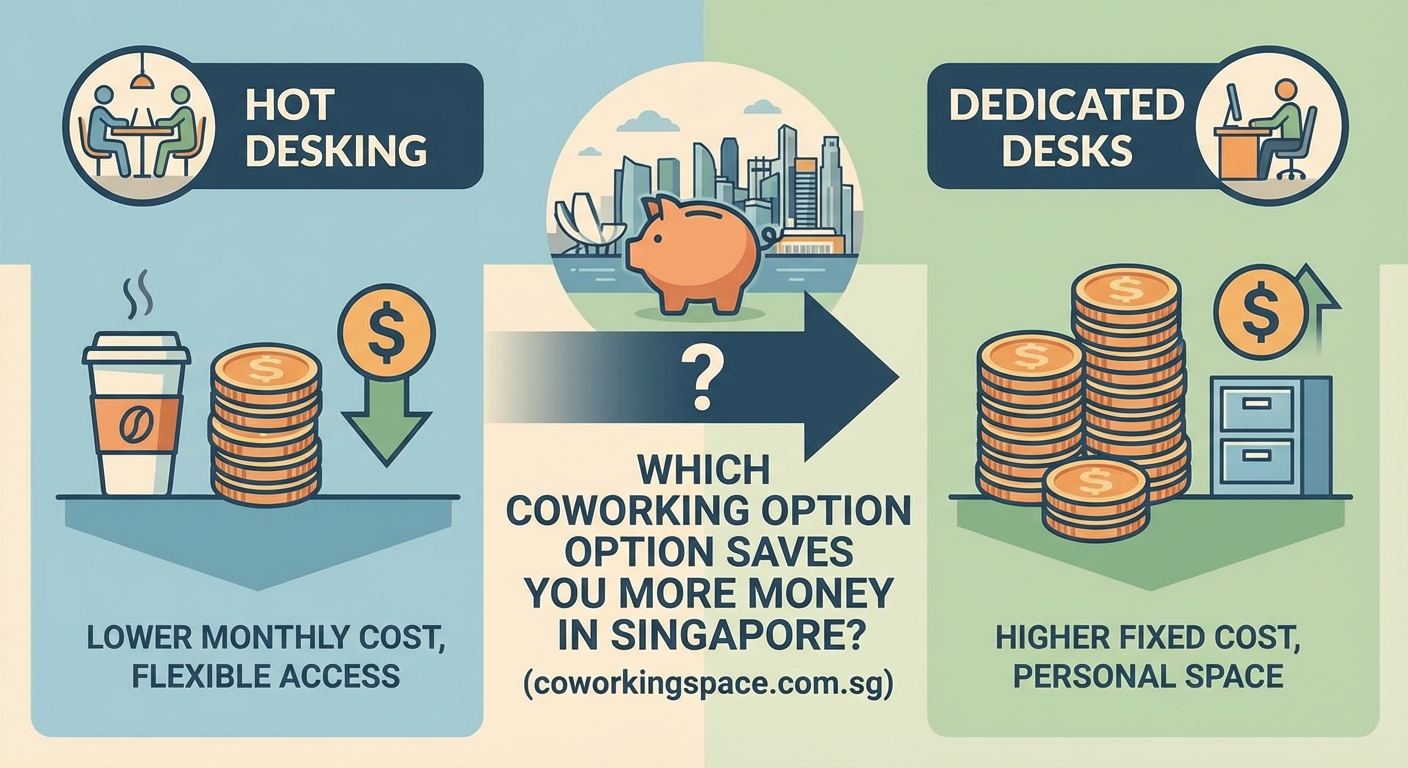
Hot desking seems cheaper until you factor in what you’ll need to replace or supplement.
Storage lockers at most Singapore coworking spaces cost $10 to $25 monthly. If you need to store anything beyond a laptop, this adds up.
Meeting room access gets expensive fast. Hot desk members typically pay $30 to $60 per hour for meeting rooms. Dedicated desk members often get two to four hours monthly included. If you meet clients even twice monthly, that’s $60 to $120 saved.
Equipment wear matters too. Daily packing and unpacking shortens laptop lifespan. Cables fray faster. Adapters get lost. These aren’t huge costs individually, but a $40 replacement cable every few months adds $120+ annually.
Time costs count. Arriving 15 minutes early to secure a good hot desk spot might not seem significant. Over a month, that’s five hours of productive time lost. For someone billing $80 per hour, that’s $400 in opportunity cost.
The budget-friendly coworking spaces in Singapore under $300 per month often compromise on these extras, making the hidden costs even more relevant to your decision.
When hot desking actually saves you more money
Hot desks work brilliantly for specific situations. Remote workers splitting time between home and coworking spaces benefit most. You get professional environment access without paying for space you’re not using.
Freelancers with variable schedules love the flexibility. Some weeks you’re traveling. Other weeks you’re heads down at home. Hot desking lets you pay one flat rate while using the space only when it makes sense.
People testing coworking before committing long-term should start with hot desks. You’ll learn your actual usage patterns before locking into pricier memberships.
Digital nomads staying in Singapore temporarily get maximum value from hot desks. Why pay for a dedicated desk when you’re only in town for six weeks?
The cost advantage holds strongest when you need minimal equipment. If you work entirely from a laptop with cloud storage, hot desking eliminates the main dedicated desk benefits.
When dedicated desks become the better financial choice
Daily users hit the break-even point fast. If you’re in the space 20+ days monthly, dedicated desks offer better value per visit.
Anyone meeting clients regularly needs the consistency. Your Zoom background stays identical. Your professional setup looks polished. Clients notice these details.
Teams benefit enormously from dedicated desks. Having three team members at adjacent dedicated desks costs $1,500 to $2,100 monthly. That’s still far cheaper than traditional office space in Singapore, which runs $4,000+ monthly for similar square footage.
People with specialized equipment setups can’t function with hot desks. Video editors need color-calibrated monitors. Developers want multiple screens. Designers need graphics tablets. These tools don’t travel well.
If you’re building a business that needs a registered address, many dedicated desk memberships include business registration services. Hot desk plans rarely offer this. The $100 to $200 you’d pay separately for virtual office services essentially subsidizes part of your dedicated desk cost.
The understanding coworking membership types: hot desks vs dedicated desks vs private offices guide covers additional scenarios where dedicated desks provide better long-term value.
Comparing actual membership costs across Singapore locations
Central Business District spaces charge premium rates. Hot desks start at $350. Dedicated desks begin around $650.
Suburban locations like Paya Lebar or Kallang offer better rates. Hot desks run $220 to $300. Dedicated desks cost $450 to $600.
Boutique spaces in neighborhoods like Tiong Bahru or Joo Chiat price competitively to attract creative professionals. You’ll find hot desks at $250 and dedicated desks at $500.
Location impacts your commute costs too. A CBD space at $400 monthly might cost you an extra $80 monthly in transport compared to a neighborhood space at $280. Suddenly the “expensive” neighborhood option saves $200 monthly overall.
Consider these real pricing examples from mid-2024:
| Location Type | Hot Desk Range | Dedicated Desk Range | Meeting Room Hours Included |
|---|---|---|---|
| CBD (Raffles Place, Tanjong Pagar) | $350 to $450 | $650 to $850 | 0 to 2 hours (hot desk), 2 to 5 hours (dedicated) |
| Secondary CBD (Paya Lebar, Bugis) | $280 to $380 | $500 to $700 | 0 to 2 hours (hot desk), 2 to 4 hours (dedicated) |
| Suburban (Kallang, Geylang) | $220 to $320 | $450 to $600 | 0 to 1 hour (hot desk), 1 to 3 hours (dedicated) |
| Neighborhood (Tiong Bahru, Katong) | $250 to $350 | $480 to $650 | 0 to 2 hours (hot desk), 2 to 4 hours (dedicated) |
Running the numbers for different work scenarios
Scenario 1: Freelance writer working 10 days monthly
Hot desk at $300 monthly: $30 per visit. Total: $300.
Dedicated desk at $550 monthly: $55 per visit. Total: $550.
Savings with hot desk: $250 monthly, $3,000 annually.
Scenario 2: Startup founder working 22 days monthly with regular client meetings
Hot desk at $320 monthly + $60 for two meeting room hours: $380 total. Per-visit cost: $17.27.
Dedicated desk at $580 monthly with four meeting room hours included: $580 total. Per-visit cost: $26.36.
But the founder needs consistent video call backgrounds and storage for product samples. The dedicated desk prevents $40 monthly in storage fees and saves 10 hours monthly in setup time. At an $80 hourly rate, that’s $800 in opportunity cost saved.
Real savings with dedicated desk: $460 monthly when factoring in time value.
Scenario 3: Remote employee working 15 days monthly, minimal equipment
Hot desk at $300 monthly: $20 per visit.
Dedicated desk at $550 monthly: $36.67 per visit.
This person works from a laptop only. No client meetings. No storage needs.
Savings with hot desk: $250 monthly, $3,000 annually.
Scenario 4: Designer with dual monitor setup, working 18 days monthly
Hot desk at $320 monthly + $20 storage + $30 monthly in equipment wear from daily packing: $370 total.
Dedicated desk at $600 monthly: $600 total.
But the designer wastes 30 minutes daily setting up monitors. That’s nine hours monthly. At $70 hourly rate: $630 in opportunity cost.
Real cost of hot desk: $370 + $630 = $1,000.
Savings with dedicated desk: $400 monthly.
Additional factors that influence your total cost
Contract length affects pricing. Month-to-month memberships cost 10% to 20% more than annual commitments. A hot desk might jump from $300 to $360 monthly without a contract. Dedicated desks might increase from $550 to $660.
Some spaces offer hybrid memberships. You get a dedicated desk three days weekly and hot desk access the other days. These typically cost 60% to 70% of full dedicated desk rates, landing around $350 to $450 monthly.
Peak hour pricing exists at some spaces. If you only need morning access (7 AM to 1 PM), you might find discounted hot desk rates at $200 to $250 monthly. This works perfectly for early risers who prefer home offices in afternoons.
Community events and networking opportunities vary by membership tier. Some spaces reserve premium networking events for dedicated desk members. If you’re building a business where connections matter, this soft benefit has real value.
The how much does it really cost to work from a coworking space in Singapore breakdown covers many of these variable costs in detail.
Testing before committing to either option
Most Singapore coworking spaces offer day passes at $25 to $40. Buy five day passes before committing to any membership. You’ll learn whether hot desking frustrates you or feels liberating.
Try visiting at different times. Morning availability differs drastically from afternoon situations. Peak hours (10 AM to 2 PM) show you the worst-case scenario for hot desk availability.
Bring your full equipment setup on test days. Setting up dual monitors in a hot desk environment reveals whether you’ll tolerate daily setup routines.
Schedule a client video call from the space. You’ll immediately know if the background noise level works for your professional needs.
Track your actual usage for one month using day passes. Multiply your visit count by 1.5 to account for growth. That’s your realistic monthly usage estimate.
Many spaces offer trial weeks at reduced rates. A $50 trial week for hot desking or $100 trial week for dedicated desks lets you experience real conditions before paying full monthly rates.
Negotiating better rates regardless of which option you choose
Singapore coworking spaces negotiate more than you’d expect. Operators want consistent occupancy.
Annual prepayment often unlocks 15% to 20% discounts. A $300 monthly hot desk becomes $3,060 annually instead of $3,600. That’s $540 saved.
Referral programs exist at most spaces. Bring one new member and get a month free. Bring three and some spaces offer permanent 10% discounts.
Off-peak memberships (starting after 1 PM or ending before 11 AM) sometimes get 20% to 30% discounts. A $600 dedicated desk might drop to $420 for afternoon-only access.
Team discounts apply when bringing multiple people. Three hot desk memberships might cost $800 instead of $900. Five dedicated desks might run $2,500 instead of $3,000.
Ask about quarterly promotions. Many spaces run specials during slower months (June, July, December). You might snag a dedicated desk at hot desk pricing for three months, then negotiate to maintain that rate.
The 7 money-saving tips for freelancers using coworking spaces in Singapore article shares additional negotiation strategies that work.
Common mistakes people make when choosing between options
Picking based solely on monthly price ignores total cost of ownership. That cheap hot desk becomes expensive when you factor in wasted time and equipment wear.
Overestimating usage leads to paying for dedicated desks you use 10 days monthly. Be brutally honest about your work patterns.
Underestimating equipment needs causes frustration. If you realize three months in that you need dual monitors, switching from hot desk to dedicated desk often requires waiting for availability.
Ignoring location convenience costs money. A slightly pricier space that’s 15 minutes closer saves 10 hours monthly in commute time. At any reasonable hourly rate, proximity pays for itself.
Forgetting to account for growth hurts later. If you’re building a business, that solo hot desk works today. But six months from now when you hire someone, you’ll wish you’d started with a dedicated desk in a space that accommodates team growth.
Not testing during peak hours gives false impressions. Visiting at 4 PM on a Tuesday shows you an empty, quiet space. Return at 11 AM on a Wednesday for reality.
Switching between membership types as your needs change
Most Singapore coworking spaces allow monthly membership changes with 30 days notice. You’re not locked into your initial choice forever.
Start with a hot desk if you’re uncertain. After two months, you’ll know whether you need to upgrade. Moving from hot desk to dedicated desk is usually straightforward when space allows.
Downgrading from dedicated desk to hot desk requires more planning. You’ll need to clear your desk and return equipment. Some spaces charge early termination fees if you’re on annual contracts.
Seasonal workers benefit from switching. Use a dedicated desk during busy season (three to six months), then drop to hot desk access during slower periods.
The flexibility to switch matters more than making the perfect initial choice. Choose the option that fits your current situation, knowing you can adjust in 30 to 60 days.
Making your final decision based on real numbers
Calculate your true monthly usage. Count actual workdays, not aspirational ones.
List your equipment needs. Laptop-only workers have different requirements than people with monitors, tablets, and specialized tools.
Factor in meeting frequency. Two client meetings monthly changes the cost equation significantly.
Consider your hourly rate. Time wasted on setup and logistics has real dollar value.
Account for growth plans. Where will you be in six months? Switching memberships costs time and sometimes money.
Add up hidden costs. Storage, meeting rooms, equipment wear, and opportunity costs all matter.
Compare total cost of ownership, not just membership fees. A $300 hot desk that costs you $200 monthly in inefficiency isn’t cheaper than a $550 dedicated desk that maximizes your productivity.
“The cheapest membership option rarely delivers the best value. Calculate your total cost including time, convenience, and hidden fees. Most people underestimate how much daily setup routines cost them in lost productivity and mental energy.” – Workspace consultant with 12 years helping Singapore professionals choose coworking options
Your workspace choice impacts more than just your budget
The hot desk versus dedicated desk decision shapes your daily work experience. Hot desking offers flexibility and lower costs for occasional users. Dedicated desks provide consistency and better value for daily workers.
Your actual savings depend on honest assessment of your work patterns, equipment needs, and how you value your time. Run the numbers with your specific situation. Include the hidden costs most people miss.
Start with a trial period before committing long-term. Your real-world experience will reveal whether saving $200 monthly on a hot desk matters more than the convenience and productivity gains from a dedicated space. Both options work brilliantly for the right person. Make sure you’re choosing based on your actual needs, not just the advertised price.