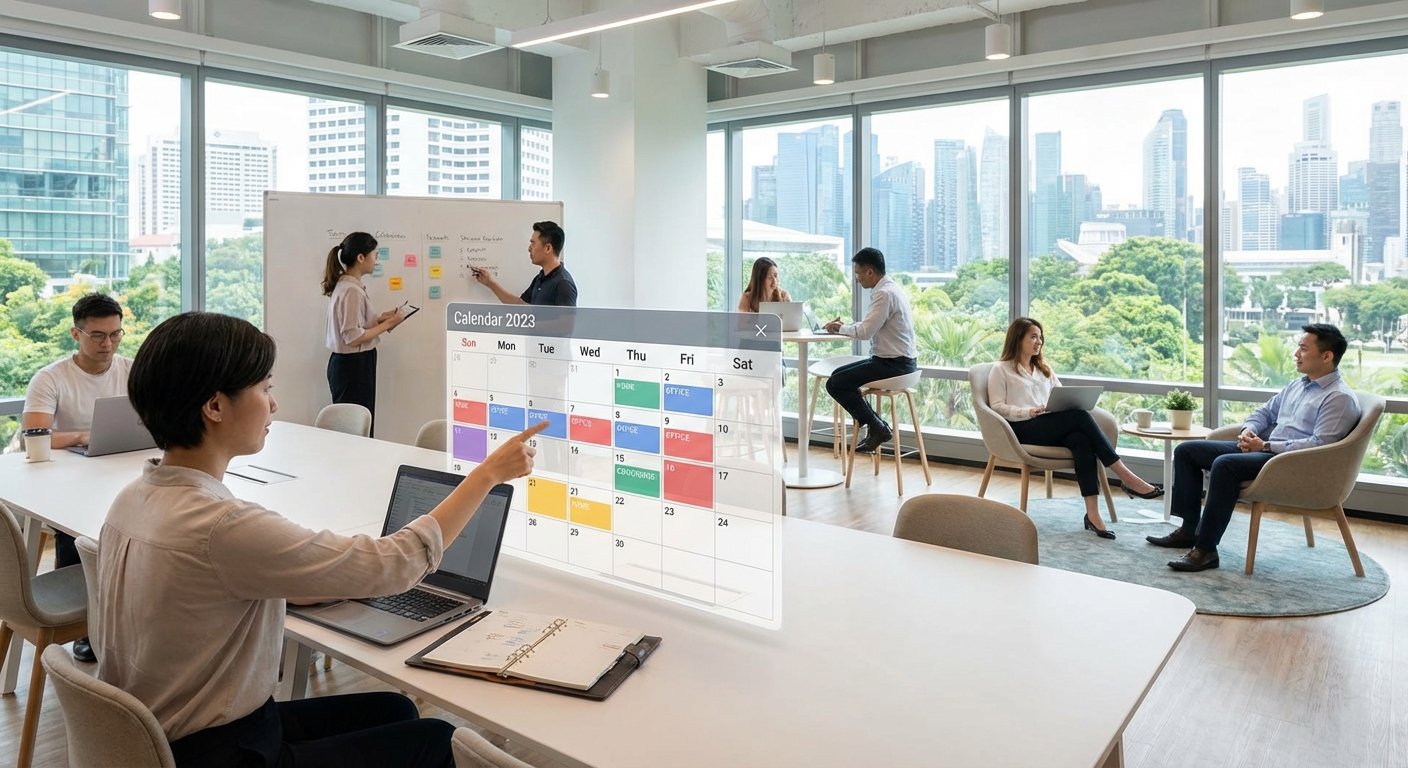
Building a hybrid work schedule feels like solving a puzzle with pieces that keep changing shape. Your team wants flexibility. Your budget demands efficiency. Your company culture needs consistency. And you’re trying to make it all work without a traditional office lease.
Coworking spaces offer a practical middle ground. They give your hybrid team professional workspace when needed, without the overhead of a permanent office. But throwing people into a shared workspace without a clear schedule creates chaos, not collaboration.
A successful hybrid work schedule coworking space strategy requires three elements: clear team anchor days for collaboration, flexible individual work arrangements, and transparent booking systems. When implemented properly, this approach reduces office costs by 40-60% while maintaining team cohesion. The key is treating coworking space access as a strategic resource, not just a desk rental.
Understanding what hybrid work actually means for your team
Hybrid work isn’t just “sometimes office, sometimes home.” It’s a deliberate system where work location matches work type.
Your marketing team might need face time for brainstorming. Your developers might prefer deep focus at home. Your sales team might want client-facing meeting rooms on demand.
The mistake most managers make is creating a one-size-fits-all schedule. Monday, Wednesday, Friday in the office. Tuesday, Thursday at home. Everyone follows the same pattern regardless of their actual work needs.
This approach fails because it ignores how different roles require different environments. A content writer crushing deadlines needs quiet. A product team launching a feature needs whiteboard space and energy.
Why coworking spaces are perfect for hybrid teams in Singapore offers flexibility that traditional offices can’t match. You’re not locked into a five-year lease for space you might not need.
Step-by-step process for building your hybrid schedule
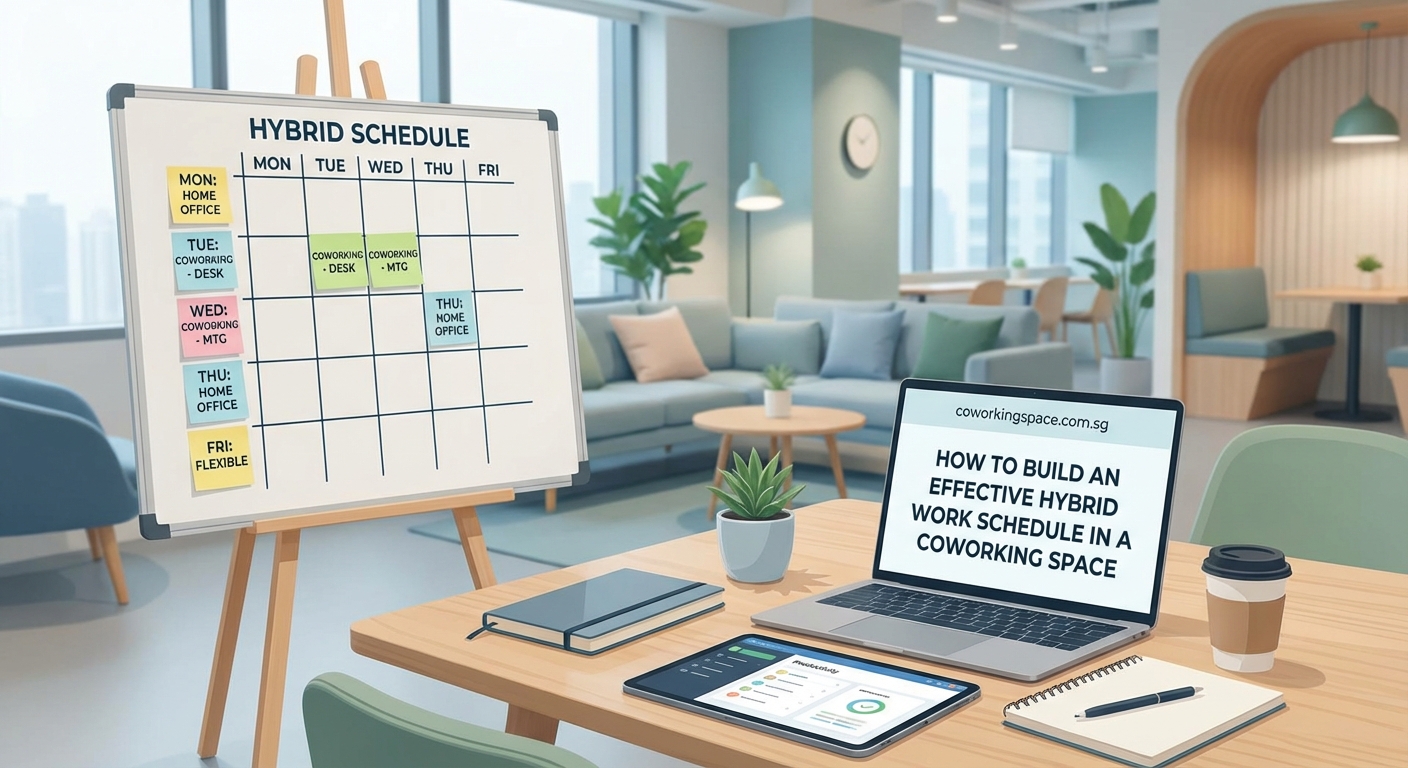
Creating an effective schedule takes more than picking random days for office attendance. Here’s how to do it properly.
-
Audit your team’s actual collaboration needs. Track how often people need to work together in person. Look at meeting patterns, project timelines, and communication bottlenecks from the past quarter.
-
Identify your anchor days. These are non-negotiable in-person days when the whole team (or department) shows up. Most successful hybrid teams use 1-2 anchor days per week.
-
Map individual flexibility windows. Between anchor days, let people choose their location based on task requirements. Writing proposals? Home. Client presentations? Coworking space.
-
Set booking lead times. Require team members to reserve coworking space at least 48 hours in advance. This prevents the “everyone shows up on the same day” problem.
-
Build in schedule reviews. Every six weeks, assess what’s working and what isn’t. Adjust anchor days, change booking policies, or shift team arrangements based on real data.
-
Create clear communication protocols. Everyone should know where teammates are working each day. Use a shared calendar or Slack status to eliminate the “where is everyone?” confusion.
“The best hybrid schedules are boring and predictable. Your team shouldn’t spend mental energy figuring out where to work. They should spend it doing actual work.” – Operations Director at a 50-person tech startup
Choosing the right coworking membership structure
Not all coworking memberships work for hybrid teams. The wrong choice wastes money or creates access problems.
Here’s what different membership types actually mean for your schedule:
| Membership Type | Best For | Scheduling Flexibility | Cost Efficiency |
|---|---|---|---|
| Hot desks | Teams under 10 people with unpredictable schedules | High | Best for 2-3 days/week |
| Dedicated desks | Consistent 3-4 day/week users who need personal space | Medium | Break-even at 3 days/week |
| Private offices | Teams needing secure space or daily access | Low | Only cost-effective at 4+ days/week |
| Day passes | Occasional users or testing phase | Maximum | Expensive beyond 1 day/week |
| Team packages | 5+ people with synchronized schedules | Medium | Best value for anchor day models |
Most hybrid teams get the best value from a combination approach. Core team members get dedicated desks for anchor days. Others use day passes for their flexible days.
Understanding coworking membership types: hot desks vs dedicated desks vs private offices helps you match membership structure to actual usage patterns.
The math matters here. If you’re paying for dedicated desks but people only show up twice a week, you’re burning money. If you’re using day passes for regular attendance, you’re overpaying by 30-40%.
Avoiding the common scheduling mistakes that kill productivity

Most hybrid schedules fail in predictable ways. Here’s what to watch for.
The empty office problem: You book space for 10 people. Three show up. The others forgot, got sick, or had client meetings. Now you’re paying for unused desks while your team works from scattered coffee shops.
Solution: Implement a 24-hour cancellation policy. If someone can’t make their scheduled day, they must notify the team and cancel their booking. This frees up space for others.
The overcrowding disaster: Everyone decides Wednesday is the best day. Your coworking space becomes standing room only. People can’t find desks. Meeting rooms are booked solid.
Solution: Cap attendance per day. If your team is 15 people, limit coworking days to 8-10 people maximum. Rotate who gets priority each week.
The collaboration gap: Your anchor days don’t actually generate collaboration. People show up, sit at separate desks, wear headphones, and work independently. You’re paying for proximity, not productivity.
Solution: Schedule specific collaboration activities on anchor days. Team standups at 10am. Lunch together at 1pm. Project reviews at 3pm. Give people reasons to interact.
The timezone confusion: Your Singapore team overlaps with clients in New York and London. Half your team needs to be available for early morning calls. The other half handles evening meetings.
Solution: Create timezone-based scheduling blocks. Early birds book Monday/Tuesday for US overlap. Night owls take Thursday/Friday for Asia-Pacific focus. Wednesday becomes the anchor day when everyone’s available during core hours.
What companies should know before implementing hybrid work policies covers the legal and HR considerations most managers miss.
Making coworking space amenities work for your schedule
The amenities matter more than you think. A coworking space with poor meeting room access kills your hybrid schedule before it starts.
Your team needs:
- Reliable meeting rooms that you can book in advance, not fight for each morning
- Enough power outlets so people aren’t hunting for charging spots
- Stable internet that handles video calls without dropping
- Phone booths for private conversations that don’t disturb others
- Kitchen facilities so people can eat lunch without leaving for an hour
- Printing access for the contracts and documents that still require physical signatures
Meeting room booking systems: what to expect at Singapore coworking spaces explains how different spaces handle reservations.
The booking system itself becomes part of your schedule. If your coworking space uses a clunky reservation platform, people will skip booking and show up hoping for availability. That creates the overcrowding problem.
Look for spaces with:
- Mobile app booking (not just desktop)
- Real-time availability updates
- Calendar integration with Google or Outlook
- Automatic reminders 24 hours before your booking
- Easy cancellation and rescheduling
Measuring whether your hybrid schedule actually works
You need concrete metrics, not gut feelings about whether your schedule is effective.
Track these numbers monthly:
-
Space utilization rate: How many booked desks actually get used? Target 80-90%. Below 70% means people aren’t showing up. Above 95% means you’re undersupplying space.
-
Collaboration frequency: How often do team members interact during anchor days? Count actual conversations, not just proximity. Target at least 3-4 meaningful interactions per person per anchor day.
-
Cost per person per month: Divide your total coworking costs by the number of people using the space. Compare this to traditional office costs in your area. You should save 40-60%.
-
Employee satisfaction: Survey your team quarterly. Ask specific questions: “Do you have enough in-person time with teammates?” “Is the schedule predictable?” “Can you do your best work with this arrangement?”
-
Meeting room utilization: What percentage of your booked meeting time actually gets used? Target 70-85%. Lower means people are over-booking as insurance. Higher means you need more meeting capacity.
Are coworking spaces worth the cost? Breaking down the true value provides a framework for calculating real ROI.
If your metrics show problems, adjust fast. Don’t wait for quarterly reviews. Change anchor days, modify booking policies, or switch membership types based on what the data tells you.
Handling the edge cases that test your system
Perfect schedules look great on paper. Real life throws curveballs.
New hire onboarding: New team members need more in-person time during their first month. Build this into your schedule by reserving dedicated desk access for the first 30 days. After that, they transition to the standard hybrid arrangement.
Project crunch periods: When your team is pushing toward a deadline, you might need everyone in the same space for a week. Keep a budget buffer for temporary private office rentals during these periods.
Team size changes: Your 8-person team becomes 15 people. Your coworking membership structure no longer fits. Review your space needs every time you add or lose 3+ people.
Location preferences: Some team members live near one coworking location. Others prefer a different neighborhood. Consider multi-location memberships if your coworking provider has several branches.
International team members: Your Singapore-based hybrid team includes someone working from Kuala Lumpur or Bangkok. They can’t attend anchor days in person. Set up virtual anchor day participation with dedicated video conference time.
5 common coworking mistakes that new members make (and how to avoid them) helps you anticipate problems before they become crises.
Building team culture when people aren’t always together
The biggest hybrid work challenge isn’t logistics. It’s maintaining team cohesion when people work in different locations on different days.
Your hybrid schedule needs intentional culture-building moments:
- Start anchor days with a 15-minute team standup where everyone shares what they’re working on
- End anchor days with a casual social hour (no work talk allowed)
- Rotate lunch partners so people connect with different teammates each anchor day
- Create a shared Slack channel for “coworking space photos” where people post pictures of their setup, coffee, or workspace views
- Celebrate wins in person, not just over Slack
The teams that succeed with hybrid work treat anchor days as special. They’re not just “office days.” They’re the moments when your distributed team becomes a real team again.
The psychology behind coworking: why shared spaces boost productivity explains the social dynamics that make coworking effective for team building.
Technology that makes hybrid scheduling actually manageable
You can’t run a hybrid schedule with spreadsheets and hope. You need proper tools.
Essential technology stack for hybrid teams:
- Scheduling platform: Tools like Officely, Robin, or Kadence let people book desks, see who’s coming in, and coordinate schedules
- Calendar integration: Your coworking bookings should appear automatically in everyone’s work calendar
- Team availability dashboard: A simple shared view showing who’s working where each day
- Meeting room booking: Separate from desk booking, with automatic reminders and check-in requirements
- Communication hub: Slack channels or Teams groups dedicated to schedule coordination
The goal is removing friction. If booking a coworking desk takes more than 60 seconds, people won’t do it consistently.
7 essential tools remote workers need when using coworking spaces covers the personal productivity tools that complement your team systems.
Creating schedule flexibility without creating chaos
Flexibility is why people want hybrid work. But unlimited flexibility creates coordination nightmares.
The solution is structured flexibility. Give people choice within boundaries.
Here’s a framework that works:
Fixed elements:
– Anchor days (everyone must attend)
– Core hours (10am to 3pm, everyone available regardless of location)
– Weekly team meeting time (same day, same time, every week)
– Monthly all-hands (in person, scheduled 3 months in advance)
Flexible elements:
– Which non-anchor days people work from the coworking space
– Start and end times (within reason)
– Which coworking location they use (if multiple options exist)
– Whether they work from home or a coffee shop on non-anchor days
This structure gives people autonomy while maintaining predictability. Your team knows when they’ll see each other. They know when everyone’s available. But they still control their daily routine.
Adapting your schedule as your team grows
A schedule that works for 5 people breaks at 15 people. What works for 15 people becomes unwieldy at 30.
Plan for growth from the start:
5-10 people: Single anchor day works fine. Everyone can fit in a small team area. Informal coordination through Slack.
10-20 people: Move to two anchor days or split into sub-teams with different anchor days. Need dedicated meeting room access. Formal booking system required.
20-50 people: Multiple teams with different schedules. Some teams might need private office space. Sophisticated scheduling platform necessary. Dedicated operations person to manage bookings.
50+ people: Consider multiple coworking locations or a hybrid of coworking plus small permanent office. Separate scheduling by department. Full-time facilities coordinator.
What makes a coworking space different from a traditional office? helps you understand when to stick with coworking versus transitioning to traditional office space.
The key is reviewing your structure every time you double in size. What worked for your startup doesn’t work for your scale-up.
Making your hybrid schedule sustainable long-term
The first month of a new hybrid schedule always feels fresh and exciting. The challenge is maintaining it for years.
Sustainability requires:
Regular schedule audits: Every quarter, review utilization data and team feedback. Make small adjustments before small problems become big ones.
Budget flexibility: Your coworking costs will fluctuate. Build in 15-20% buffer for growth, special projects, and unexpected needs.
Clear ownership: Someone on your team needs to own the hybrid schedule. This isn’t an “everyone’s responsibility” situation. Assign it to an operations person or team lead.
Documentation: Write down your scheduling policies, booking procedures, and decision-making criteria. When new people join, they should be able to understand the system in 10 minutes.
Feedback loops: Create easy ways for team members to suggest improvements. Monthly anonymous surveys work better than annual reviews.
Remote work burnout: how coworking spaces can help you recover addresses the mental health considerations that impact schedule sustainability.
When your hybrid schedule needs a complete reset
Sometimes your schedule isn’t working and small tweaks won’t fix it. You need a full reset.
Signs you need to start over:
- Space utilization consistently below 60%
- Team members regularly skip anchor days
- Complaints about the schedule outnumber positive feedback
- Your costs are higher than a traditional office would be
- People actively avoid coming to the coworking space
If you’re seeing three or more of these signs, don’t try to patch the system. Start fresh.
Run a reset workshop with your team:
- Review what isn’t working (30 minutes of honest feedback)
- Identify non-negotiable requirements (what must the new schedule include?)
- Brainstorm alternative structures (no idea is too radical)
- Test a new approach for 30 days
- Gather feedback and iterate
The teams that succeed with hybrid work aren’t the ones who get it perfect on the first try. They’re the ones who adapt when something isn’t working.
Making hybrid work actually work for your team
A hybrid work schedule coworking space strategy isn’t about finding the perfect formula. It’s about building a system that matches your team’s actual needs, then adjusting as those needs change.
Start with clear anchor days. Add structured flexibility. Use the right coworking membership type. Track real metrics. And most importantly, listen when your team tells you something isn’t working.
The goal isn’t to recreate a traditional office with more steps. It’s to give your team the environment they need to do their best work, whether that’s collaborative space twice a week or focused home time with occasional team connection.
Your first schedule won’t be perfect. That’s fine. Build something good enough to start, then make it better based on what you learn. Three months from now, you’ll have a system that actually works for your specific team, not a generic template from someone else’s playbook.