
Choosing your first coworking space in Singapore can feel overwhelming. You’re staring at dozens of listings, each promising the perfect work environment, but you’re not sure what actually matters for your specific situation.
The good news? You don’t need to be an expert to make a smart choice. You just need to know what questions to ask and which factors will genuinely affect your daily work life. This guide walks you through every decision point, from understanding membership types to evaluating locations, so you can confidently pick a space that supports your productivity and fits your budget.
Choosing your first coworking space in Singapore requires evaluating location convenience, membership flexibility, essential amenities, community culture, and total costs. Start with trial days to test the environment, prioritize internet reliability and workspace comfort, and select a membership type that matches your actual usage patterns. The right space should reduce your commute time, support your work style, and provide room to scale as your needs change.
Understanding membership types before you commit
Your membership type shapes everything from your daily routine to your monthly expenses.
Hot desks give you access to any available seat in a shared area. You show up, find an open spot, and get to work. This flexibility works well if you travel frequently or only need workspace a few days per week.
Dedicated desks provide a permanent station that’s yours alone. Your monitor stays plugged in, your notebooks remain stacked exactly where you left them, and you never waste time hunting for a seat during peak hours.
Private offices give you an enclosed room with a door you can close. Teams use these for confidential calls, and solo workers who need absolute quiet often find the investment worthwhile.
Each option comes with different price points and trade-offs. Understanding coworking membership types helps you match your work patterns to the right setup.
Location matters more than you think
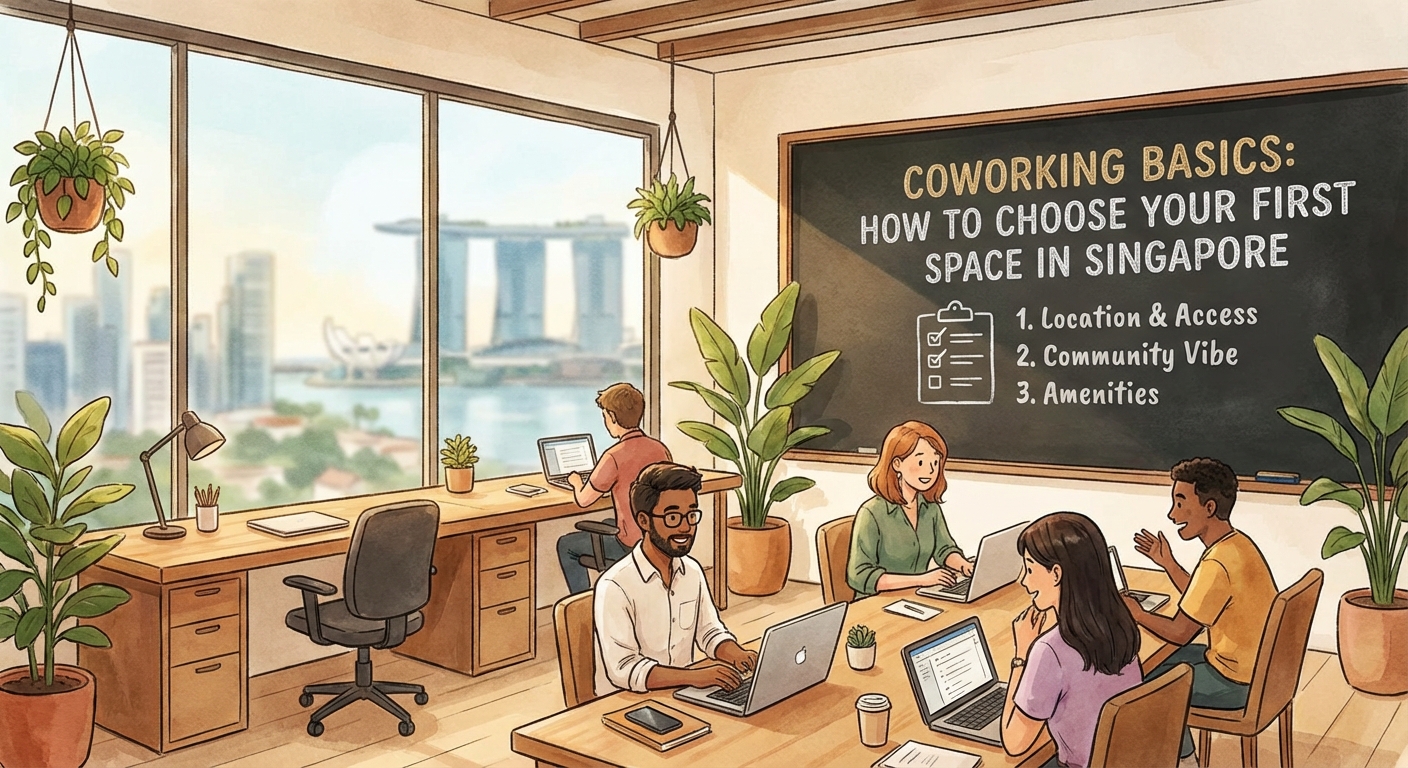
Your coworking space location affects your energy levels, punctuality, and willingness to actually show up.
Calculate your door-to-door commute time, not just the MRT distance. A space that’s “only two stops away” might require a 15-minute walk from the station, turning a theoretical 10-minute commute into 35 minutes each way.
Consider these location factors:
- Proximity to clients if you host regular in-person meetings
- Access to lunch options that fit your budget and dietary needs
- Evening safety if you work late hours
- Parking availability if you drive
- Backup transportation options when the MRT has delays
Central business districts like Raffles Place offer prestige and client convenience but come with premium pricing. Neighborhoods like Tiong Bahru or Paya Lebar provide lower costs while maintaining good connectivity.
Test your commute during actual working hours before signing anything. A route that feels manageable at 11 AM might become frustrating during morning rush hour.
Essential amenities you cannot compromise on
Some amenities sound nice but aren’t critical. Others will make or break your productivity.
Internet speed and reliability sit at the top of the non-negotiable list. Ask about the connection speed, whether it’s fiber, and if bandwidth gets throttled during peak hours. A coworking space with unreliable WiFi wastes your time and damages your professional reputation when video calls drop.
Ergonomic seating prevents the back pain and neck strain that develop after months of poor posture. Standing desks and ergonomic chairs make a measurable difference in your physical comfort during long work sessions.
Meeting room access becomes crucial when you need private space for client calls or team discussions. Check the booking system, cancellation policies, and whether your membership includes any complimentary hours.
Power outlets should be plentiful and conveniently located. Hunting for charging spots or using extension cords stretched across walkways signals poor space planning.
Climate control affects your concentration more than you realize. Spaces that run too cold or too warm make it harder to focus for extended periods.
| Essential Amenity | Why It Matters | What to Check |
|---|---|---|
| Internet Speed | Supports video calls and file transfers | Minimum 100 Mbps, fiber connection |
| Ergonomic Furniture | Prevents physical strain | Adjustable chairs, desk height options |
| Meeting Rooms | Enables private conversations | Booking availability, soundproofing |
| Power Access | Keeps devices charged | Outlets at every desk, no adapters needed |
| Climate Control | Maintains focus | Individual temperature zones, good ventilation |
Must-have amenities extend beyond basics to include printing access, lockers, and kitchen facilities that support your daily workflow.
How to evaluate community and culture fit

The people around you shape your work experience more than the furniture does.
Some spaces attract tech startups and developers. Others cater to creative professionals, consultants, or finance workers. The dominant industry mix influences conversation topics, networking opportunities, and even the noise level.
Visit during your typical working hours to observe the actual atmosphere. A space might look perfect in photos but feel chaotic or uncomfortably quiet in person.
Watch for these culture indicators:
- How members interact in common areas
- Whether people take phone calls at their desks or move to designated zones
- The balance between focused work and social activity
- How staff respond to member requests
- Whether the community skews toward solo workers or teams
Finding your tribe becomes easier when you understand what professional environment helps you thrive.
Introverts and extroverts have different community needs. Realistic networking expectations help you assess whether a space’s social culture will energize or drain you.
Your step-by-step selection process
Follow this systematic approach to narrow down your options and make a confident decision.
-
List your absolute requirements based on your work style, budget, and location constraints. Separate must-haves from nice-to-haves.
-
Research 5 to 7 spaces that meet your basic criteria. Check their websites, read member reviews, and note their membership options and pricing.
-
Schedule tours at your top 3 choices. Visit during the hours you’d actually work there to see the space at its busiest.
-
Request trial days or day passes before committing to a monthly membership. One full workday reveals issues that a 30-minute tour might miss.
-
Test critical features during your trial. Make video calls to check audio quality. Work for several hours to evaluate desk comfort. Use the meeting rooms and kitchen facilities.
-
Calculate total monthly costs including membership fees, transportation, lunch expenses, and any additional charges for printing or meeting room usage.
-
Review contract terms carefully. Note the minimum commitment period, cancellation requirements, and policies for upgrading or downgrading your membership.
The biggest mistake new members make is choosing a space based on aesthetics alone. A beautiful space that doesn’t support your actual work needs becomes an expensive distraction. Test the practical elements that affect your daily productivity before signing anything.
Common mistakes that waste your money and time
New coworking members often overlook these critical factors until problems emerge.
Choosing a membership tier based on aspirational usage rather than realistic patterns leads to overspending. If you genuinely work from home three days per week, a full-time dedicated desk costs more than you need.
Ignoring peak hour crowding creates frustration when you can’t find a hot desk seat or book a meeting room during critical hours. Visit during 10 AM to 3 PM on weekdays to see actual capacity.
Underestimating noise sensitivity causes ongoing distraction. Open plan spaces generate ambient sound from conversations, keyboard typing, and phone calls. Staying focused in shared workspaces requires either high tolerance or access to quiet zones.
Skipping the contract fine print leads to surprise charges or restrictive cancellation terms. Some spaces require 30 days notice, while others lock you in for three or six months.
Common coworking mistakes extend beyond these basics to include networking missteps and productivity pitfalls.
| Mistake | Why It Happens | How to Avoid It |
|---|---|---|
| Overcommitting to full-time membership | Optimistic usage estimates | Track current work patterns for two weeks first |
| Choosing based on photos alone | Spaces look different in person | Always visit during working hours |
| Ignoring commute reality | Underestimating door-to-door time | Test the full journey during rush hour |
| Skipping trial days | Pressure to decide quickly | Insist on testing before long-term commitment |
| Focusing only on price | Missing hidden costs | Calculate total monthly expenses |
Budget considerations beyond the membership fee
The membership price represents just one component of your total coworking costs.
Transportation expenses add up quickly. A space that costs $50 less per month but requires an extra 30 minutes of commute time each way might not save you money when you factor in transportation costs and lost productive hours.
Food and beverage costs vary by location. Central business districts offer convenient options but at premium prices. Some spaces include coffee and snacks, while others charge for everything.
Printing and meeting room usage often incur additional fees. Check whether your membership includes any complimentary allocation or if you’ll pay per page and per hour.
Locker rental might cost extra if you want secure storage for personal items or work equipment.
Budget-friendly options exist across Singapore if you prioritize cost efficiency over premium locations.
Understanding what to budget beyond membership fees prevents financial surprises three months into your commitment.
Questions to ask during your space tour
The right questions reveal information that standard tours might gloss over.
Ask about internet reliability and what happens during outages. Request the actual measured speed, not just the advertised tier.
Inquire about the busiest hours and whether hot desk availability becomes an issue. Some spaces oversell capacity, leaving members scrambling for seats.
Check meeting room booking procedures. How far in advance can you reserve? What’s the cancellation policy? Are there blackout periods during popular times?
Request details about the community. What industries do most members represent? Does the space host networking events? Are these optional or do they create disruption during working hours?
Clarify the membership terms. What’s the minimum commitment? How much notice do you need to give for cancellation? Can you upgrade or downgrade easily?
Ask about security measures. How do members access the building after hours? Are there lockers? What happens if equipment goes missing?
Find out about upcoming changes. Will the space undergo renovations? Are membership prices scheduled to increase? Is the operator expanding or consolidating locations?
Testing a space before you commit
Trial periods protect you from expensive mistakes.
Most reputable coworking spaces offer day passes or week-long trials. Use this time strategically to evaluate factors that only become apparent during actual work.
Arrive at your normal working time and stay for a full day. Notice whether the space feels energizing or draining after six or seven hours.
Test the internet by uploading large files and joining video calls. Check whether connection quality degrades during peak hours when everyone’s online.
Work from different areas if you’re considering a hot desk membership. Some zones might have better lighting, less noise, or more comfortable furniture.
Use the facilities you’ll need regularly. Book a meeting room, make copies, prepare lunch in the kitchen, and test the coffee quality if that matters to you.
Talk to existing members if possible. Ask about their experience, what they wish they’d known before joining, and whether the space has improved or declined over time.
Flexibility for changing needs
Your work situation will evolve, and your coworking space should adapt with you.
New freelancers might start with a hot desk and need a dedicated desk as their client base grows. Startups often begin with a single desk and expand to a private office as they hire team members.
Choose operators that make transitions straightforward. Some spaces let you upgrade mid-month with prorated charges, while others force you to wait until your contract renewal.
Hybrid workspace memberships provide flexibility for workers who split time between multiple locations.
Consider whether the operator has multiple locations if you might need to work from different neighborhoods. Multi-location access adds value for members who travel around Singapore regularly.
Making your final decision with confidence
You’ve toured spaces, tested facilities, and calculated costs. Now it’s time to commit.
Trust your gut reaction about the space’s atmosphere. If something feels off during your trial, that discomfort won’t disappear after you sign a contract.
Prioritize the factors that affect your daily work over impressive but rarely used amenities. A space with a stunning rooftop terrace doesn’t help if you never have time to use it.
Start with a shorter commitment if possible. Three months gives you enough time to truly evaluate a space without trapping you in a year-long contract if it doesn’t work out.
Keep your backup options in mind. Know which spaces you’d move to if your first choice doesn’t meet expectations.
Whether coworking spaces are worth the cost depends on how well you match your needs to the right space and membership type.
Your workspace sets the foundation for everything else
The coworking space you choose becomes your professional home base. It influences your productivity, professional network, and daily satisfaction with your work life.
Take the time to evaluate options thoroughly rather than rushing into the first available membership. A few extra days of research and trial visits save months of frustration and wasted money.
Remember that your first choice doesn’t have to be your permanent choice. Many successful freelancers and entrepreneurs try two or three spaces before finding their ideal fit. Each experience teaches you more about what you actually need versus what sounds appealing in theory.
Start your search with clear priorities, test spaces during real working conditions, and choose a membership that matches your current situation with room to grow. Your perfect coworking space is out there, and now you know exactly how to find it.