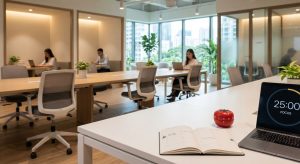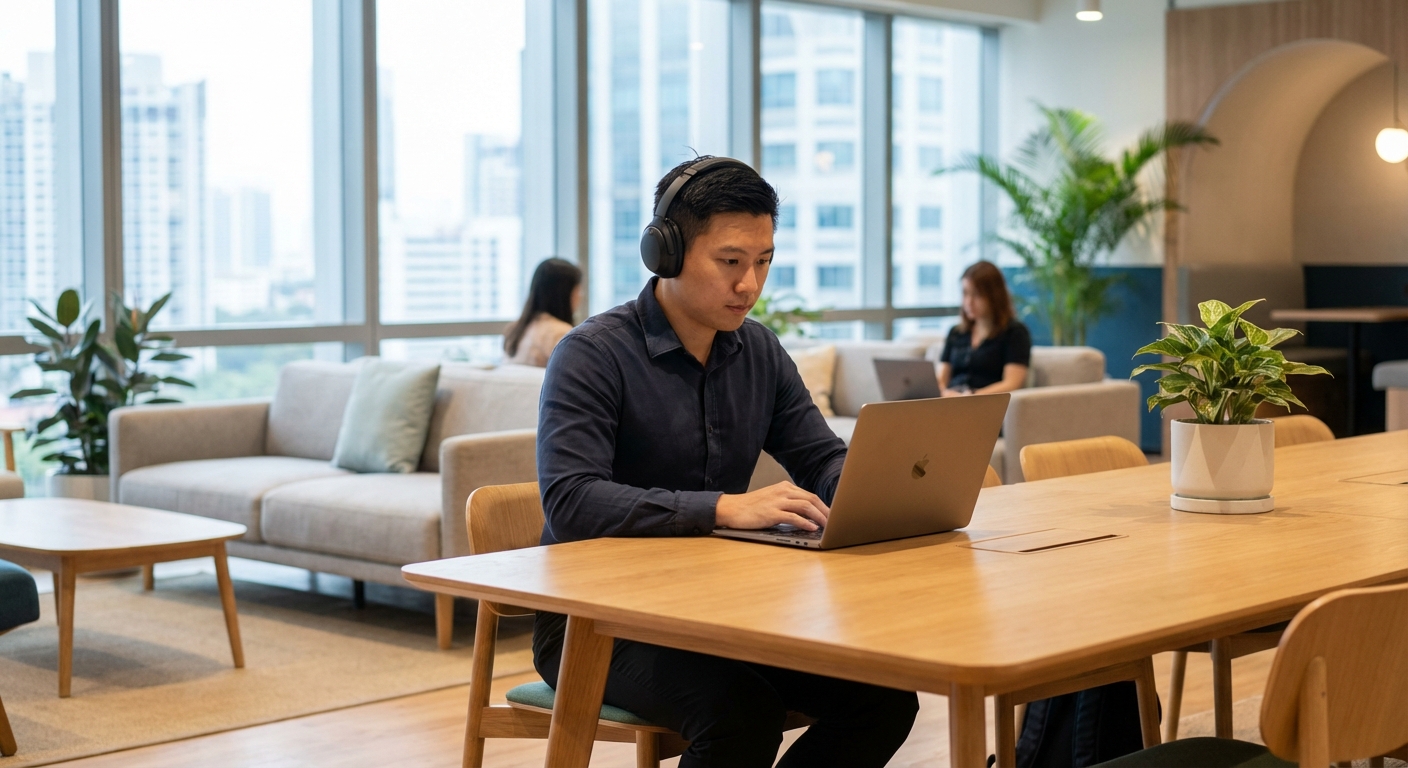
Shared workspaces offer flexibility and community, but they also come with noise, movement, and constant interruptions. You sit down with your laptop, ready to tackle a big project, and suddenly someone’s on a video call two desks away while another member chats loudly near the coffee station. Your concentration shatters before you’ve even started.
The good news? You can train yourself to work productively in almost any environment. It takes the right combination of environmental design, personal habits, and mental techniques. Let me show you how.
Staying focused in shared workspaces requires a three-part approach: controlling your physical environment through strategic seating and noise management, building consistent work routines that signal focus time to your brain, and developing mental resilience through techniques like time blocking and mindful transitions. Most distractions can be minimized with the right tools and habits, allowing you to maintain productivity even in busy coworking environments.
Choose your workspace location strategically
Not all desks in a coworking space are created equal. Your physical location dramatically impacts your ability to concentrate.
Position yourself away from high-traffic areas. Avoid spots near entrances, kitchens, printers, or meeting rooms. These zones generate constant movement and noise that pulls your attention away from work.
Corner desks and wall-facing positions work best for most people. You eliminate visual distractions from behind while controlling what appears in your peripheral vision. When you face a wall, your brain has fewer stimuli to process.
Some coworking spaces offer designated quiet zones. Use them. These areas typically enforce stricter noise policies and attract members who value concentration over collaboration. If your space doesn’t have quiet zones, choosing between open workspace and quiet zones becomes even more important when selecting your membership.
Test different spots during your first week. Morning light might energize you, or it might create screen glare. A desk near windows could feel inspiring or overstimulating. Pay attention to how your productivity changes based on location.
Master noise management techniques
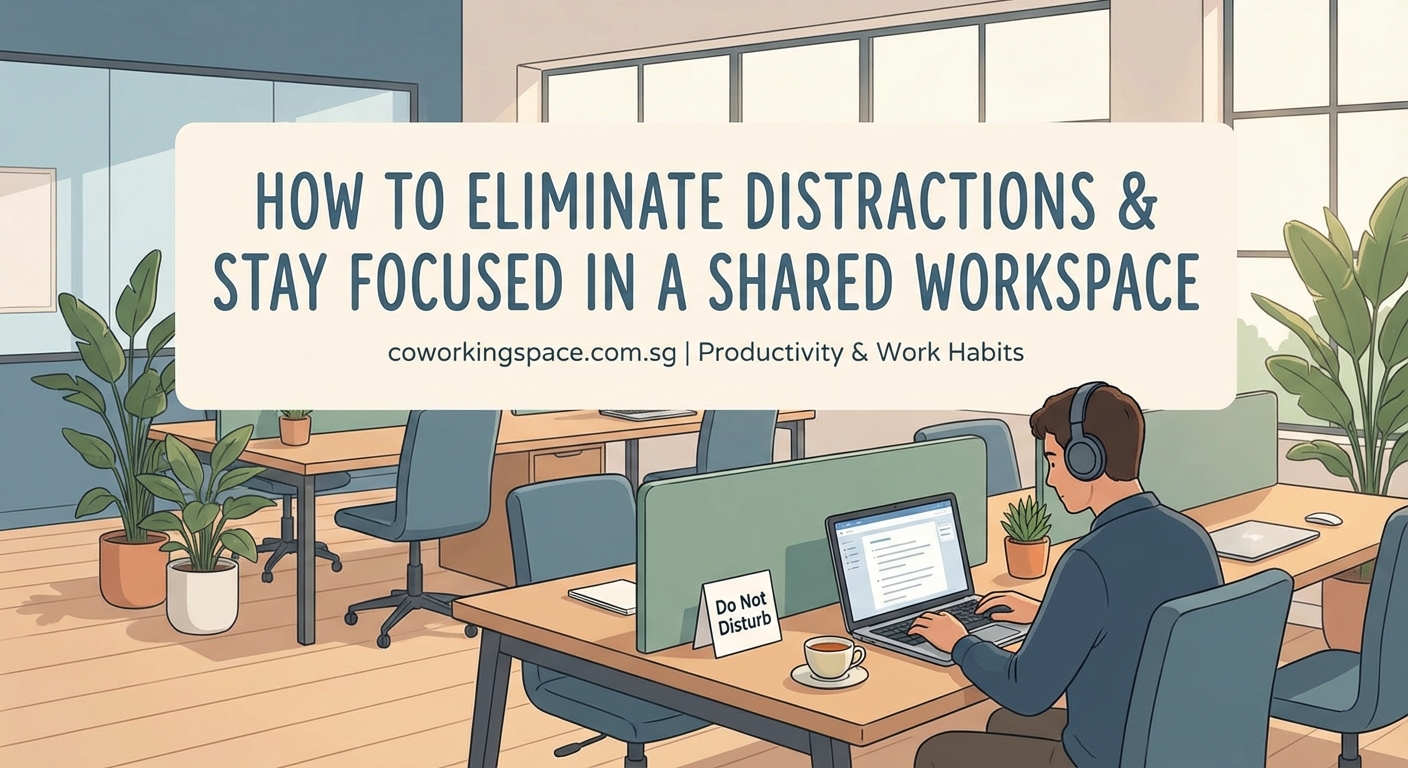
Sound is the biggest complaint in shared workspaces. You can’t control other people’s volume, but you can control what reaches your ears.
Invest in quality noise-canceling headphones. This isn’t optional equipment. It’s essential infrastructure for shared workspace productivity. Over-ear models with active noise cancellation block more sound than earbuds. They also signal to others that you’re in focus mode.
Create a focus playlist. Your brain associates specific sounds with specific states. Use the same music or ambient noise every time you need deep concentration. After a few weeks, hearing that playlist will trigger focus automatically. Many people prefer instrumental music, white noise, or nature sounds because lyrics can compete with verbal tasks.
Consider these sound options:
- Binaural beats designed for concentration
- Coffee shop ambience recordings
- Classical music or lo-fi hip hop
- Brown noise or pink noise generators
- Silence (if your headphones cancel enough ambient sound)
Use your headphones even when not playing audio. The visual cue tells coworkers you’re unavailable for casual conversation. Most people respect this boundary.
Build a pre-work ritual that signals focus time
Your brain needs clear transitions between activities. A consistent ritual tells your mind it’s time to concentrate.
Start with the same sequence every morning. This might look like:
- Arrive at your desk and organize your physical space
- Pour coffee or fill your water bottle
- Put on headphones and start your focus playlist
- Review your task list and choose your first priority
- Set a timer for your first work block
- Close all unnecessary browser tabs and applications
The specific actions matter less than the consistency. When you repeat the same pattern daily, your brain recognizes the cue and shifts into work mode faster.
Many productive coworking members swear by morning routines that boost productivity as their foundation for focused workdays.
Physical cues help too. Some people change into specific “work clothes” even though coworking spaces are casual. Others use a particular notebook or pen only for work tasks. These tangible markers strengthen the mental association.
Use time blocking to protect your attention
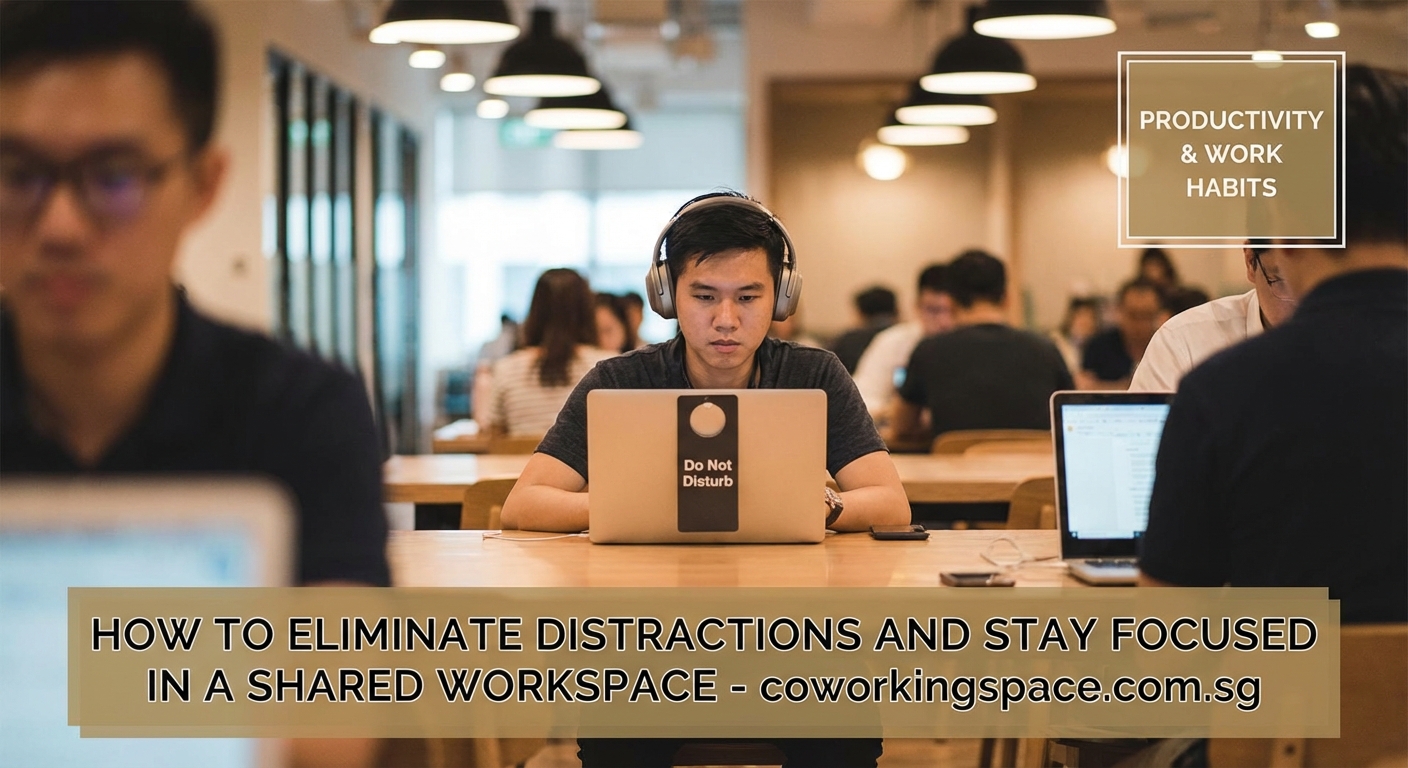
Continuous partial attention kills productivity. You check email, work on a report, respond to messages, and browse research all at once. Nothing gets your full focus.
Time blocking solves this problem. You assign specific tasks to specific time periods and work on nothing else during that block.
Here’s how to implement it:
- Review your task list each morning
- Estimate how long each task actually takes (be realistic)
- Schedule blocks of 90 minutes or less for focused work
- Plan breaks between blocks
- Protect these blocks like you’d protect a meeting
During a time block, turn off notifications completely. Close your email. Put your phone face down or in your bag. Tell yourself you’ll check everything during your next break.
The Pomodoro Technique works particularly well in coworking environments because it creates natural break points when you can socialize or handle interruptions.
Track which times of day you focus best. Most people have a cognitive peak between 9 AM and noon. Schedule your hardest work during your personal peak hours. Save email, admin tasks, and meetings for your lower-energy periods.
Create physical and digital boundaries
Boundaries protect your focus from both external interruptions and internal distractions.
Use visual signals to communicate availability. When you’re in deep work mode:
- Wear headphones
- Position your body language to appear engaged with your screen
- Place a small sign on your desk if your space allows it
- Avoid eye contact with people walking by
These signals aren’t rude. They’re professional communication that you’re currently unavailable.
Set up your digital workspace to minimize distractions:
| Distraction Type | Solution |
|---|---|
| Email notifications | Check email only during designated times (e.g., 10 AM, 2 PM, 4 PM) |
| Slack or chat messages | Use “Do Not Disturb” mode during focus blocks |
| Social media | Use website blockers during work hours |
| Phone calls | Set phone to silent and return calls during breaks |
| Calendar pop-ups | Disable meeting reminders except 5 minutes before |
Keep only essential applications open. Each open tab or program creates a small cognitive load. Your brain tracks all of them, even when you’re not actively using them.
Manage visual distractions in your line of sight
Movement catches your eye automatically. It’s an evolutionary response you can’t turn off, but you can minimize triggers.
Face a wall or divider when possible. This eliminates most peripheral movement. If you must face the room, position yourself so high-traffic areas aren’t directly in your view.
Adjust your screen position. Your monitor should be at eye level or slightly below. When you look at your screen, you naturally look down, reducing what appears in your peripheral vision.
Use a laptop stand and external keyboard if you work on a laptop. This raises your screen and improves both ergonomics and visual control.
Some people use physical barriers. A small plant, a water bottle, or a stack of books positioned strategically can block distracting movement without seeming antisocial.
Declutter your workspace. Visual chaos creates mental chaos. Keep only what you need for your current task on your desk. Everything else goes in your bag or a drawer.
Handle interruptions with a consistent protocol
Interruptions will happen. How you handle them determines whether they derail your entire day or just cost a few minutes.
When someone approaches your desk:
- Remove one headphone (not both)
- Ask “Is this urgent, or can we talk at 3 PM?”
- If it’s truly urgent, deal with it immediately
- If not, schedule a specific time to discuss it
This approach respects both your focus and the other person’s needs. Most “urgent” matters can wait 30 minutes.
For digital interruptions, batch your responses. When a message comes in during a focus block, add it to a list. Respond to everything on the list during your next break. This prevents constant context switching.
“The ability to perform deep work is becoming increasingly rare at exactly the same time it is becoming increasingly valuable in our economy. The few who cultivate this skill will thrive.” This principle applies directly to shared workspaces, where the environment makes focus harder but also more valuable.
Build mental resilience against ambient distractions
Some noise and movement will always get through. Mental training helps you maintain focus despite imperfect conditions.
Practice returning to focus. When you notice your attention has drifted, don’t judge yourself. Simply redirect your attention to your task. This “noticing and returning” is like a mental pushup. Each repetition strengthens your focus muscle.
Use a focus anchor. This is a physical sensation you can return to when distracted. Many people use their breath. When you notice you’re distracted, take three slow breaths while focusing on the sensation. Then return to work. The breath acts as a reset button.
Expect distractions. When you accept that interruptions will happen, they bother you less. You’re not fighting reality. You’re working skillfully within it.
Take real breaks. Your brain can’t maintain intense focus for eight hours. Plan breaks every 90 minutes. Get up, move around, and let your attention wander. This prevents burnout and actually improves your focus during work blocks.
Understanding the psychology behind coworking helps you work with the environment’s natural rhythms rather than against them.
Optimize your personal workspace setup
Your immediate environment affects your ability to concentrate. Small improvements compound over time.
Bring the right tools:
- Quality headphones with good battery life
- Laptop stand or external monitor
- External keyboard and mouse
- Notebook for capturing stray thoughts
- Water bottle to avoid frequent trips to the kitchen
- Phone charger so low battery doesn’t distract you
Many coworking spaces offer ergonomic chairs and standing desks that can significantly improve your focus by reducing physical discomfort.
Adjust lighting to reduce eye strain. Position your screen perpendicular to windows to avoid glare. If the overhead lighting is harsh, consider a small desk lamp with warmer light.
Control your temperature comfort. Bring a light jacket if the air conditioning runs cold. Feeling physically uncomfortable makes focus nearly impossible.
Keep healthy snacks at your desk. Blood sugar crashes destroy concentration. Nuts, fruit, or protein bars provide steady energy without the sugar crash of typical office snacks.
Develop a shutdown routine to maintain work-life boundaries
How you end your workday affects how well you focus the next day. A clear shutdown routine prevents work from bleeding into personal time.
Create an end-of-day ritual:
- Review what you accomplished today
- Write tomorrow’s top three priorities
- Close all work-related applications
- Clear your desk
- Do a final email check (5 minutes maximum)
- Pack your bag
- Remove your headphones and leave the space
This sequence signals to your brain that work is complete. Without it, you’ll continue processing work problems during personal time, which leads to mental fatigue and reduced focus the next day.
Many people who avoid common time-wasting habits credit their shutdown routine as the foundation of their productivity system.
Compare effective and ineffective focus strategies
Not all focus techniques work equally well in shared spaces. Here’s what actually helps versus what seems like it should help:
| Effective Strategy | Why It Works | Ineffective Strategy | Why It Fails |
|---|---|---|---|
| Consistent daily routine | Creates automatic focus triggers | Working at different times daily | Prevents habit formation |
| Noise-canceling headphones | Blocks 70-80% of ambient sound | Relying on willpower alone | Mental fatigue after 30 minutes |
| Time blocking with breaks | Matches natural attention spans | Marathon work sessions | Leads to burnout and distraction |
| Strategic desk location | Reduces visual triggers | Sitting wherever is available | Exposes you to maximum distraction |
| Digital boundaries | Eliminates notification interruptions | Keeping all apps open | Creates constant temptation |
| Physical focus anchors | Provides reset mechanism | Pushing through distraction | Increases frustration and reduces output |
Address the unique challenges of hot desking
If you don’t have a dedicated desk, you face additional focus challenges. Different locations mean you can’t build the same environmental consistency.
Scout your options when you arrive. Spend five minutes finding the best available spot rather than grabbing the first empty desk. This small investment pays off all day.
Create portable consistency. Use the same focus playlist, the same notebook, the same pre-work ritual regardless of where you sit. These portable cues help your brain shift into focus mode even in changing environments.
Pack a “focus kit” with everything you need. When your tools are always the same, the location matters less. Your headphones, laptop stand, and water bottle become your consistent workspace.
Building a personal productivity system that travels with you solves many hot desking challenges.
Arrive early to claim better spots. The best desks get taken first. If focus is your priority, arriving 30 minutes early might be worth it.
Handle phone calls and video meetings without destroying focus
Meetings interrupt deep work, but they’re unavoidable. The key is minimizing their impact on your focus.
Book meeting rooms for calls whenever possible. Most coworking spaces have meeting room booking systems that let you reserve space for 30 minutes or an hour. Taking calls in a private room protects both your focus and other members’ concentration.
When meeting rooms aren’t available:
- Move to a phone booth or designated call area
- Keep calls as short as possible
- Return to your desk only after the call is completely finished
- Take a two-minute break to reset before resuming work
Batch meetings when possible. Four scattered 15-minute calls destroy your entire day. Four consecutive calls in one 90-minute block leave the rest of your day intact for focused work.
Use the time before and after meetings strategically. The 10 minutes before a meeting is too short for deep work. Use it for email, admin tasks, or planning. The same applies to the time after meetings while your brain transitions back to focus mode.
Recognize when to work from home instead
Coworking spaces aren’t ideal for every task. Sometimes the best productivity decision is working elsewhere.
Consider working from home when you need to:
- Write a complex document requiring hours of uninterrupted thought
- Prepare for a major presentation
- Handle sensitive phone calls
- Process difficult emotions or stress
- Recover from illness while still being somewhat productive
Building an effective hybrid work schedule means matching your location to your task requirements.
Use coworking spaces for:
- Collaborative work
- Routine tasks that benefit from ambient energy
- Days when you need external structure
- Networking and relationship building
- Tasks requiring specific equipment or amenities
Knowing when to stay home isn’t a failure. It’s strategic thinking about where you work best for different types of work.
Making focus a daily practice, not a one-time fix
Staying focused in shared workspaces isn’t about finding one perfect technique. It’s about building a system of small practices that work together.
Start with your environment. Choose your location carefully, manage noise with good headphones, and create visual boundaries that minimize distractions.
Add structure through time blocking and consistent routines. Your brain craves patterns. Give it clear signals about when to focus and when to rest.
Finally, develop mental resilience. Accept that distractions will happen and practice returning to focus without frustration.
The coworking members who thrive aren’t the ones with supernatural concentration. They’re the ones who’ve built reliable systems that work with the environment’s realities rather than against them. Your focus will improve each week as these practices become automatic. Give yourself time to build the habits, and adjust what isn’t working. Within a month, you’ll find that the same space that once felt impossibly distracting has become your most productive work environment.