
Singapore looks perfect on paper for remote workers. Fast internet, great food, safe streets, and a location that makes the rest of Asia easy to reach.
But here’s the reality check: Singapore doesn’t offer a dedicated digital nomad visa. That doesn’t mean you can’t work here, but it does mean you need to understand the actual visa options, what’s legal, and how to make it work without breaking immigration rules.
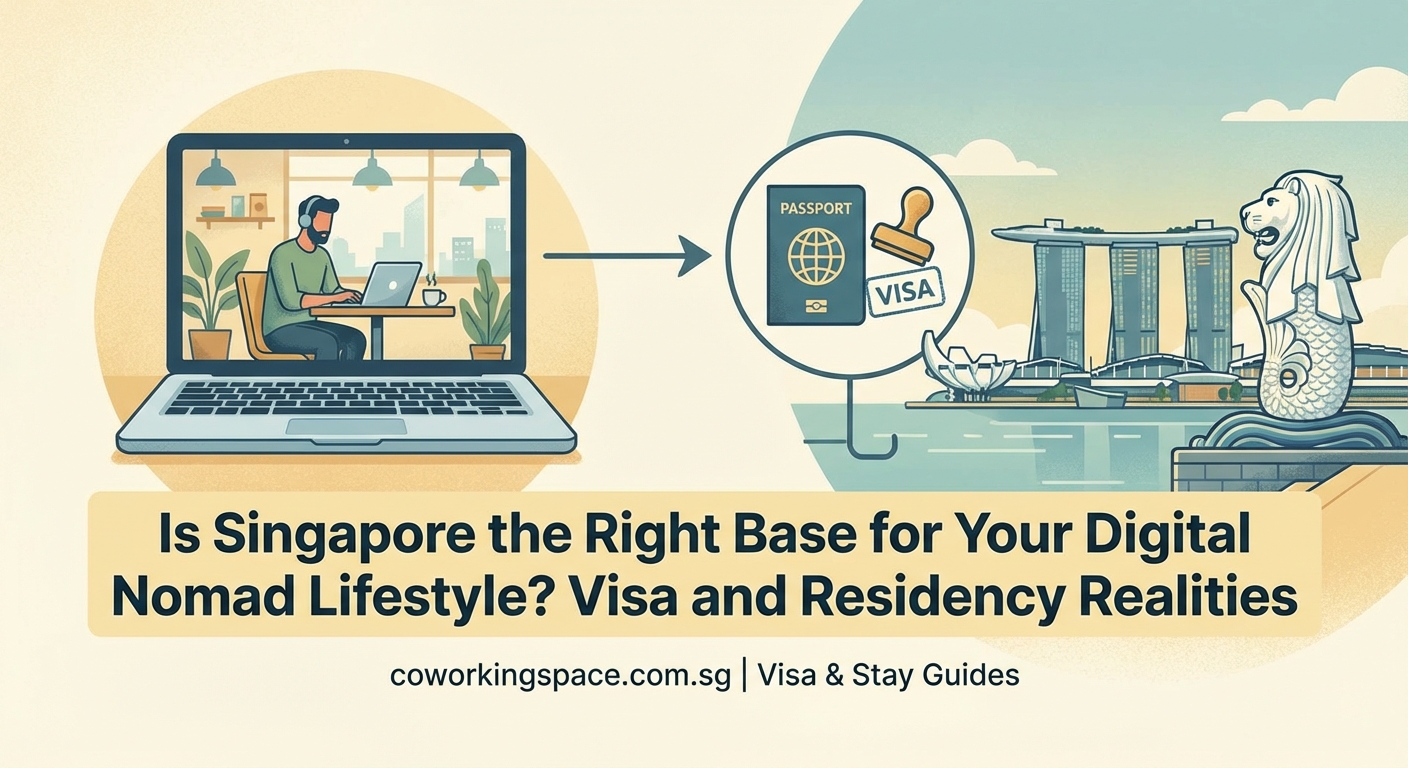
Singapore has no specific digital nomad visa, but remote workers can stay legally through tourist visas (up to 90 days), Employment Passes (if working for a Singapore company), EntrePass (for entrepreneurs), or dependent passes. Working remotely for foreign clients on a tourist visa exists in a legal gray area. Long-term residence requires formal employment, business ownership, or significant investment. Most digital nomads use Singapore as a short-term base while maintaining legal residence elsewhere.
Understanding Singapore’s Visa Landscape for Remote Workers
Singapore’s immigration system wasn’t built with digital nomads in mind. It was designed for traditional employment, business ownership, and investment.
That creates challenges for people who want to work remotely while based here.
The Ministry of Manpower (MOM) issues work passes based on local employment. If you’re not employed by a Singapore entity, you don’t qualify for most standard work passes.
Tourist visas allow stays of 30, 60, or 90 days depending on your nationality. Most Western passport holders get 90 days visa-free on arrival.
Here’s where it gets murky: working remotely for clients or employers outside Singapore while on a tourist visa isn’t explicitly addressed in immigration law. Singapore doesn’t have clear rules about this scenario.
Some remote workers interpret this as permission. Others see it as a legal risk.
The safest interpretation is that tourist visas are for tourism, not work of any kind. But enforcement focuses on people working for Singapore companies without proper authorization, not laptop workers in cafes serving overseas clients.
Visa Options That Actually Exist
Let’s look at what’s actually available if you want to base yourself in Singapore.
Short-Term Tourist Visa
Duration: 30 to 90 days depending on nationality.
Who it works for: Remote workers testing Singapore as a base, or those rotating between multiple countries.
Legal status: Technically for tourism only. Working remotely exists in a gray area.
Practical reality: Thousands of remote workers do this. Immigration officers rarely ask about remote work arrangements. The risk comes if you overstay or try to extend repeatedly.
You can’t legally earn income from Singapore sources on a tourist visa. But working for foreign clients while physically present? That’s the undefined zone.
Employment Pass (EP)
Duration: Up to 2 years initially, renewable.
Who it works for: Remote workers who can convince a Singapore company to sponsor them, or those willing to take local employment.
Requirements:
– Monthly salary of at least S$5,000 (higher for older applicants)
– Acceptable qualifications (degree preferred)
– Employer must be registered in Singapore
– Job must meet MOM criteria
This is the gold standard for legal work authorization. But it requires a local employer, which defeats the purpose for most digital nomads.
Some remote workers have convinced their overseas employers to set up a Singapore entity to sponsor them. That’s expensive and complex for the employer.
EntrePass
Duration: 1 year initially, renewable if business criteria are met.
Who it works for: Entrepreneurs willing to start a real business in Singapore.
Requirements:
– Register a company in Singapore (Private Limited)
– Meet one of these criteria: secured funding from recognized investors, possess intellectual property, have partnerships with Singapore institutions, or demonstrate extraordinary achievements
– Business plan that shows innovation and growth potential
– Minimum paid-up capital of S$50,000
This isn’t a backdoor for freelancers. Immigration expects a genuine startup that will hire locals and contribute to the economy.
If your “business” is just freelancing for overseas clients, your EntrePass application will likely be rejected or not renewed.
However, if you’re building a real product or service with growth potential, this becomes viable. Many digital nomad entrepreneurs have successfully used EntrePass to establish themselves here.
You can learn more about the application process through how to apply for Singapore’s EntrePass visa as a startup founder.
Dependent’s Pass
Duration: Tied to the main pass holder’s validity.
Who it works for: Spouses or children of EP, S Pass, or Employment Pass holders.
Work rights: Dependent’s Pass holders can apply for a Letter of Consent (LOC) to work in Singapore.
This is a legitimate path if your partner has Singapore employment. You get legal residency, and with LOC approval, you can work locally or continue remote work with full legal clarity.
Personalized Employment Pass (PEP)
Duration: 3 years, non-renewable.
Who it works for: High earners with significant career achievements.
Requirements:
– Currently earn at least S$22,500 per month, or
– Last drawn fixed monthly salary of at least S$18,000 in your last EP
PEP gives you flexibility to stay in Singapore for up to 6 months between jobs. But you still need Singapore employment to qualify initially.
Not practical for most digital nomads unless you’re transitioning from high-level corporate work.
The Legal Gray Zone of Remote Work
Let’s address the elephant in the room.
Many digital nomads work remotely from Singapore on tourist visas. They serve overseas clients, get paid to foreign bank accounts, and don’t interact with the Singapore economy beyond spending money here.
Singapore immigration law doesn’t explicitly prohibit this. But it also doesn’t explicitly permit it.
The Immigration and Checkpoints Authority (ICA) states that tourist visas are for “social visits” and that any form of employment requires a work pass.
Does remote work for foreign clients count as “employment” in this context? There’s no clear answer.
Countries like Thailand and Indonesia have recently clarified that remote work for foreign companies doesn’t require work authorization. Singapore hasn’t made such a statement.
The practical reality is that enforcement is minimal. Immigration officers at the airport don’t typically ask about remote work arrangements. They’re looking for people who might work illegally for Singapore companies or overstay.
But there’s risk. If questioned, you have no legal protection. If you need to interact with government agencies for any reason, your work status could become an issue.
Some remote workers address this by:
- Maintaining legal residence in another country
- Keeping stays under 90 days
- Having a clear exit plan and onward travel booked
- Not mentioning work when entering Singapore
This isn’t legal advice. It’s a description of what people actually do.
The safest approach is to assume tourist visas don’t permit any work, even remote work. Everything else is calculated risk.
Practical Strategies for Basing Yourself in Singapore
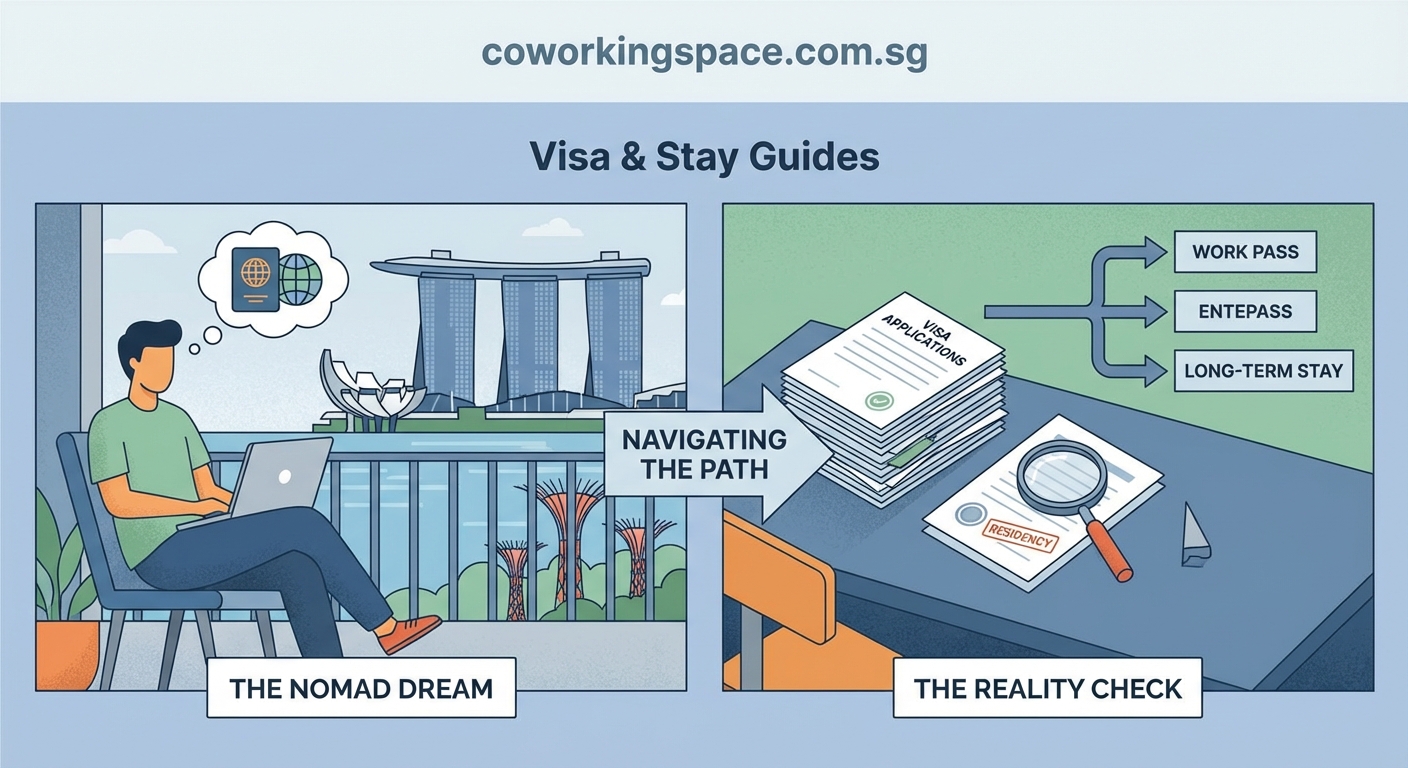
If you want to make Singapore work as a digital nomad base, here are your realistic options.
Strategy 1: Rotate In and Out
Stay for 60 to 90 days, then leave for at least 30 days before returning.
This keeps you within tourist visa limits and reduces the appearance of residence.
Works well if you’re already planning to travel regionally. Bali, Bangkok, Kuala Lumpur, and Manila are all a few hours away.
The downside is the lack of stability. You can’t truly settle. You need to plan around visa limits.
Strategy 2: Secure Local Employment
Find a Singapore company willing to hire you remotely or in a hybrid arrangement.
This gives you an Employment Pass and full legal status. You can stay long-term, open bank accounts, and rent apartments without complications.
The challenge is convincing an employer to sponsor you when you want flexibility. Some companies offer remote-first roles with Singapore contracts. Others won’t consider it.
Tech companies, startups, and international firms are most likely to accommodate this arrangement.
Strategy 3: Start a Real Business
If you have a legitimate business idea with growth potential, EntrePass becomes viable.
This requires commitment. You need to invest capital, create a real business structure, and meet ongoing requirements to maintain your pass.
But it gives you long-term legal status and the ability to build something substantial in Singapore’s business environment.
Many digital nomads have transitioned from freelancing to building agencies, SaaS products, or consulting firms using this path.
Strategy 4: Leverage Dependent Status
If your partner can secure Singapore employment, you can join them on a Dependent’s Pass.
With a Letter of Consent, you have full work rights. You can continue remote work, take local clients, or do both.
This is one of the cleanest legal paths for digital nomads, but it requires your partner to commit to Singapore employment.
Strategy 5: Use Singapore as a Regional Hub
Base yourself legally in a country with better digital nomad infrastructure (Thailand, Indonesia, Malaysia), but make regular trips to Singapore for meetings, networking, and productivity.
Singapore’s visa-free access makes this easy. You get the benefits of Singapore’s business environment without the visa complications.
If you’re considering whether Singapore makes financial sense for your situation, is Singapore worth it for digital nomads breaks down the real costs.
Comparing Visa Strategies: What Works Best
| Strategy | Legal Status | Duration | Setup Difficulty | Cost | Best For |
|---|---|---|---|---|---|
| Tourist visa rotation | Gray area | 60-90 days per visit | Easy | Low | Short-term stays, regional travelers |
| Employment Pass | Fully legal | 2+ years | Medium to hard | Medium | Those willing to take local employment |
| EntrePass | Fully legal | 1+ years | Hard | High | Entrepreneurs with real businesses |
| Dependent’s Pass + LOC | Fully legal | Unlimited | Medium | Low | Partners of EP holders |
| Regional hub approach | Fully legal | Flexible | Easy | Medium | Those wanting Singapore access without residence |
Common Mistakes Remote Workers Make
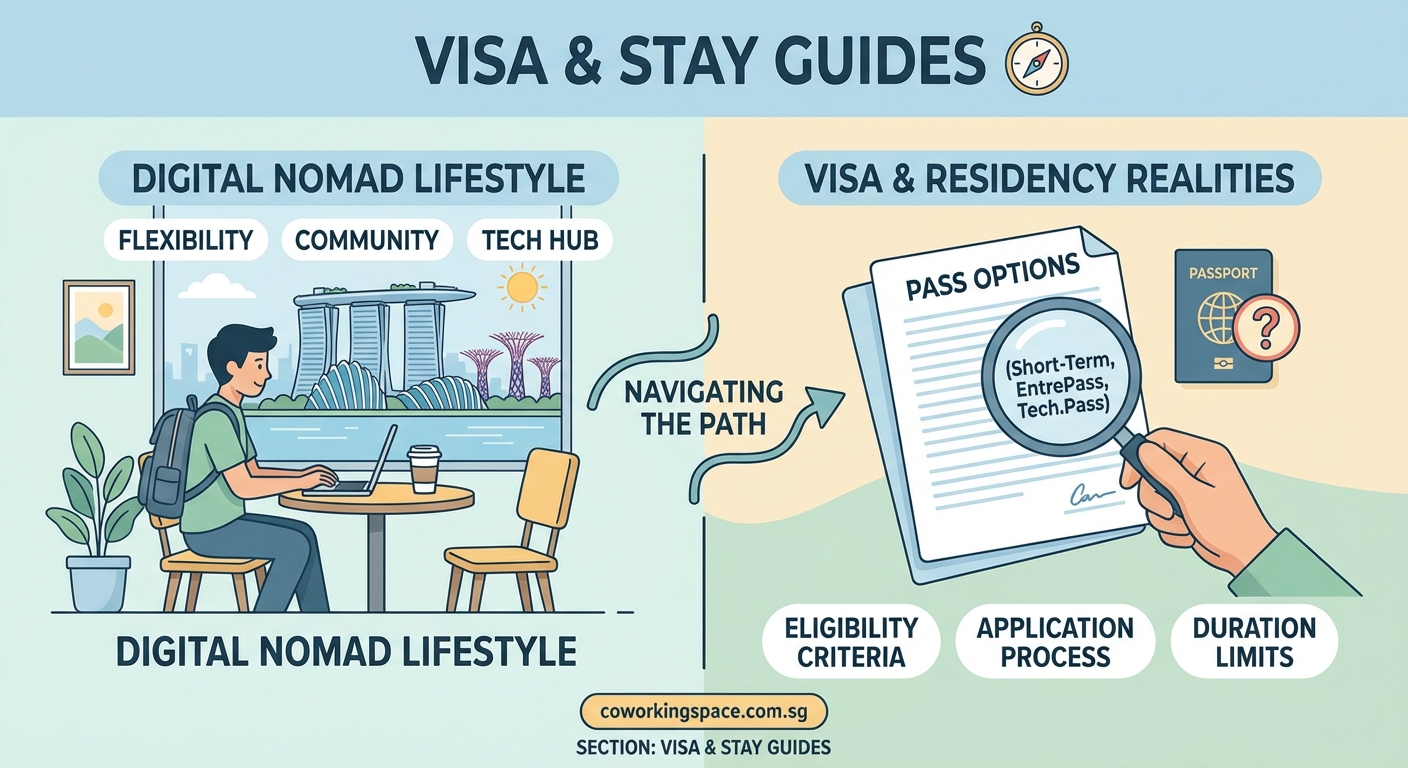
Assuming tourist visas permit remote work. They don’t explicitly. You’re taking a calculated risk.
Overstaying visa limits. This creates real problems. Singapore takes immigration violations seriously. Overstays can result in fines, bans, or deportation.
Trying to extend tourist visas repeatedly. After multiple back-to-back visits, immigration may question your intentions. They might deny entry or limit your stay.
Starting a fake business for EntrePass. MOM reviews business operations. If your company isn’t genuine, your pass won’t be renewed. Some people have faced legal consequences for fraudulent applications.
Working for Singapore clients on a tourist visa. This is clearly illegal. If caught, you face serious penalties.
Not maintaining ties to another country. If you have no legal residence anywhere, that becomes a problem. Immigration officers may question your status.
Ignoring tax implications. Spending significant time in Singapore can create tax residency, even on a tourist visa. You need to understand the tax rules of both Singapore and your home country.
For more guidance on avoiding common pitfalls, check out 5 common coworking mistakes that new members make and how to avoid them.
Setting Up Your Work Environment in Singapore
Once you’re here legally (or within your risk tolerance), you need a place to work.
Working from your accommodation gets old fast. Singapore apartments are small. Hotels are expensive and not designed for productivity.
Coworking spaces solve this problem. They give you professional space, fast internet, and community without long-term commitments.
Most spaces offer day passes, weekly rates, and monthly memberships. You can try different locations before committing.
Key factors to consider:
- Location: Choose something near your accommodation or with good MRT access. Singapore’s public transport is excellent, but long commutes eat into your day.
- Internet speed: Most coworking spaces have fiber connections with 500Mbps or faster. Test it before committing to a membership.
- Meeting rooms: If you take video calls, you need access to private spaces. Check availability and booking systems.
- Operating hours: Some spaces are 24/7, others close evenings or weekends. Match this to your work schedule.
- Community: Some spaces focus on networking and events. Others are quieter and work-focused. Choose based on your preference.
Day passes typically cost S$30 to S$50. Monthly memberships range from S$250 to S$800 depending on location and amenities.
If you’re trying to keep costs down, budget-friendly coworking spaces in Singapore under $300 per month provides specific options.
For first-timers, how to choose your first coworking space in Singapore walks through the selection process.
Banking and Financial Logistics
Opening a Singapore bank account as a tourist is difficult. Most banks require proof of residence or employment.
Options that work:
International banks with digital accounts. Wise, Revolut, and similar services let you hold SGD and other currencies without local residence.
Home country accounts with good international cards. Use debit or credit cards that don’t charge foreign transaction fees. Many remote workers keep their home banking and use ATMs for cash.
Business accounts if you have EntrePass. Once you register a Singapore company, you can open corporate accounts. Most banks want to see actual business activity before approving accounts.
For everyday spending, credit cards work everywhere in Singapore. Hawker centers and some small shops still prefer cash, but card acceptance is widespread.
ATM withdrawals face fees from both your home bank and the Singapore ATM operator. Factor this into your budget if you need cash regularly.
Healthcare Considerations
Singapore has excellent healthcare, but it’s expensive for foreigners without insurance.
Tourist visas don’t include healthcare coverage. You’re responsible for all medical costs.
A doctor’s visit costs S$50 to S$150. Emergency room visits can run into thousands. Hospitalization is extremely expensive without insurance.
Get international health insurance before arriving. Plans designed for digital nomads typically cost S$100 to S$300 per month depending on coverage level.
SafetyWing, World Nomads, and Cigna Global are popular options. Make sure your plan covers Singapore specifically, as some exclude expensive countries.
If you’re on an Employment Pass, you’ll have access to Singapore’s healthcare system and may get employer-provided insurance.
Housing Options for Different Stay Lengths
Short stays (under 1 month): Hotels, serviced apartments, or Airbnb. Expect to pay S$80 to S$200 per night depending on location and quality.
Medium stays (1 to 3 months): Serviced apartments with monthly rates, or subletting from other expats. Monthly costs range from S$2,000 to S$4,000 for a studio or one-bedroom in central areas.
Long stays (3+ months): Proper rental leases if you have legal status. Expect to pay S$2,500 to S$5,000+ per month for a one-bedroom apartment, plus a deposit of two to three months’ rent.
Rental contracts typically require Employment Pass or other long-term visa documentation. Landlords won’t rent to people on tourist visas for extended periods.
If you need temporary housing while figuring out your long-term plan, 5 best short-term housing options for remote workers visiting Singapore covers the options in detail.
Tax Implications You Need to Understand
Singapore taxes based on residency, not citizenship.
You become a tax resident if you stay in Singapore for 183 days or more in a calendar year, or if you work here for three consecutive years.
Tax residents pay progressive income tax on Singapore-sourced income. Rates range from 0% to 24% depending on income level.
Non-residents pay flat rates: 15% on employment income, 24% on director’s fees, and 22% on other income.
Here’s the complicated part: if you’re working remotely for foreign clients while physically in Singapore, is that Singapore-sourced income?
The Inland Revenue Authority of Singapore (IRAS) hasn’t provided clear guidance on this scenario.
Conservative interpretation: if you’re performing work while physically in Singapore, it’s Singapore-sourced.
Liberal interpretation: if your clients are overseas and you’re paid to foreign accounts, it’s foreign-sourced.
Most remote workers in this situation don’t file Singapore taxes. But if you become a tax resident and IRAS investigates, you could face penalties.
Consult a tax professional familiar with both Singapore and your home country’s tax laws. Double taxation agreements may protect you, but you need to understand your specific situation.
Building a Sustainable Long-Term Approach
If you want to make Singapore work beyond short visits, you need a real plan.
The tourist visa rotation strategy has limits. After a year or two, immigration may start questioning your frequent entries. You also can’t build a stable life when you need to leave every 90 days.
For long-term sustainability, consider these paths:
1. Transition to formal employment. Look for Singapore companies hiring in your field. Tech, finance, and consulting firms regularly sponsor foreign workers. You sacrifice some freedom but gain legal stability.
2. Build a business worth an EntrePass. If you have entrepreneurial ambitions, Singapore offers an excellent environment. But commit to building something real, not just maintaining freelance status.
3. Establish yourself in a nearby country with better digital nomad infrastructure. Thailand’s Long-Term Resident Visa, Malaysia’s Digital Nomad Visa, or Indonesia’s Second Home Visa all offer better options for long-term stays. Use Singapore for regular visits rather than as your primary base.
4. Accept the temporary nature. Many digital nomads use Singapore as a 3 to 6 month base while exploring Asia, then move on. There’s nothing wrong with treating it as a temporary stop rather than a permanent home.
For those committed to building a career while based here, how to build a sustainable digital nomad career while based in Singapore provides a comprehensive roadmap.
What to Do Before You Arrive
1. Research your nationality’s visa requirements. Check the ICA website for current rules. Requirements change periodically.
2. Secure international health insurance. Don’t skip this. Singapore’s healthcare costs can destroy your budget without coverage.
3. Set up international banking. Get accounts that work globally without excessive fees.
4. Understand your home country’s tax obligations. Many countries tax citizens on worldwide income regardless of where they live. Know your filing requirements.
5. Have a backup plan. If immigration denies you entry or limits your stay, where will you go? Always have a plan B.
6. Join digital nomad communities. Online forums and groups share current information about what’s working and what’s not. Rules and enforcement change, and community knowledge helps you stay informed.
“Singapore works brilliantly as a digital nomad base if you understand the limitations and plan accordingly. The mistake people make is assuming it’s like Thailand or Bali. It’s not. You need either legal status or a clear rotation strategy, and you need to accept that long-term residence requires formal employment or business ownership. Once you work within those constraints, Singapore offers incredible quality of life, safety, and connectivity.” – Remote work consultant with 8 years of Asia-Pacific experience
Making Singapore Work Within Legal Boundaries
Singapore offers remote workers a lot: safety, infrastructure, food, culture, and regional access.
But it doesn’t offer easy long-term legal residence for digital nomads.
You can make it work through tourist visa rotations, but that’s a short-term solution with legal uncertainty. For anything beyond a few months per year, you need formal status.
The paths exist. Employment Pass, EntrePass, and dependent status all provide legal residence. They just require commitment to traditional employment or entrepreneurship.
For many remote workers, the better approach is treating Singapore as a regional hub rather than a permanent base. Establish legal residence in a more nomad-friendly country, then make regular trips to Singapore for the benefits it offers.
There’s no perfect solution. Every approach involves tradeoffs between legal certainty, cost, freedom, and stability.
The key is making an informed decision based on your specific situation, risk tolerance, and long-term goals. Singapore can absolutely work as part of your digital nomad lifestyle, but you need to understand exactly what you’re getting into before you arrive.
If you decide Singapore makes sense for your situation, how digital nomads can maximize productivity in Singapore’s coworking spaces will help you make the most of your time here.