
You’ve probably noticed it before. You sit down in a coffee shop or shared workspace, and suddenly the work flows easier. Your focus sharpens. Ideas come faster. It’s not magic. It’s psychology at work, and understanding how coworking spaces tap into our mental wiring can change how you approach your workday.
Coworking spaces boost productivity through social facilitation, structured environments, and psychological separation between home and work. The presence of others working creates accountability, reduces isolation, and triggers motivation through observation. Understanding these psychological mechanisms helps remote workers, freelancers, and entrepreneurs make informed workspace decisions that align with their mental needs and work styles.
Social Facilitation Makes You Work Harder
Working alone at home sounds peaceful. But your brain responds differently when others are present.
Social facilitation is a psychological phenomenon where people perform better on tasks when others are watching or working nearby. This effect has been documented since 1898, when researcher Norman Triplett noticed cyclists rode faster when competing against others rather than racing against the clock.
The same principle applies in coworking spaces. When you see someone focused on their laptop, your brain registers their effort. You naturally match their energy level. This isn’t conscious. It happens automatically.
The effect works strongest for tasks you already know how to do. If you’re writing emails, building spreadsheets, or coding familiar functions, the presence of others pushes you to work faster and more efficiently.
For complex problem solving or creative work, the effect changes slightly. You still benefit from the ambient energy, but you might need quiet zones for maximum productivity when tackling difficult challenges.
The Power of Psychological Separation
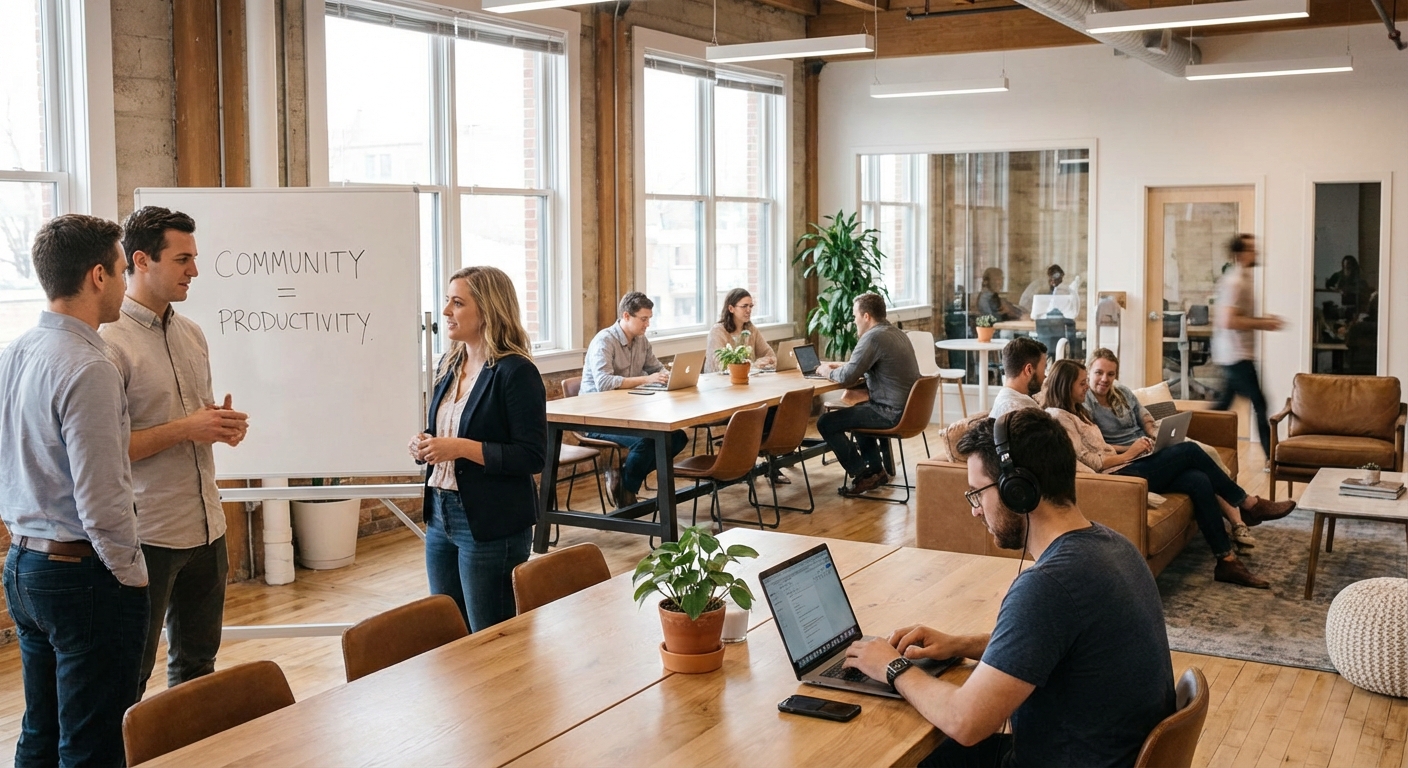
Your brain creates mental associations with physical spaces. Your bedroom means sleep. Your kitchen means food. Your couch means relaxation.
When you work from home, these associations blur. Your dining table becomes your office. Your brain never fully switches into work mode because the space signals multiple conflicting purposes.
Coworking spaces solve this problem through environmental psychology. The moment you walk through the door, your brain recognizes the space as work territory. This mental switch happens automatically.
This separation creates several benefits:
- Clearer focus when you arrive at the space
- Better ability to disconnect when you leave
- Reduced work anxiety bleeding into personal time
- Stronger boundaries between professional and personal identity
The physical commute to a coworking space, even if it’s just ten minutes, acts as a transition ritual. Your brain uses this time to shift gears. You arrive ready to work. You leave ready to relax.
Accountability Through Ambient Awareness
Nobody is watching you work at home. You can spend thirty minutes scrolling social media and nobody knows.
Coworking spaces create what psychologists call “ambient accountability.” You’re not being monitored or judged, but the simple awareness that others might notice your behavior influences your choices.
This works through multiple psychological mechanisms:
- Self-presentation theory suggests we naturally want to present ourselves positively to others, even strangers.
- Social norms in coworking spaces establish expectations around productive behavior.
- Identity reinforcement happens when you see yourself as part of a working community.
The effect is subtle but powerful. You’re less likely to waste time when surrounded by people actively working. You maintain better posture. You take more intentional breaks rather than mindless scrolling sessions.
This accountability doesn’t feel oppressive because it’s self-imposed. You’re not reporting to a manager. You’re simply responding to the social environment around you.
Combating Isolation and Loneliness
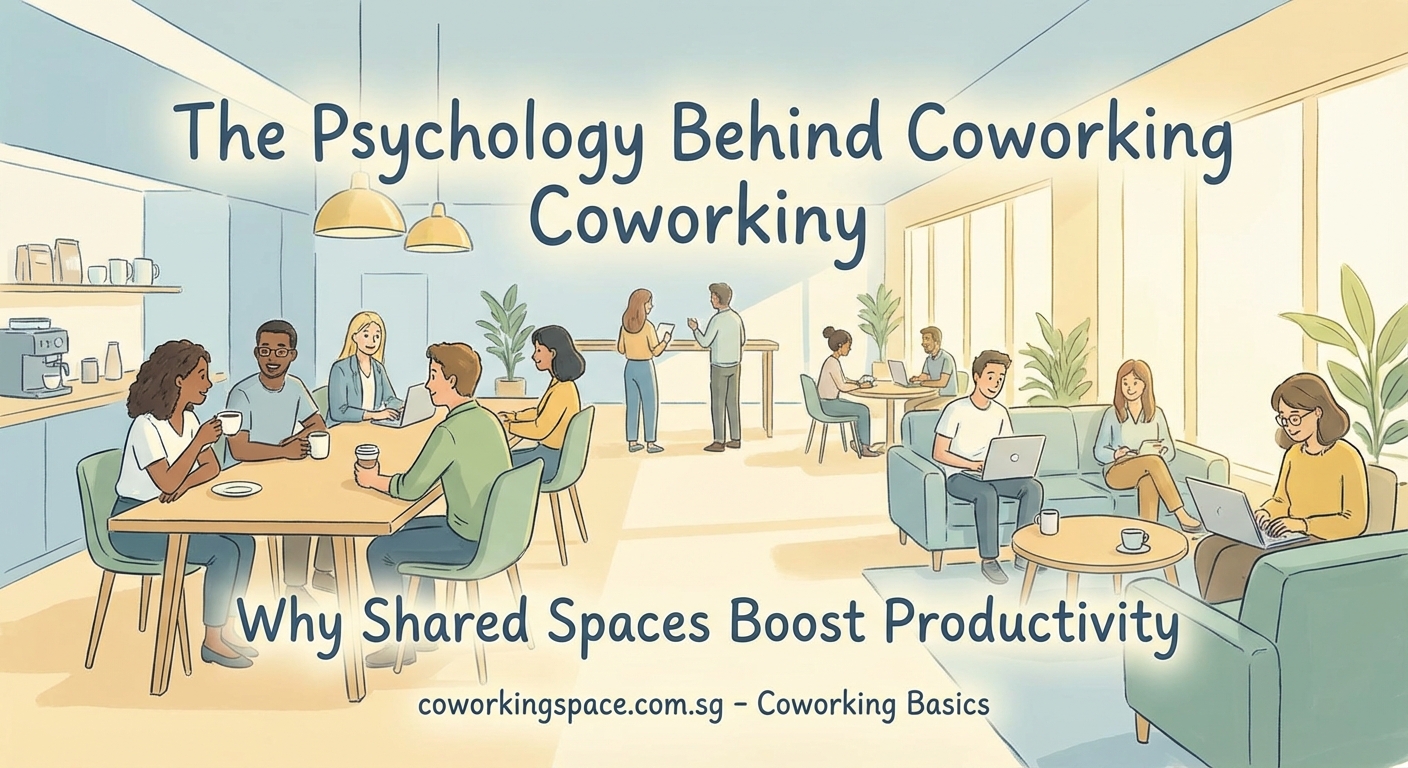
Remote work creates a hidden psychological cost that many people underestimate until they experience it.
Humans are social creatures. We evolved in groups. Extended isolation triggers stress responses in our brains, even when we’re introverts who enjoy solitude.
Research from the American Psychological Association shows that chronic loneliness increases cortisol levels, disrupts sleep patterns, and impairs cognitive function. These effects directly harm productivity, even if you don’t consciously feel lonely.
Coworking spaces provide what psychologists call “passive social contact.” You don’t need to have deep conversations or make friends. Simply being around other humans satisfies a basic psychological need.
This explains why many remote workers report feeling more energized after working in a coworking space, even if they barely spoke to anyone. The ambient presence of others fulfills a social requirement that working alone cannot meet.
For people who want deeper connections, building professional networks in Singapore becomes easier when you share physical space with others in similar situations.
Structured Environments Reduce Decision Fatigue
Every small decision you make drains mental energy. What should I eat? Where should I sit? Should I work now or later? When should I take a break?
Psychologists call this decision fatigue. The more choices you make, the worse your decision quality becomes throughout the day.
Working from home maximizes decision fatigue. You face constant small choices about your environment, schedule, and behavior. Each one chips away at your mental reserves.
Coworking spaces reduce this load through structure. The space is already set up. The environment is ready. You simply arrive and work. This preservation of mental energy lets you focus on important decisions related to your actual work.
Many coworking spaces also provide structured amenities that further reduce daily friction:
| Amenity Type | Psychological Benefit | Productivity Impact |
|---|---|---|
| Coffee station | Eliminates caffeine decision making | Maintains energy without leaving |
| Meeting rooms | Removes space planning stress | Enables professional client interactions |
| Printing facilities | Reduces errand interruptions | Keeps workflow continuous |
| Reception services | Handles administrative tasks | Frees mental bandwidth |
The cumulative effect of these small reductions in decision making preserves cognitive resources for the work that matters.
Motivation Through Observational Learning
Bandura’s social learning theory explains how we learn behaviors by observing others. This applies directly to work habits in coworking spaces.
When you see someone maintaining deep focus for two hours straight, your brain notes this as possible behavior. When you observe someone taking a structured break and returning refreshed, you internalize this pattern.
This observational learning happens unconsciously. You don’t deliberately copy others. You simply absorb their work rhythms and habits through exposure.
The effect becomes stronger when you observe people in similar roles. A freelance designer watching another designer work learns more applicable habits than watching a software developer, though both provide some benefit.
This is why finding your tribe matters psychologically. Being around people in similar fields accelerates the absorption of productive work patterns.
The Creativity Boost From Diverse Perspectives
Creativity doesn’t happen in isolation. It emerges from the collision of different ideas, perspectives, and approaches.
Coworking spaces naturally create what psychologists call “weak ties” – casual connections with people outside your immediate circle. Research by sociologist Mark Granovetter shows these weak ties are often more valuable for innovation than close friendships.
Why? Because people in your close circle think similarly to you. They have similar knowledge, similar blind spots, and similar approaches to problems. Weak ties expose you to different thinking patterns.
In a coworking space, you might overhear a conversation about a tool you’ve never considered. You might see someone approach a problem differently than you would. These small exposures accumulate into creative insights.
The psychology here involves what researchers call “conceptual blending.” Your brain automatically combines ideas from different domains, creating novel solutions. The more diverse your inputs, the more creative combinations your brain can generate.
“Innovation happens at the intersection of different fields and perspectives. Coworking spaces naturally create these intersections through their diverse membership, sparking creative solutions that wouldn’t emerge in isolated work environments.”
Environmental Design and Cognitive Performance
The physical environment directly affects how your brain functions. This isn’t metaphorical. Environmental factors measurably change cognitive performance.
Natural light exposure regulates circadian rhythms, improving alertness and mood. Studies show workers in naturally lit spaces report 51% less eyestrain and 63% less drowsiness.
Temperature affects focus. Research indicates optimal cognitive performance occurs between 21 and 23 degrees Celsius. Too hot or too cold, and your brain diverts resources to temperature regulation.
Noise levels matter differently for different tasks. Moderate ambient noise (around 70 decibels) actually improves creative thinking by encouraging abstract processing. Complete silence or loud noise both impair performance.
Well designed coworking spaces consider these factors:
- Large windows for natural light exposure
- Climate control systems maintaining optimal temperature
- Acoustic design balancing collaboration and concentration
- Variety of spaces for different work modes
These environmental considerations aren’t luxuries. They’re psychological necessities that directly impact your ability to think, focus, and produce quality work.
Understanding what makes coworking spaces different from traditional offices helps you appreciate these intentional design choices.
Routine and Ritual Building
Humans are creatures of habit. We perform better with consistent routines because they reduce cognitive load and create psychological momentum.
Coworking spaces facilitate routine building in ways home offices cannot. The physical act of going to the space becomes a ritual that signals work mode to your brain.
Many successful coworking members develop personal rituals:
- Always sitting in the same area
- Starting the day with coffee in the common area
- Taking lunch breaks at consistent times
- Ending the day by tidying their workspace
These rituals aren’t superstitions. They’re psychological anchors that help your brain transition between different mental states. The consistency creates predictability, which reduces anxiety and improves focus.
The communal nature of coworking spaces also supports routine maintenance. When you see the same people following their routines, it reinforces your own habit patterns. This social reinforcement makes routines more durable.
For remote workers struggling with consistency, building morning routines that boost productivity becomes easier when you have a consistent destination.
Identity and Professional Self-Concept
How you see yourself affects how you behave. Psychologists call this self-concept, and it’s surprisingly malleable based on context.
When you work from your couch in pajamas, your brain struggles to activate your professional identity. The environment doesn’t match the mental state you’re trying to access.
Coworking spaces help activate and reinforce your professional self-concept. The environment signals “this is where professionals work.” Your brain responds by accessing the behaviors, attitudes, and capabilities associated with your professional identity.
This identity activation happens through several mechanisms:
- Environmental cues (desks, computers, professional conversations)
- Social comparison with other working professionals
- Behavioral consistency (acting professionally in a professional space)
- Self-perception (seeing yourself as someone who goes to work)
The effect compounds over time. The more you work in a professional environment, the stronger your professional identity becomes, and the more naturally professional behaviors emerge.
This is particularly valuable for freelancers and entrepreneurs who lack the external identity reinforcement that traditional employment provides.
Breaking the Monotony Trap
Variety isn’t just the spice of life. It’s a psychological necessity for sustained cognitive performance.
Working in the same environment every day creates habituation. Your brain stops noticing the space. Stimulation decreases. Motivation drops. This is why even people who love their home office eventually feel stagnant.
Coworking spaces naturally provide environmental variety. Different people each day. Varying ambient energy levels. Occasional events or changes in the space. This variation prevents habituation and keeps your brain engaged.
Some coworking spaces offer multiple membership types that let you vary your work environment intentionally. Hot desking means you might sit somewhere different each day. This constant novelty keeps your brain alert and engaged.
The psychological benefit isn’t just about avoiding boredom. Varied environments actually improve memory formation and learning by creating distinct contextual cues that help your brain organize and retrieve information.
Managing Distractions Through Social Norms
Paradoxically, working around other people can reduce distractions rather than create them.
Coworking spaces establish implicit social norms around acceptable behavior. People naturally moderate their noise levels, phone conversations, and movement patterns based on what they observe others doing.
This creates a self-regulating environment. Unlike coffee shops where anything goes, coworking spaces develop a culture of respectful productivity. Most members naturally eliminate distractions because they see others doing the same.
The social pressure is gentle but effective. You’re less likely to take a loud phone call in the middle of the workspace when everyone around you is focused. You naturally adapt your behavior to match community expectations.
This differs completely from working at home, where no external social norms exist to moderate your behavior. You’re entirely self-regulating, which requires constant willpower expenditure.
The Mental Health Connection
Productivity isn’t just about output. It’s about sustainable performance that doesn’t burn you out.
Mental health and productivity are deeply interconnected. Depression, anxiety, and stress all impair cognitive function, decision making, and motivation. Any workspace strategy that ignores mental health will eventually fail.
Coworking spaces support mental health through multiple psychological pathways:
- Social connection reduces isolation and loneliness
- Physical separation between work and home improves work-life balance
- Community support provides informal emotional resources
- Environmental variety prevents the stagnation that feeds depression
- Structured routines create stability that reduces anxiety
For remote workers experiencing burnout, the psychological benefits of coworking often matter more than the practical amenities.
The mental health benefits aren’t automatic. They require engagement with the space and community. But for people willing to participate, coworking spaces provide psychological support that isolated work cannot match.
Applying Psychological Insights to Your Workspace Choice
Understanding the psychology behind coworking spaces helps you make better decisions about where and how you work.
Not every psychological benefit will matter equally to everyone. Introverts might value quiet zones more than networking opportunities. Extroverts might prioritize community events and social spaces. People with strong self-discipline might need less external accountability than others.
The key is matching your psychological needs to the right environment. Consider these questions:
- Do you struggle with motivation when working alone?
- Does isolation affect your mood or energy?
- Do you benefit from external structure and routine?
- Does your home environment blur work-life boundaries?
- Do you perform better with ambient social presence?
Your answers reveal which psychological mechanisms matter most for your productivity. This self-awareness helps you choose the right coworking space and membership type for your specific needs.
Remember that psychological needs change over time. What works during an intense project phase might differ from what you need during routine maintenance work. Flexibility in your workspace strategy accommodates these shifting psychological requirements.
Why Your Brain Craves What Coworking Provides
Your brain didn’t evolve for isolated remote work. It evolved for collaborative group effort in shared physical spaces. Coworking spaces align with these deep psychological patterns in ways that home offices simply cannot.
The productivity boost you experience in coworking spaces isn’t about willpower or discipline. It’s about working with your psychology instead of against it. When you understand these mechanisms, you can make informed choices about your work environment that support both your output and your wellbeing.
Whether you’re a freelancer fighting isolation, an entrepreneur building a startup, or a remote worker seeking structure, the psychology of coworking spaces offers real solutions to common challenges. The question isn’t whether these psychological effects exist. The question is whether you’ll use them to your advantage.