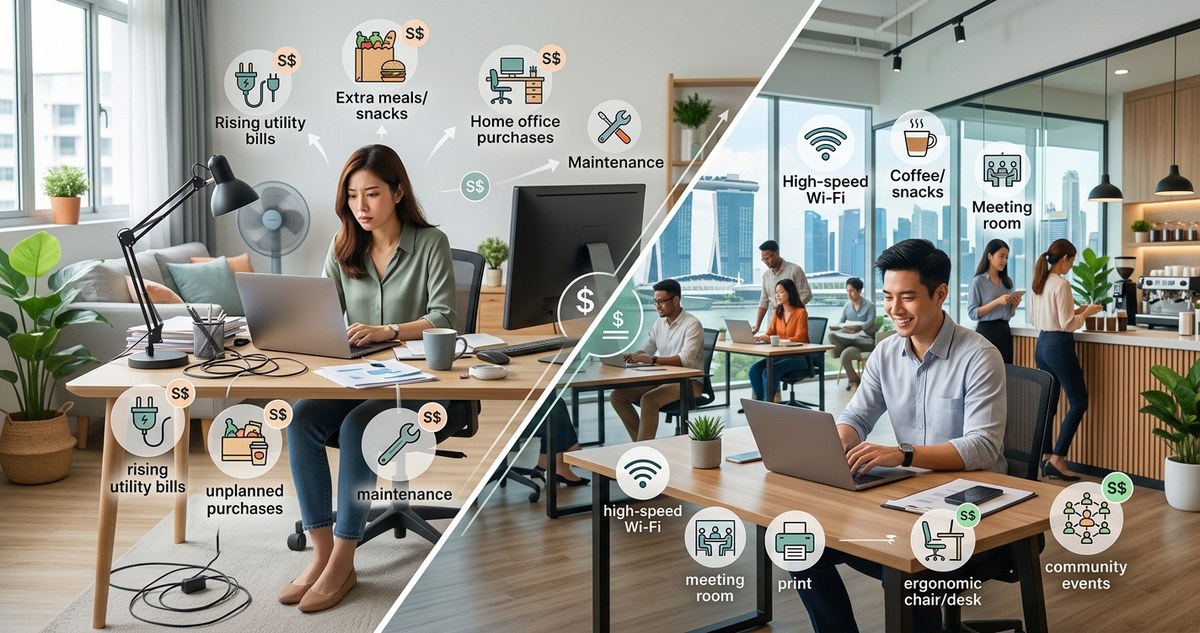
You’ve been working from your HDB flat for six months now. The coffee is free, the commute is zero, and you can work in your pajamas. Sounds perfect, right? But your electricity bill has doubled, your back hurts from that dining chair, and you haven’t had a real conversation in days. Meanwhile, your friend raves about her coworking space membership. She’s making connections, staying focused, and somehow spending less than you thought possible. Which option actually makes sense for your wallet and your sanity?
Working from home in Singapore costs more than most people realize. Hidden expenses include higher utility bills, home office equipment, and productivity losses from distractions. Coworking spaces offer predictable monthly costs with included amenities, professional environments, and networking opportunities. The right choice depends on your work style, budget, and career goals. This guide breaks down every cost factor so you can make an informed decision.
The real cost of working from home in Singapore
Most remote workers in Singapore underestimate their home office expenses by 40% or more.
You see the zero rent and think you’re saving a fortune. But the costs add up in ways you don’t notice until you run the numbers.
Your electricity bill jumps first. Air conditioning runs all day instead of just evenings and weekends. That’s an extra $80 to $150 monthly for most HDB flats. Add your computer, monitors, printer, and that coffee machine you bought to replace your office’s free brew.
Internet upgrades come next. Your home plan worked fine for Netflix, but video calls and large file uploads need faster speeds. That’s another $20 to $40 monthly.
Then there’s furniture. Your dining chair wasn’t designed for eight hour workdays. A proper office chair costs $300 to $800. A desk runs $200 to $600. Monitor arms, keyboard trays, footrests, and proper lighting add hundreds more.
Food costs shift too. You’re not splitting lunch costs with colleagues or hitting the hawker center. You’re ordering delivery more often because cooking for one feels like a hassle. That’s easily $300 to $500 monthly.
The hidden costs hurt more. No separation between work and home means you never truly disconnect. Your living room becomes your office. Your bedroom becomes your meeting room. Your mental space shrinks.
Here’s what one month of working from home actually costs in Singapore:
| Expense Category | Monthly Cost (SGD) |
|---|---|
| Increased utilities | $80 – $150 |
| Internet upgrade | $20 – $40 |
| Equipment amortization | $50 – $100 |
| Food and beverages | $300 – $500 |
| Maintenance and repairs | $30 – $50 |
| Total | $480 – $840 |
That doesn’t include the upfront investment in furniture and equipment, which typically runs $1,500 to $3,000.
What coworking spaces actually cost in Singapore
Coworking memberships in Singapore range from $250 to $800 monthly, depending on location and membership type.
Hot desk memberships start around $250 to $400 monthly in neighborhoods like Geylang or Kallang. You get a different desk each day, but you have access to all amenities.
Dedicated desks run $400 to $600 monthly. Same desk every day, storage space, and the ability to leave your setup intact.
Private offices start at $800 monthly for single person spaces and scale up based on team size.
But here’s what those prices include. High speed internet that actually works. Unlimited coffee and tea. Climate controlled environment. Professional meeting rooms. Printing and scanning. Ergonomic furniture. Cleaning services. Receptionist support at many locations.
You’re not paying extra for utilities. You’re not maintaining equipment. You’re not troubleshooting your router at 2pm before a client call.
The understanding coworking membership types: hot desks vs dedicated desks vs private offices guide explains each option in detail, but the key insight is this: the membership fee covers everything.
Most spaces also offer day passes for $30 to $50. Perfect for testing before committing or for occasional use.
Location matters significantly. Spaces in Raffles Place or Orchard Road charge premium rates. But quality spaces in Paya Lebar, Tiong Bahru, or near Changi offer excellent value at lower price points.
Breaking down the productivity equation
Your work output determines your actual cost per productive hour, not just your monthly expenses.
Working from home sounds cheaper until you calculate how much time you actually spend working versus being distracted.
Studies from Singapore Management University found that remote workers in HDB flats experience an average of 23 interruptions daily. Delivery notifications. Neighbors renovating. Family members needing attention. The fridge calling your name.
Each interruption costs you 15 to 25 minutes of focus time. Not just the interruption itself, but the time needed to get back into flow state.
That’s 5 to 9 hours of lost productivity weekly. For a freelancer billing $80 hourly, that’s $400 to $720 in lost revenue each week.
Coworking spaces eliminate most distractions. Everyone around you is working. There’s no laundry to fold. No temptation to start cleaning the bathroom instead of finishing that proposal.
The psychology behind coworking: why shared spaces boost productivity article explains the science, but the practical result is clear: most people complete 20% to 35% more work in coworking environments.
“I thought I was productive at home until I tracked my actual working hours. I was billing 4 hours daily on average. At a coworking space, I consistently bill 6 to 7 hours. The membership pays for itself in saved time alone.” – Rachel Tan, freelance designer
Your commute matters too, but probably less than you think. Most Singapore coworking spaces are within 15 minutes of MRT stations. That’s 30 minutes daily commuting versus zero at home. But if those 30 minutes result in 2 extra hours of productive work, the math works out strongly in favor of leaving home.
The social cost of isolation
Humans aren’t designed to work alone in apartments for months on end.
Remote work isolation leads to measurable mental health impacts. Singapore’s Institute of Mental Health reports a 40% increase in remote worker consultations since 2020, with loneliness and anxiety as primary concerns.
You might not notice it happening. First few weeks feel liberating. No office politics. No forced small talk. Just you and your work.
But after three months, most people start feeling the effects. Motivation drops. Decision making becomes harder. Creative thinking suffers. You start talking to yourself or your cat more than you’d like to admit.
The remote work burnout: how coworking spaces can help you recover guide covers the warning signs, but prevention beats treatment.
Coworking spaces provide casual human interaction without forced socialization. You’re around people. You might chat while making coffee. You might ask someone’s opinion on a design choice. But you’re not obligated to attend team building exercises or pretend to care about someone’s weekend plans.
For freelancers and small business owners, the networking value adds another dimension. That casual coffee chat might become your next client. The person at the next desk might need exactly what you offer.
Professional connections in Singapore’s coworking spaces lead to business opportunities 3 to 4 times more frequently than online networking, according to data from the Singapore Freelancers Association.
How to calculate your break even point
Let’s run the actual numbers for your situation.
- Calculate your true home office costs monthly, including utilities, internet, equipment amortization, and food.
- Estimate your productive hours weekly at home versus what you could achieve in a focused environment.
- Multiply your hourly rate by the productivity difference.
- Compare total home costs plus lost revenue against coworking membership fees.
Here’s a real example:
Sarah is a content strategist billing $100 hourly. At home, she completes 20 billable hours weekly. Her home office costs run $600 monthly. She estimates she could complete 28 billable hours weekly in a distraction-free environment.
That’s 8 extra hours weekly, or 32 hours monthly. At $100 hourly, that’s $3,200 in additional revenue potential.
A dedicated desk membership near her location costs $450 monthly. Her break even calculation looks like this:
- Home office costs: $600
- Coworking membership: $450
- Direct savings: $150
- Additional revenue potential: $3,200
- Net monthly benefit: $3,350
Even if she only captures half the productivity gains, she’s still ahead by over $1,000 monthly.
Your numbers will differ based on your hourly rate, current productivity level, and work requirements. But the framework applies universally.
The are coworking spaces worth the cost? breaking down the true value article provides additional calculation methods and real case studies from Singapore professionals.
Different work styles need different solutions
Not everyone thrives in coworking environments, and not everyone struggles at home.
Introverts who do deep, focused work might perform better at home despite the costs. If you’re a programmer who needs absolute quiet for 8 hour coding sessions, home might be your best option.
But if you’re a consultant who takes frequent calls, a coworking space with phone booths and meeting rooms makes more sense than disturbing your family or neighbors all day.
Creative professionals often benefit from the energy of coworking spaces. Seeing other people working motivates you. Overhearing conversations might spark ideas. The change of scenery breaks creative blocks.
Small business owners gain the most from coworking spaces. You need a professional address for your business registration. You need meeting rooms for client presentations. You need the credibility that comes from inviting clients to a proper office rather than your living room.
Hybrid approaches work too. Some professionals use coworking spaces 2 to 3 days weekly and work from home the rest. This balances costs while maintaining social connection and productivity benefits.
The how to build an effective hybrid work schedule in a coworking space guide helps you design a schedule that fits your needs.
Hidden benefits that shift the calculation
Some coworking advantages don’t show up in monthly budget spreadsheets but significantly impact your career and income.
Professional development happens naturally in coworking spaces. You overhear how someone solved a problem you’re facing. You see tools and techniques you didn’t know existed. You learn by proximity.
Many spaces host workshops, speaker series, and skill sharing sessions. That’s free education you’d otherwise pay hundreds or thousands for.
Business credibility matters more than most freelancers realize. When you list a premium business district address instead of your HDB block, clients perceive you differently. Fair or not, that perception affects your ability to charge premium rates.
Meeting room access solves a major problem for remote workers. Where do you meet clients professionally? Coffee shops are noisy and unprofessional. Your home feels too casual. Hotels charge $50 to $100 hourly for meeting rooms. Coworking spaces include meeting rooms in your membership.
The meeting room booking systems: what to expect at singapore coworking spaces article explains how booking typically works and what to expect.
Equipment access adds value too. Professional printers, scanners, laminators, and binding machines. All maintained and ready to use. No toner to buy. No paper jams to fix.
Common mistakes people make when comparing options
Most people focus solely on the membership fee and miss everything else.
They compare $400 monthly coworking costs against zero rent at home and declare home the winner. But they ignore the $600 in hidden home costs and the $2,000 in lost productivity.
Others choose the cheapest coworking space without considering location or amenities. You save $100 monthly but spend an extra hour commuting daily. That’s 20 hours monthly, worth far more than $100 for most professionals.
Some people try coworking for one week and decide it’s not for them. But it takes 2 to 3 weeks to adjust to a new work environment and build routines. The 5 common coworking mistakes that new members make (and how to avoid them) guide covers this and other adjustment issues.
Others commit to expensive annual memberships without testing different spaces first. Use day passes at 3 to 5 different locations before committing. Each space has a different vibe, layout, and community. What works for someone else might not work for you.
The how to choose your first coworking space in singapore: a beginner’s guide walks you through the evaluation process step by step.
Making the decision that fits your situation
Your choice depends on four key factors: your work type, income level, personality, and career stage.
If you’re earning under $3,000 monthly, home might make more financial sense initially. Focus on building your client base and income before investing in coworking.
If you’re earning $3,000 to $6,000 monthly, coworking likely pays for itself through productivity gains and professional development.
If you’re earning over $6,000 monthly, coworking is almost certainly worth it. Your time is too valuable to lose to home distractions and isolation.
Career stage matters too. Early career professionals benefit enormously from coworking communities. You’re building your network, learning from others, and establishing your professional identity.
Established professionals with strong client bases might need coworking less for networking but still benefit from the productivity and separation between work and home life.
Test before committing. Use day passes for two weeks. Track your productivity, mood, and actual costs. Compare that data against two weeks working from home with the same tracking.
Let the numbers guide your decision, not assumptions or what works for someone else.
When working from home actually makes sense
Home wins for specific situations and work types.
If you have a dedicated home office room with a door, proper furniture, and family who respect your work time, home can work beautifully. The key is true separation between living space and work space.
If your work requires absolute silence for long periods, home might be better than even the quietest coworking space. Sound engineers, writers working on complex projects, and certain types of developers fall into this category.
If you’re managing young children and need flexibility to handle school pickups, sick days, and unexpected schedule changes, home provides that flexibility.
If you live far from any quality coworking spaces and commuting would consume 2+ hours daily, the math shifts in favor of home.
If you’re naturally highly disciplined, rarely feel lonely, and genuinely enjoy working alone, you might be the rare person who thrives working from home long term.
But be honest with yourself. Most people overestimate their discipline and underestimate their need for social interaction.
Location specific considerations in Singapore
Singapore’s compact size means you’re never far from coworking options, but location dramatically affects value.
CBD spaces in Raffles Place or Marina Bay charge premium rates but offer prestige addresses and proximity to corporate clients. Worth it if your clients are in finance or professional services.
Suburban spaces in neighborhoods like Tiong Bahru, Katong, or Serangoon offer better value and shorter commutes for residents in those areas. The 7 hidden gem coworking spaces in tiong bahru you need to visit showcases some excellent options.
Spaces near MRT stations provide easy access but might cost slightly more. Spaces requiring bus connections cost less but add commute time.
Consider your client locations too. If most meetings happen in the CBD, a suburban coworking space means traveling for every client meeting. A CBD space becomes your base for the day.
The budget-friendly coworking spaces in singapore under $300 per month guide helps you find affordable options across different neighborhoods.
Your workspace decision affects more than just your budget
Where you work shapes your professional identity, daily routine, mental health, and career trajectory.
Working from home keeps you comfortable but potentially stagnant. You’re not exposed to new ideas, people, or opportunities. Your network doesn’t grow. Your skills might not either.
Coworking spaces push you slightly outside your comfort zone daily. That discomfort drives growth. You meet people doing interesting work. You hear about opportunities before they’re publicly posted. You level up through exposure.
The decision isn’t permanent either. Many professionals start at home, move to coworking as their business grows, then eventually get their own office. Or they do the reverse, downsizing from expensive offices to flexible coworking arrangements.
Your needs will change as your business evolves, your income fluctuates, and your life circumstances shift. Reevaluate every 6 to 12 months.
The goal isn’t finding the perfect solution forever. It’s finding the right solution for right now that moves your career and business forward while maintaining your sanity and financial health.
Run your numbers honestly. Test both options properly. Then choose based on data, not assumptions. Your future self will thank you for making a thoughtful decision rather than defaulting to what seems easiest today.