
Choosing between a coworking day pass and a monthly membership can feel like standing at a crossroads. You want flexibility, but you also want value. You need professional workspace, but you’re not sure how long you’ll stay in one place. For travelers, remote workers, and digital nomads, this decision directly impacts your budget, productivity, and work routine.
Day passes work best for stays under two weeks, offering maximum flexibility at $25 to $50 daily. Monthly memberships become cost-effective after 10 to 12 days of use, typically ranging from $250 to $600 in Singapore. Your choice depends on travel duration, work frequency, and whether you value predictable costs or spontaneous schedule changes. Calculate your expected usage days before committing to either option.
Understanding Day Pass Pricing and Benefits
Day passes give you instant access without long-term commitment.
Most coworking spaces in Singapore charge between $25 and $50 per day. Premium locations near Raffles Place or Orchard Road push closer to $60.
You get full amenities for that single day. High-speed internet, printing credits, coffee, and meeting room access (usually with advance booking). You walk in, work, and leave without paperwork or ongoing obligations.
The flexibility is real. You can try different spaces across the city. One day in a quiet space near Tiong Bahru, another in a buzzing hub at Paya Lebar Quarter. This variety helps you find what actually works for your focus style.
Day passes shine when:
- You’re visiting Singapore for less than two weeks
- Your work schedule is unpredictable
- You want to test multiple spaces before committing
- You only need workspace two or three days per week
- You prefer working from cafes but need professional space occasionally
But here’s the math that matters. If you work 10 days at $35 per day, you’ve spent $350. Many monthly memberships cost less than that.
Breaking Down Monthly Membership Structures
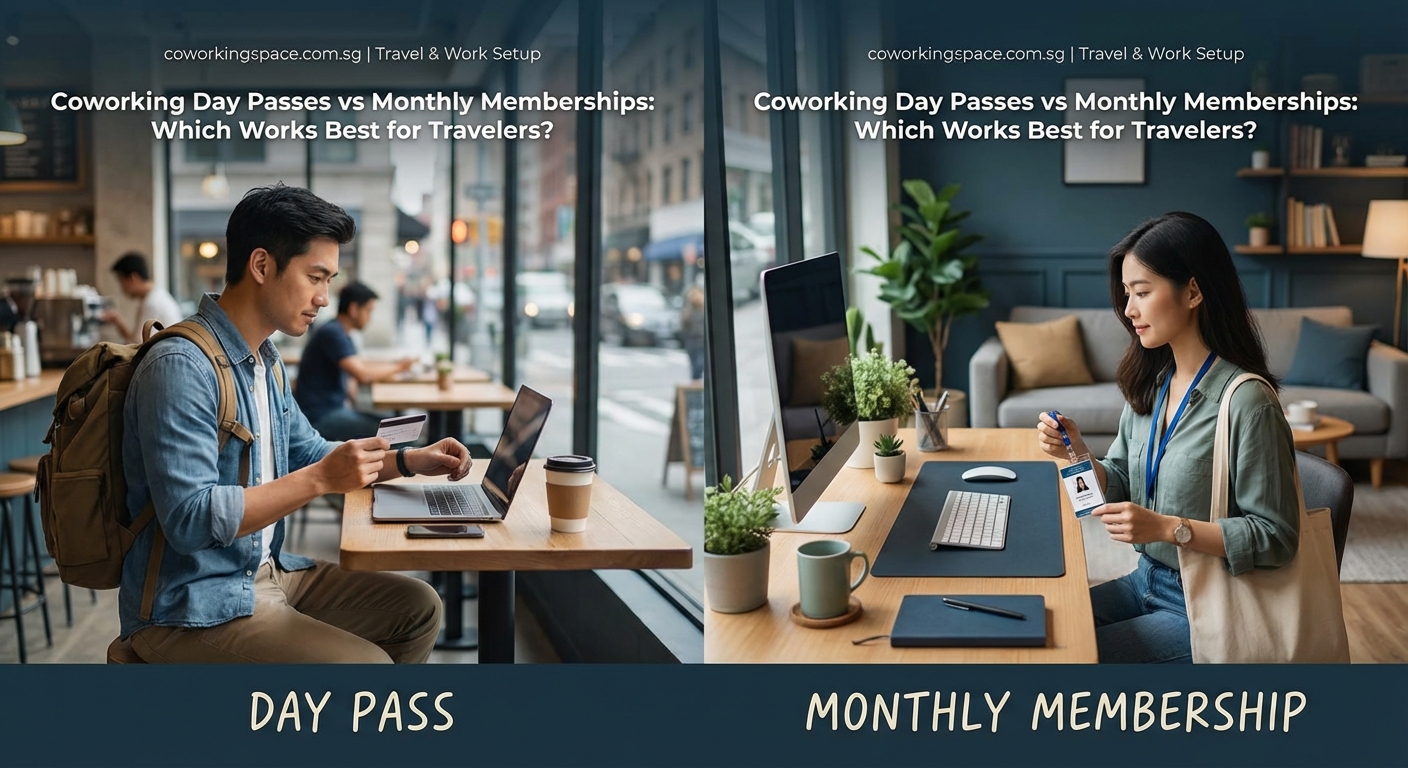
Monthly memberships come in tiers, not one-size-fits-all packages.
Hot desk memberships typically range from $250 to $400 monthly. You get access every business day, but you don’t have an assigned spot. You choose any available desk when you arrive.
Dedicated desk memberships run $450 to $600 monthly. Same desk every day, storage space, and priority booking for meeting rooms.
Some spaces offer hybrid packages. Five-day passes valid for any five days that month, priced around $150 to $200. Ten-day packages at $250 to $350.
Monthly members usually get:
- 24/7 access (or extended hours)
- Unlimited printing allowances
- Free meeting room hours (2 to 10 hours monthly)
- Mail handling services
- Community event access
- Guest passes for clients or collaborators
The commitment varies. Some spaces require three-month minimums. Others go month-to-month after an initial period. A few offer true month-to-month from day one, though they charge slightly more for that flexibility.
Understanding different membership types helps you match your work style to the right tier.
Calculating Your Break-Even Point
Math tells the truth about which option saves money.
Take your expected monthly workspace days and multiply by the average day pass cost. Compare that to monthly membership fees.
Here’s a practical example:
| Usage Pattern | Day Pass Cost (15 days) | Monthly Membership | Savings |
|---|---|---|---|
| 5 days/month | $175 | $300 | Day pass wins |
| 10 days/month | $350 | $300 | Membership wins |
| 15 days/month | $525 | $300 | Membership wins significantly |
| 20 days/month | $700 | $300 | Membership wins by $400 |
The break-even point typically hits around 8 to 12 days, depending on local pricing.
But pure cost isn’t everything. Factor in:
- Meeting room needs (members get free hours)
- Printing volume (day passes often limit pages)
- Mail handling requirements
- Networking event access
- Guest privileges
A monthly membership at $350 that includes 5 hours of meeting room time effectively costs less if you’d otherwise pay $30 per hour for those rooms.
Budget considerations extend beyond the base membership fee.
Flexibility Factors That Impact Your Decision
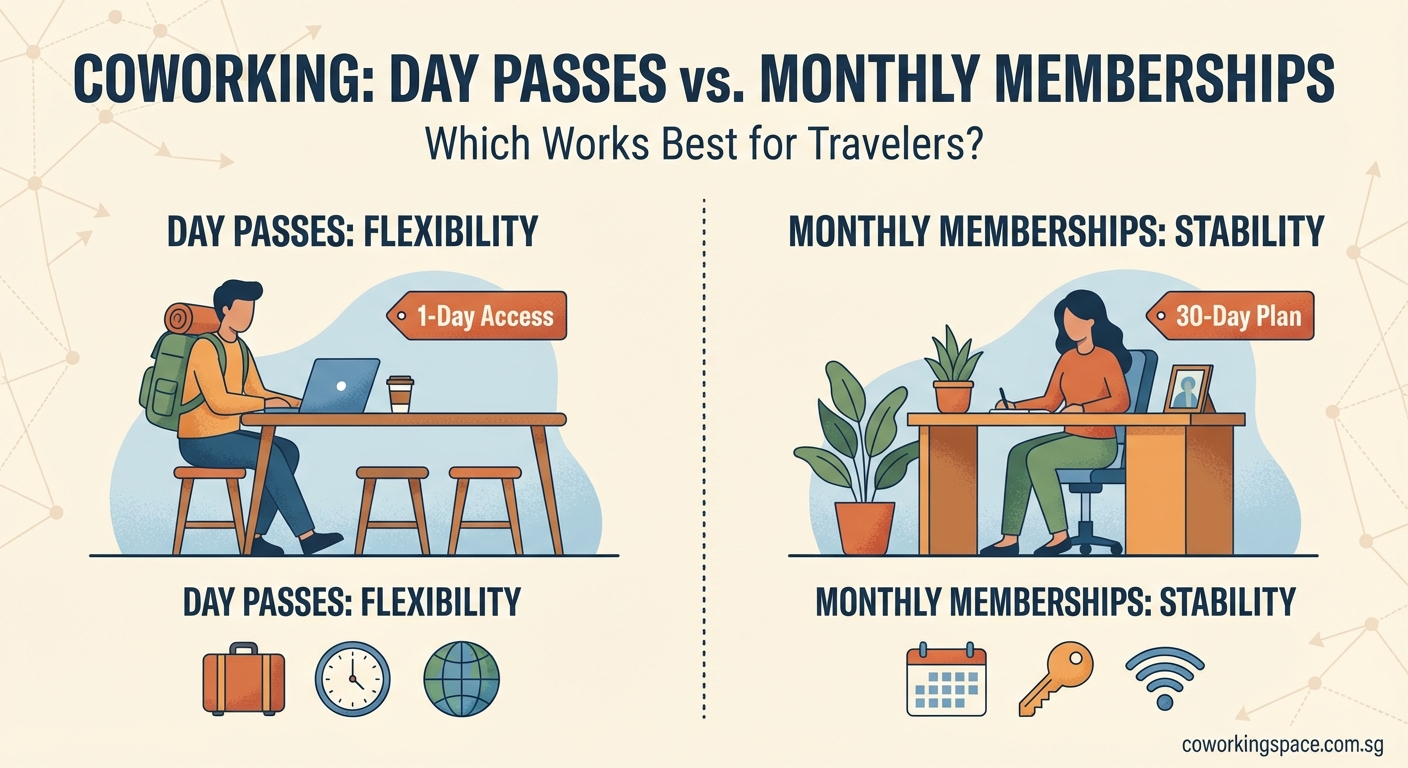
Your travel pattern matters more than average costs.
If you’re island-hopping through Southeast Asia, spending two weeks in Singapore, one week in Bali, two weeks in Bangkok, day passes make sense. You’re never in one city long enough to justify monthly commitments.
But if Singapore is your base for three months while you take weekend trips, a monthly membership wins. You have consistent workspace when you’re in town, and you’re not paying for days you’re away.
Consider your work rhythm too. Some remote workers need workspace every single day for structure and separation from home. Others work from their apartment most days and only need coworking space for client calls or focus sessions.
Monthly memberships work best when you can predict your schedule at least two weeks ahead. Day passes excel when your plans change with 24 hours notice.
The psychological factor is real. Having a monthly membership creates routine. You know where you’re working tomorrow. Your workspace is waiting. That certainty helps some people maintain productivity.
Day passes keep options open but require daily decisions. Where will I work today? Is that space available? Do I feel like going out or staying home? Decision fatigue adds up.
Hidden Costs and Value-Adds to Consider
The sticker price doesn’t tell the complete story.
Day passes often come with limitations:
- No storage (carry everything daily)
- Limited printing credits (5 to 10 pages)
- Meeting room access charged separately ($20 to $40 per hour)
- No mail handling
- Peak hour restrictions at some locations
- Guest policies vary wildly
Monthly memberships include perks that offset the base cost:
- Secure storage locker or drawer
- Unlimited standard printing
- 2 to 10 free meeting room hours
- Professional business address
- Guest passes (2 to 5 monthly)
- Community events, workshops, happy hours
- Discounts at partner cafes and services
Some spaces offer reciprocal access. Your Singapore membership might include day passes at partner locations in other cities. If you’re traveling through Asia, that network access adds significant value.
Insurance and liability matter too. Regular members typically get coverage included. Day pass users might need separate coverage for equipment or liability concerns.
The amenities available often differ between pass types and membership levels.
Matching Options to Different Traveler Profiles
Different work styles need different solutions.
The Weekend Warrior visits Singapore monthly for 3 to 5 days. Day passes win. Total monthly cost stays under $200. No wasted membership fees when you’re back home in Jakarta or Manila.
The Extended Stay Traveler spends 6 to 12 weeks in one location before moving on. Monthly membership makes sense. Even with a three-month minimum, the per-day cost beats daily rates. Cancel before your next destination.
The Frequent Returner comes to Singapore quarterly for two-week stretches. This one’s tricky. Day passes work if visits are unpredictable. But if you’re coming every three months like clockwork, some spaces offer quarterly packages that split the difference.
The Slow Traveler stays 3 to 6 months per city. Monthly membership is obvious. You’re practically a local. Get the dedicated desk, build community, and maximize the value of consistent space.
The Business Traveler needs professional space for client meetings during week-long trips. Day passes with meeting room access work, but calculate whether a monthly membership with included meeting hours costs less across multiple trips.
The Digital Nomad Hub-Hopper works from different neighborhoods throughout the month. Day passes at multiple locations provide variety. Or choose a coworking network with multi-location access under one membership.
For those staying short-term, location flexibility often trumps cost savings.
Trial Strategies Before Committing Long-Term
Smart travelers test before investing.
Start with day passes at three different spaces. Work a full day at each. Pay attention to:
- Internet speed during peak hours (test video calls)
- Noise levels throughout the day
- Desk availability and competition for spots
- Community vibe and networking potential
- Proximity to your accommodation
- Food options nearby or on-site
- Cleanliness and maintenance standards
Take notes immediately after each visit. Your impressions fade fast.
Many spaces offer trial weeks. Five consecutive days at a reduced rate, usually 30% to 40% off the monthly membership. This gives you real experience with the commute, daily routine, and community before committing.
Ask about refund policies. Some spaces offer prorated refunds if you need to leave early due to travel changes. Others don’t refund but let you freeze membership for a month.
Check cancellation terms carefully. “30-day notice” means you pay for an extra month after deciding to leave. “End of current billing cycle” is more flexible.
Request a tour during your intended work hours. A space that’s perfect at 10am might be chaotic at 2pm when the afternoon crowd arrives.
Common mistakes when choosing your first space include signing up based on photos alone or choosing the closest location without considering work style fit.
When Hybrid Approaches Make the Most Sense
You don’t have to choose just one option forever.
Many travelers use both strategically. Monthly membership at your primary workspace, plus day passes at other locations for variety or when your main space is full.
This hybrid approach works well for:
- Testing new neighborhoods before relocating
- Accessing specific amenities (some spaces have better meeting rooms, others have better focus zones)
- Maintaining routine while keeping options open
- Building networks in multiple communities
Some coworking spaces offer “plus” memberships. You get a home base with dedicated access, plus a certain number of day passes at partner locations. These packages typically cost 20% to 30% more than standard monthly memberships but provide genuine flexibility.
Another hybrid strategy: monthly membership during busy work periods, switching to day passes during lighter months. If you know January through March are intense project months, commit to membership then. Use day passes in slower seasons when you’re working less or traveling more.
Network memberships provide the ultimate hybrid solution. One monthly fee gives you access to dozens of locations globally. Coworking near Changi Airport might be perfect for early morning flights, while a space in the CBD works better for client meetings.
The key is honest assessment of your actual usage patterns, not aspirational ones.
Practical Steps to Make Your Decision
Follow this process to choose confidently:
-
Track your current workspace usage for two weeks. How many days do you actually need professional space versus working from accommodation?
-
Calculate your break-even point using real prices from spaces you’re considering. Include meeting room needs and printing volume.
-
Assess your travel certainty. Do you know you’ll be in Singapore for the next month, or might plans change with 48 hours notice?
-
Test three spaces with day passes before committing. Different locations have dramatically different cultures and work environments.
-
Review your budget constraints. Can you afford the upfront monthly cost, or do you need the pay-as-you-go flexibility of day passes?
-
Consider your work style needs. Do you need routine and consistency, or variety and spontaneity?
-
Check contract terms carefully. Understand cancellation policies, refund options, and minimum commitments before signing.
-
Factor in secondary benefits. Will you use community events? Do you need mail handling? Is meeting room access valuable?
Create a simple spreadsheet:
- Column A: Expected workspace days this month
- Column B: Day pass cost per day
- Column C: Total day pass cost (A × B)
- Column D: Monthly membership cost
- Column E: Difference (C minus D)
If Column E is positive, membership saves money. If negative, day passes cost less.
But also list non-financial factors:
- Routine and structure value
- Community access importance
- Flexibility requirements
- Storage needs
- Professional image concerns
These qualitative factors often tip the decision when the math is close.
Real-World Scenarios from Traveling Professionals
Sarah, a freelance designer, spent two months in Singapore. She started with day passes, spending $40 daily at premium spaces. After 8 days ($320), she switched to a $350 monthly membership. The remaining 35 days cost her $10 per day effectively. She saved approximately $800 versus continuing with day passes.
Marcus, a consultant visiting Singapore quarterly for 10-day stretches, sticks with day passes. His total quarterly cost is $350 to $400. A monthly membership would require paying for months he’s not in Singapore. Day passes give him flexibility to work from different neighborhoods based on client locations.
Jennifer and Tom, a couple working remotely while traveling Asia, use a hybrid approach. Jennifer maintains a monthly membership at her favorite space ($300) because she needs consistent workspace and community. Tom uses day passes ($35 each) on days he needs to escape their apartment, averaging 5 to 6 days monthly. Their combined cost ($475 to $510) is less than two monthly memberships.
David, a business traveler spending one week monthly in Singapore, calculated that day passes plus meeting room rentals cost $450 per visit. He switched to a monthly membership ($400) that includes 5 meeting room hours. Even though he only uses the space 5 to 7 days monthly, the meeting room access makes membership worthwhile.
These real examples show there’s no universal answer. Your situation determines the best choice.
Making the Switch Between Options
Your needs change as your travel patterns evolve.
Switching from day passes to monthly membership is straightforward. Most spaces welcome the upgrade. Some even credit recent day pass purchases toward your first month.
Give yourself permission to change approaches. Starting with day passes while you figure out your routine is smart. Committing to membership once you’ve found the right space makes sense.
Going from monthly membership back to day passes requires more planning. Review your contract terms. Give proper notice. Some spaces let you downgrade mid-month with prorated adjustments.
If you’re leaving a city but plan to return, ask about pause options. A few spaces let you freeze membership for one or two months without losing your desk or community standing.
Evaluating spaces efficiently becomes easier once you know what matters most for your work style.
Finding the Right Balance for Your Work Life
The coworking day pass versus monthly membership decision isn’t permanent or universal.
Your choice should match your current situation, not some ideal future scenario. If you’re in Singapore for three weeks, don’t force a monthly membership just because the math says it saves $50. The flexibility of day passes might be worth that cost.
Conversely, if you know you’ll work from coworking spaces 15 days this month, don’t cling to day passes out of fear of commitment. The membership will save you money and provide better amenities.
Start with the option that feels right for your immediate needs. You can always adjust. The beauty of coworking is that these spaces understand travelers and remote workers. They’ve seen every pattern and usually accommodate changes gracefully.
Track your actual usage for a month. Let real data guide your next decision. You might surprise yourself with how often (or rarely) you actually use workspace versus working from your accommodation or cafes.
The goal isn’t finding the perfect option. It’s finding the option that works well enough for your current travel phase while keeping your budget in check and your productivity high.