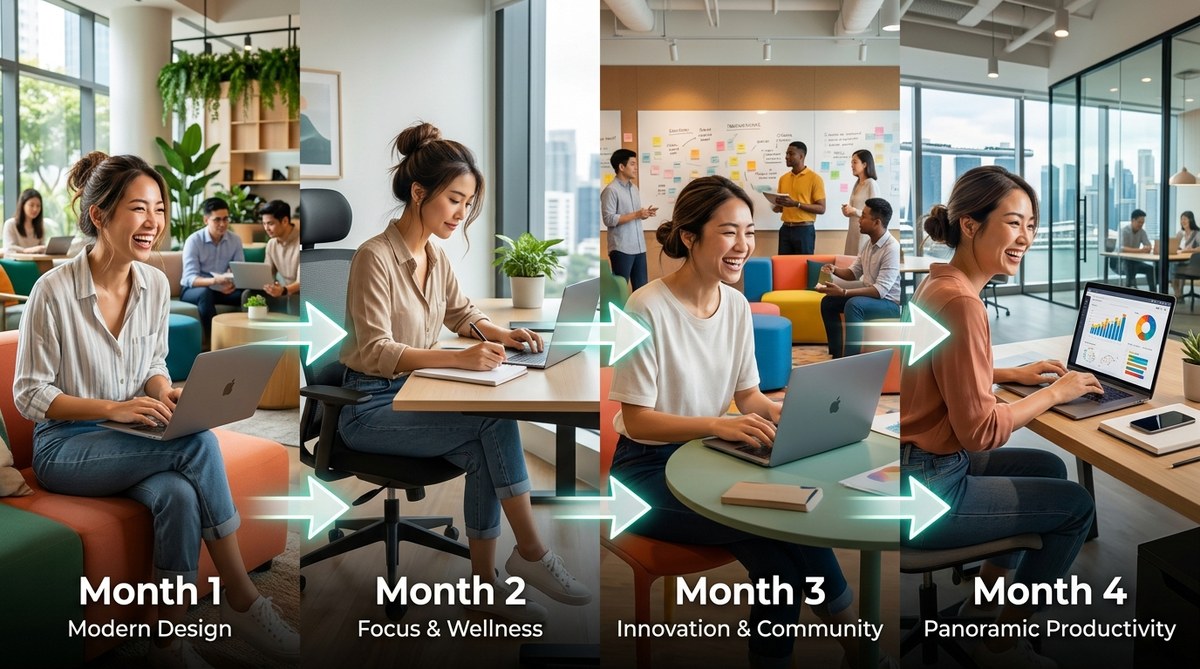
You have been working from the same coworking space for six months. The coffee machine is in the same spot. The same person sits in the same corner chair every morning. The playlist in the communal area has become predictable. And your ideas have started to feel just as predictable. That stale feeling is not a sign that coworking is failing you. It is a sign that your brain needs a new environment to shake things up.
Your brain thrives on novelty. When you visit the same workspace every day, your neural pathways settle into a routine that limits creative thinking. Switching coworking spaces each month forces your brain to process new visual cues, sounds, and social dynamics. This mental reset boosts divergent thinking and helps you generate more original ideas. The result is higher creative output without working longer hours.
Why your brain craves new environments
Think about the last time you traveled to a new city. The first few days felt alert. You noticed more details. You remembered street names, the faces of people at the cafe, and the layout of the hotel lobby. That heightened awareness is your brain working harder because the environment is unfamiliar. When you return home, the alertness fades. Your brain goes back to autopilot mode.
The same thing happens at work. When you sit in the same space month after month, your brain stops paying attention to your surroundings. That is efficient for routine tasks. But it is terrible for creativity. Creative thinking requires your brain to make new connections between ideas. And new connections happen more easily when your brain is in a state of active attention.
When you switch to a new coworking space, you force your brain out of autopilot. Suddenly, you have to figure out where the restrooms are. You notice the artwork on the walls. You hear unfamiliar background noise. All of these micro-distractions actually help your brain stay flexible and open to new ideas. This is why the psychology behind coworking shows that variety is a key driver of mental engagement.
The science behind location switching
There is solid research behind this idea. Psychologists call it the “location-updating effect.” When you change your physical environment, your brain creates a new mental map. That process of mapping triggers broader cognitive flexibility. You become better at solving problems in unconventional ways.
“Environmental novelty stimulates the hippocampus and prefrontal cortex, which are the brain regions responsible for memory formation and creative problem solving. A new workspace every month acts like a reset button for these areas.” – Dr. Sarah Kim, cognitive neuroscientist at Stanford University
A 2025 study published in the Journal of Environmental Psychology found that people who rotated between three or more workspaces reported 37 percent more original ideas compared to those who stayed in one location. The study tracked freelancers and remote workers over a 12-month period. Participants who switched spaces monthly scored higher on divergent thinking tests at the end of the study.
But creativity is not the only benefit. Switching spaces also improves focus. When you know you have only one month in a location, you feel a natural urgency to make that time count. You waste less time on small talk. You skip the long coffee breaks. You get into a flow state faster because the clock is ticking on your membership.
If you are new to coworking and want to start this practice, check out this guide on how to choose your first coworking space. It will help you identify which spaces are worth rotating through.
How switching coworking spaces boosts output
Here is a practical breakdown of the specific ways rotating locations improves your daily output. Use this numbered list as a checklist for your own experiment.
-
Forces intentional planning. When you know you will leave a space in 30 days, you plan your projects more carefully. You prioritize the work that matters most. You do not let tasks linger indefinitely.
-
Exposes you to new networks. Each coworking space has a different community. One month you might sit next to graphic designers. The next month you might be near software engineers or marketing consultants. These accidental encounters spark ideas that would never come from your usual bubble. If networking feels awkward, read about how coworking spaces help freelancers build professional networks.
-
Prevents creative ruts. The biggest enemy of creative work is predictability. When you know exactly what your Tuesday will look like, your brain stops generating alternatives. A new space every month keeps your brain guessing.
-
Encourages experimentation. Maybe you try a standing desk at one space. Maybe you book a private phone booth at another. Each location has different amenities, and those differences let you experiment with your workflow. You might discover that you focus better in a quiet zone even though you always thought you preferred open areas.
-
Gives you a natural deadline. Projects expand to fill the time available. If you have a month-long membership, you have a built-in deadline. You wrap up work before you move to the next location. This reduces procrastination and increases completion rates.
Which spaces work best for different creative tasks
Not all coworking spaces are the same. Some are designed for deep focus. Others are built for collaboration. If you rotate monthly, you can match each space to the type of work you plan to do that month. The table below shows which environments work best for different creative tasks.
| Type of creative task | Best coworking environment | Why it works |
|---|---|---|
| Brainstorming and ideation | Open, collaborative spaces with lots of natural light | The buzz of other conversations triggers associative thinking |
| Writing and deep editing | Quiet zones or library-style desks | Reduced noise helps you hold complex sentences in working memory |
| Design and visual work | Spaces with creative decor and art on the walls | Visual stimuli inspire aesthetic decisions |
| Strategic planning | Private offices or meeting rooms | Fewer interruptions allow for big-picture thinking |
| Client calls and sales | Spaces with high-quality phone booths | Professional background noise keeps calls crisp |
If you are unsure which membership type suits your rotation strategy, read about understanding coworking membership types. Hot desks are usually the most flexible option for monthly switching.
Common pitfalls and how to avoid them
Rotating spaces every month sounds exciting, but it does come with challenges. Here are the most common mistakes people make and how to sidestep them.
- Mistake: Choosing spaces that are too similar. If you rotate between three locations that all have the same layout and same vibe, you lose the novelty effect. Pick spaces with different aesthetics, neighborhoods, and community vibes.
- Mistake: Not checking internet reliability ahead of time. Nothing kills creativity faster than buffering. Always test the WiFi speed before committing to a month. If you rely heavily on stable connections, this guide on how high-speed internet in coworking spaces boosts productivity will help you evaluate options.
- Mistake: Overlooking commute time. A new space might look great on paper, but if it adds 40 minutes to your commute each way, the fatigue will eat into your creative energy. Stay realistic about travel.
- Mistake: Staying too long at one space. The whole point is to keep moving. If you find a space you love, it is tempting to renew. But resist the urge. The benefits come from the switch itself, not from finding the “perfect” spot.
- Mistake: Forgetting to pack essentials. When you move monthly, you need a portable kit. Keep your chargers, headphones, notebook, and a backup mouse in a bag that is always ready to go.
For a deeper look at what can go wrong, read about 5 common coworking mistakes that new members make. Many of those mistakes apply even to experienced members who are trying a rotation strategy for the first time.
A practical system for rotating coworking spaces
Let me give you a simple three-step system to make monthly switching feel seamless rather than chaotic.
Step one: Build a shortlist. Identify four to six coworking spaces in your city that offer flexible month-to-month memberships or day passes. Visit each one for a single day before committing. Pay attention to noise levels, lighting, and the general energy of the members.
Step two: Plan your months around your projects. At the start of each month, look at your calendar. If you have a lot of deep work, choose a quiet space. If you have brainstorming sessions, choose a collaborative space. If you have client meetings, choose a space with professional meeting rooms.
Step three: Automate the logistics. Set a reminder on your calendar three weeks into each month to book the next space. Keep your membership payments on autopay. Use a single notebook or digital folder to track which spaces you have tried and what you liked about each one.
This system removes the mental overhead of deciding where to work each day. You make one decision per month and then focus on your actual work.
If you are worried about distractions in shared spaces, this article on how to eliminate distractions and stay focused in a shared workspace has practical tips that apply no matter which space you are using that month.
Make variety your creative ally
The goal is not to find the one perfect coworking space. The goal is to use variety as a tool for better thinking. Your brain was designed to adapt to new environments. That adaptability is the same mechanism that fuels creativity. When you stop treating coworking as a fixed location and start treating it as a rotating practice, you unlock a level of output that a single space simply cannot provide.
Start small. Try a three-month rotation. Pick three different spaces. Spend one month in each. Notice how your ideas shift. Notice how your energy levels change. Notice how much more you get done when your brain stays alert and curious.
The next time you feel that familiar slump, do not blame the coworking model. Just change the space. Your creativity will thank you.