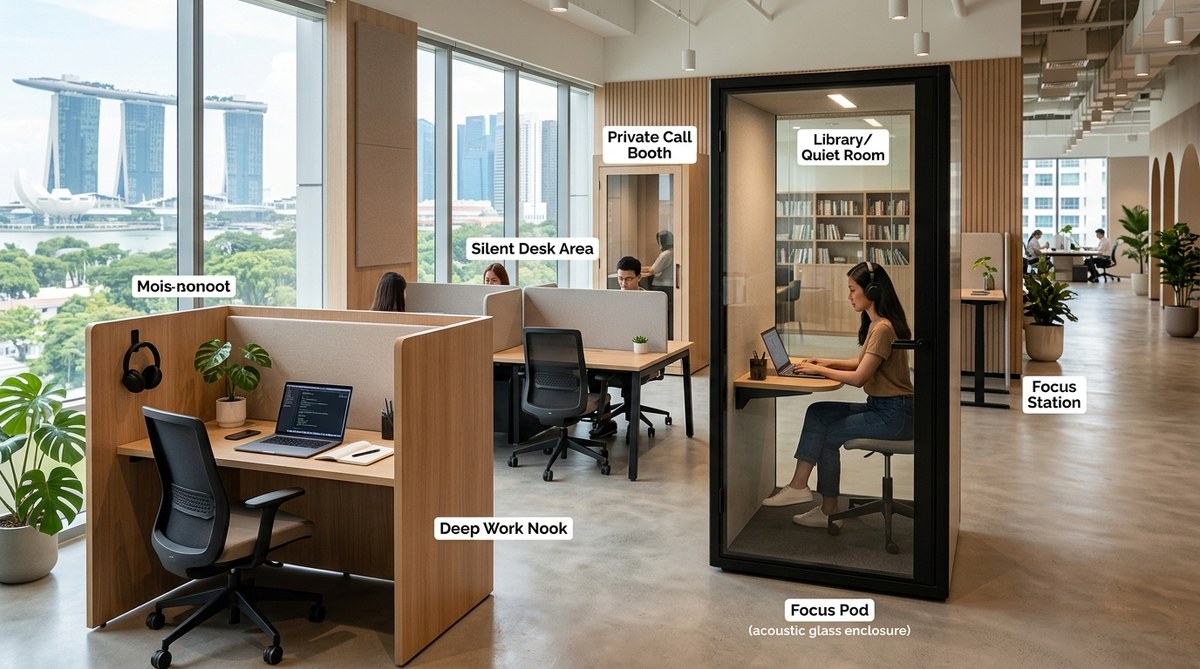
You walk into a coworking space, grab a coffee, and sit down at an open desk. Fifteen minutes later, someone takes a loud call nearby. Then you hear the whir of a milk frother. Your focus shatters. It doesn’t have to be this way. The same space that distracts you can also become your secret weapon for deep work. The difference comes down to one thing: how you use the layout around you.
Coworking spaces are designed with multiple zones for a reason. Matching your task to the right zone, timing your visits during low-traffic hours, and using simple tools like noise-canceling headphones can turn a chaotic shared office into a focused sanctuary. The layout is your ally, not your enemy.
Why Shared Spaces Can Actually Help You Focus
Working from home has its own pitfalls. The laundry calls. The fridge beckons. Your bed whispers “nap time.” A coworking space removes those temptations. But it introduces new ones: conversations, phone rings, and the clatter of keyboards.
The trick is to stop fighting the environment and start using it. Think of a coworking space like a public library. Some areas are for quiet reading. Others are for group discussion. The same logic applies here. When you match your work mode to the correct zone, you tap into something called “contextual productivity.” Your brain learns to associate a certain chair or table with focused work.
The Three Main Zones and How to Use Them
Most coworking spaces have three distinct areas. Knowing which one to pick at the right moment is your first productivity win.
The Open Collaborative Zone
This is the loudest area. It is designed for chatter, brainstorming, and quick hellos. Use this zone only for shallow work. Think of tasks like answering emails, scheduling social media posts, or updating your to-do list. Save your deep thinking for somewhere quieter.
The Quiet Zone
This is your deep work headquarters. Usually marked by signs or located behind a glass door, this area enforces silence. No calls. No loud conversations. Here, you write code, draft reports, or analyze data. If your coworking space has a designated quiet floor, book a seat there for your most important tasks.
The Private Booth or Phone Pod
These small, soundproof rooms are gold mines for focused calls or video recordings. They also work well for a 45-minute sprint of concentrated work. Reserve one through your space’s app when you need total isolation.
A Simple Process to Plan Your Day Around the Layout
Do not just show up and hope for the best. Use this numbered process to turn your coworking space into a productivity machine.
- Scan the floor plan on your app before you leave home. Identify which zones are available and how full they look. If the quiet zone is packed, arrive early or pick a different day.
- Arrive and do a five-minute walkthrough. Walk past each zone. Notice the noise level and the vibe. Trust your gut. If the open area feels too buzzy, move to a booth.
- Match your first task to the zone. Start with deep work in the quiet zone. Do shallow tasks later in the open area.
- Set a timer for 90 minutes. Use the Pomodoro technique or a simple countdown. When the timer goes off, stand up and walk to a different zone. This physical reset helps your brain stay fresh.
- End your session with a shutdown ritual. Pack your bag, clear your desk, and write down your top three tasks for tomorrow. This signals to your brain that work is done.
Common Mistakes and Better Approaches
Here is a table that shows what usually goes wrong and what to do instead.
| Mistake | Why It Hurts Focus | Better Approach |
|---|---|---|
| Sitting in the same spot every day | Your brain gets bored and distracted | Rotate zones based on your task type |
| Keeping your phone on the desk | Notifications pull you out of flow | Place your phone in your bag or a locker |
| Skipping noise-canceling headphones | Ambient chatter becomes a distraction | Use headphones even in quiet zones for extra isolation |
| Working during peak lunch hours | High traffic and noise break concentration | Arrive at 8 AM or after 1 PM |
| Ignoring the booking system for booths | You miss out on private space | Book a booth for your most critical work block |
Tools That Make the Layout Work for You
You do not need expensive gadgets. A few simple items can transform any desk into a deep work station.
- Noise-canceling headphones. These are non-negotiable. Even in a quiet zone, they create a bubble of silence.
- A physical timer. Your phone timer is fine, but a separate kitchen timer keeps your phone out of sight.
- A small desk lamp. Some coworking spaces have dim lighting. A warm desk lamp creates a focused pool of light.
- A notebook and pen. Writing by hand helps you think. Keep it on the desk for quick notes.
“The best coworking members I see treat the space like a toolkit. They pick the right tool for the job. They do not try to force every task into the same corner.” – Sarah, community manager at a Singapore coworking hub.
How to Choose the Right Desk for Your Work Style
Not all desks are created equal. Your choice should depend on the type of work you plan to do.
- High-top tables are great for standing and for short bursts of work. They discourage lounging.
- Low couches and lounge chairs are for reading or brainstorming. Do not do deep work here.
- Standard desks with good back support are your bread and butter for focused sessions. Look for desks near a window or a wall, not in the middle of a walkway.
- Booths with high backs offer privacy and reduce visual distractions. Use these for video calls or writing.
When to Visit for Maximum Focus
Timing is everything. The busiest hours in most coworking spaces are between 10 AM and 11:30 AM, and again after lunch from 1:30 PM to 3 PM. If you can adjust your schedule, try these windows:
- 8 AM to 10 AM. The space is quiet. You get first pick of the best desks. This is prime deep work time.
- 11:30 AM to 1 PM. Many members step out for lunch. The noise drops. Use this window for shallow tasks or a second deep session.
- After 4 PM. The afternoon lull sets in. Some people leave early. This can be a good time for planning or creative thinking.
If your schedule forces you to work during peak hours, book a private booth in advance. Most coworking apps let you reserve a spot up to 24 hours ahead.
A Bulleted List of Quick Wins
Here are small changes you can make today to improve your focus.
- Pick a desk that faces away from the main walkway.
- Use a website blocker on your laptop during deep work blocks.
- Keep a water bottle on your desk to avoid trips to the pantry.
- Set your phone to “do not disturb” mode for the whole session.
- Wear a hat or hoodie to signal to others that you are in the zone.
- Clean your desk of all clutter before you sit down.
- Use a standing desk for the first 30 minutes to boost alertness.
Why Layout Matters More Than You Think
The physical arrangement of a coworking space is not just decoration. It is a map of how you should work. Open areas encourage movement and quick interactions. Quiet zones invite stillness and depth. Private booths offer a cocoon for intense focus.
When you understand this map, you stop blaming the space for your distractions. You start using it as a tool. The same layout that used to break your flow can now become your flow’s best friend.
Putting It All Together for Your Next Visit
Next time you walk into a coworking space, pause at the entrance. Look around. Ask yourself: what kind of work am I here to do? Then walk to the zone that matches that work. Sit down. Set a timer. Put on your headphones. Start.
If you feel your focus slipping, change zones. Move from the open area to a booth. Or step outside for five minutes. The layout is flexible. Use it.
For more guidance on picking the right space for your needs, read our guide on how to choose your first coworking space in Singapore. If you are curious about the science behind why shared spaces work, check out the psychology behind coworking. And if you are making the switch from home, our article on coworking vs working from home might help you decide.
Your Focus Is in Your Hands
The coworking space is a stage. You are the actor. The layout gives you the sets. You get to choose which set to use for each scene. Some days you need the quiet library. Other days you need the busy coffee shop. Both are available to you.
Start small. Tomorrow, pick one zone for your hardest task. See how it feels. Adjust from there. Deep work is not about finding the perfect space. It is about using the space you have with intention. You have everything you need to make it happen.