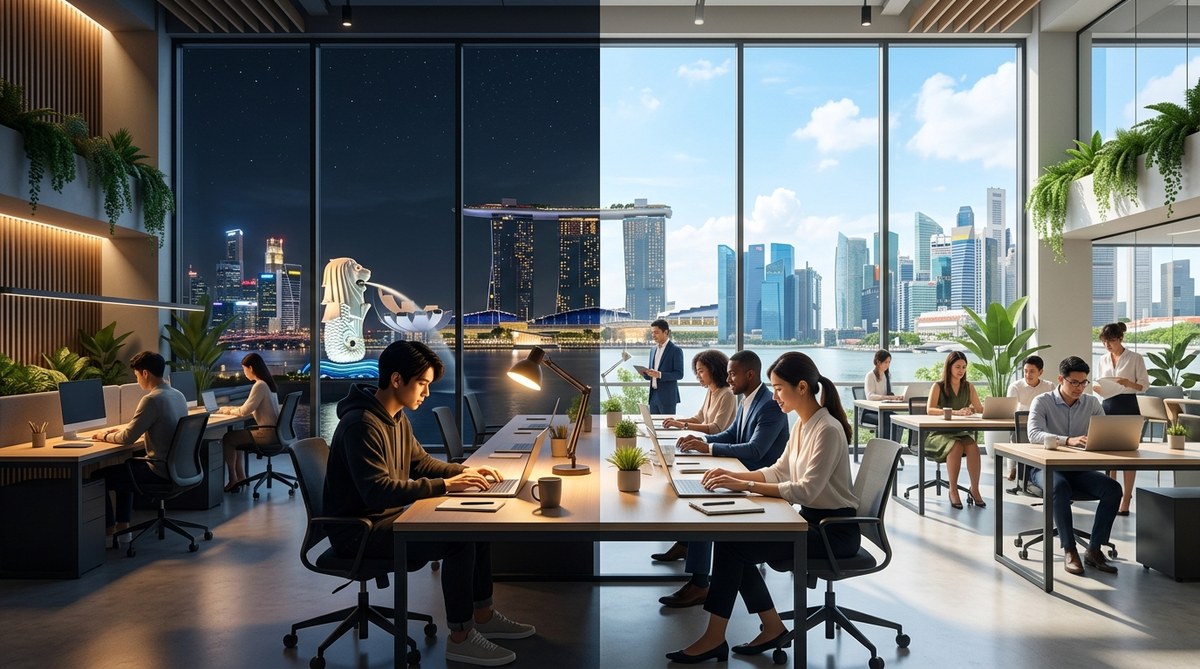
The sun sets over the Marina Bay skyline, and a significant chunk of Singapore’s workforce is just hitting their stride. If you are a freelancer catching up on US time zones, a startup founder coding your MVP until 4 AM, or a night owl who simply does your best work after midnight, a standard 9-to-6 coworking membership feels like wearing shoes that are too tight. You need a workspace that molds to your schedule, not the other way around. That is exactly why 24/7 coworking in Singapore has become an essential resource for independent professionals in 2026.
Standard hour memberships lock you into a 9-to-6 routine, but 24/7 access gives night owls and global remote workers the freedom to work on their own time. In Singapore, the premium for round-the-clock access is often worth the investment for the productivity gains, quieter environment, and flexibility it provides. Choose based on your actual work rhythm, not just the price tag.
Why Standard Hours Don’t Cut It in a 24/7 World
The traditional 9-to-6 workday is a relic of the industrial era. In the current global economy, your biggest client might be based in New York, London, or San Francisco. When they are starting their day, you are winding down yours. If you are stuck in a space that kicks you out at 6 PM, you are either cutting calls short or scrambling to find a coffee shop that won’t mop the floors around you at 9 PM.
Standard hour memberships were designed for employees with fixed shifts, not for the modern, agile workforce. For entrepreneurs and freelancers, inspiration and deadlines don’t follow a clock. Crunch periods happen. International calls happen. Your workspace should be the one thing that doesn’t add friction to your day. When it does, your productivity takes a direct hit.
Who Actually Needs 24/7 Access in Singapore?
Before you pull the trigger on a membership, ask yourself if you really fit the profile. Here are the people who benefit most from a 24/7 coworking setup:
- Freelancers serving global clients: Your 9 AM is their midnight. You need to be online when they are online.
- Startup founders: Building a company from scratch requires hours that no HR department would approve of.
- Night owl creatives: Graphic designers, writers, and software developers who enter a flow state at 1 AM and don’t want to break it.
- Shift workers and side hustlers: People with non-traditional day jobs who need a serious, quiet space to work on their second act.
- Digital nomads passing through: Jet lag doesn’t care about operating hours. Some Singapore digital nomads find it easier to work through the night when they first arrive.
If you see yourself in any of these groups, limiting yourself to standard hours is a hidden tax on your potential.
Breaking Down the Access Technology
You might be wondering how 24/7 access actually works without a full security staff on site at 3 AM. In 2026, the technology is mature and reliable. Most top tier spaces use a combination of:
- Encrypted keycards or fobs: Your membership card is programmed to unlock the main door and your specific floor.
- Biometric verification: Thumbprint or facial recognition scanners add an extra layer of security for night time entry.
- Mobile app integration: You can unlock doors, book rooms, and call for assistance directly from your phone. This is especially useful if you forget your card.
- 24/7 remote monitoring: Security cameras and sometimes remote guards oversee the space, so you are never truly alone.
This setup ensures that only paying members have access. It is actually safer than a regular office building where the front desk staff might wave anyone through.
Standard Hours vs 24/7 Access and the Real Cost Difference
Let’s talk numbers. The price gap between a basic hot desk plan and a 24/7 plan has shrunk over the last few years, but it still exists. Here is how they stack up:
| Feature | Standard Membership | 24/7 Access Membership |
|---|---|---|
| Monthly Cost (Avg) | $200 – $400 SGD | $350 – $600 SGD |
| Access Hours | 9am – 6pm, Weekdays | Anytime, every day |
| Best for | Fixed schedule workers | Night owls, global teams |
| Quiet Time | Limited (peak hours) | Excellent (after 10 PM) |
| In-Person Networking | High (daytime events) | Low (unless you participate in planned events) |
| Security | Standard daytime | Enhanced after-hours |
| Hidden Perk | Prime location options | Guaranteed parking spots |
“Don’t look at the 24/7 premium as an extra cost. Think of it as investing in your highest output hours. If you do your best thinking between 11 PM and 3 AM, that additional $200 per month usually pays for itself within a week.” – A Singapore based startup founder who exclusively uses 24/7 coworking spaces.
Maximizing Your Productivity During Off-Peak Hours
Working at night is a different beast. The energy is calmer, but you also have fewer resources and people around. Here is how to make the most of your 2 AM work sessions:
- Secure your perimeter. It can feel isolating at night. Park yourself near a well lit common area or a phone booth, not in a hidden corner far from the restrooms.
- Test the lighting. Not all spaces have great task lighting after the main lights dim. Bring a portable monitor or a small LED lamp if you need focused light.
- Stock your own snacks. The cafes are closed. The pantry might be empty. Pack a bag of healthy fuel so you don’t burn out at 1 AM.
- Respect the silence. You will likely share the floor with only a few other people. Keep calls inside the soundproof pods. It is basic coworking etiquette.
- Lock your gear. Even in a secure space, a $3,000 laptop is a target. Never leave your desk unattended, even for a bathroom break.
Following these steps will keep you safe, focused, and welcome in the space. For more tips on avoiding friction, check out this guide on 5 common coworking mistakes that new members make.
The Trade-Off: Community vs. Solitude
There is a trade-off to working nights. You miss the daytime hum. The spontaneous coffee chats. The free flow beer at 5 PM on a Thursday. That human interaction is often how freelance professionals build their networks and find their next project.
To mitigate this, you have to be intentional. Make it a point to visit the space during daytime hours occasionally. Join the weekend community events. Send a note on the community Slack channel asking if anyone wants to grab lunch. If you don’t actively cultivate those relationships, you will miss out on a huge chunk of the coworking value. Read more about why some coworking spaces have stronger communities than others to know what to look for.
How to Decide if 24/7 Access Is Right for You
Choosing between standard and 24/7 access comes down to honesty about your own habits. Follow this simple process:
- Track your energy for two weeks. Are you genuinely a night owl, or are you just procrastinating and then rushing to catch up?
- Calculate the value of your time. If you lose 2 hours every afternoon waiting for US clients to wake up, the math favors a 24/7 membership.
- Visit the space at the time you will actually use it. Do not tour a space at 3 PM if you plan to work at 3 AM. Ask for a trial night pass before committing.
- Read the fine print. Some “24/7” spaces close for public holidays or deep cleaning. Know exactly what “unlimited access” means before you sign.
Aligning Your Workspace with Your Internal Clock
Your work schedule is deeply personal. It influences your energy, your focus, and the quality of what you produce. In a fast moving city like Singapore, your workspace should never force you into a mold that doesn’t fit. Whether you choose the buzzing energy of a standard hour space or the silent sanctuary of a 24/7 hub, make sure it serves your specific rhythm. Visit a few spaces, ask the hard questions about after hours security and amenities, and give yourself the gift of a workspace that matches your ambition. No matter when the sun rises, your best work should already be done.