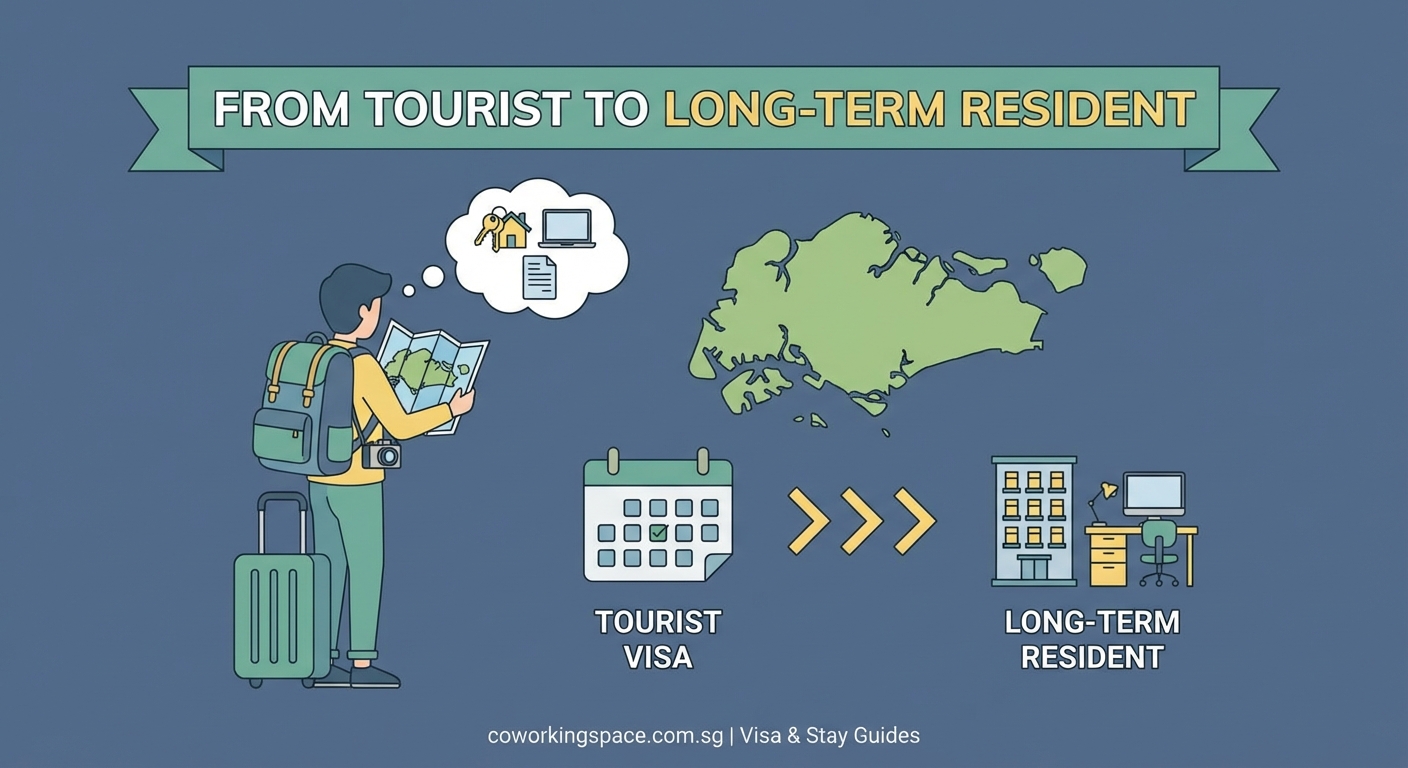
Arriving in Singapore as a tourist and falling in love with the city is easier than you think. The efficient public transport, diverse food scene, and professional opportunities make many visitors reconsider their departure dates. But moving from a short visit to a longer stay requires understanding visa rules, application processes, and legal requirements.
Singapore offers multiple pathways for tourists to extend their stay, from simple tourist visa extensions up to 89 days total, to work passes like Employment Pass and EntrePass, and long-term options such as Long-Term Visit Pass and Permanent Residency. Each option has specific eligibility criteria, documentation requirements, and processing times. Success depends on choosing the right visa category for your situation, preparing complete documentation, and applying before your current pass expires.
Understanding Singapore’s Visa Extension Framework
Singapore’s Immigration & Checkpoints Authority (ICA) manages all visa extensions and pass applications. The process differs significantly based on your current status and intended purpose for staying longer.
Most tourists enter Singapore on a 30-day social visit pass. This can be extended once for an additional 30 days, giving you a maximum of 60 days as a tourist. Some nationalities receive 90-day entry stamps, which can be extended to 89 days maximum.
The extension process is straightforward but strict. You must apply before your current pass expires. Late applications result in automatic rejection and potential overstay penalties.
Your reason for extending matters. Tourism, business meetings, and visiting family are acceptable reasons. Working without a proper work pass is illegal and results in deportation and future entry bans.
Tourist Visa Extension Process

Extending your tourist visa requires submitting an online application through the ICA website. The process takes 3 to 7 working days.
Here’s what you need:
- Valid passport with at least 6 months validity remaining
- Completed Form 14 (Extension of Short-Term Visit Pass)
- Proof of sufficient funds for your extended stay
- Return flight ticket or proof of onward travel
- Local contact information (hotel booking or host details)
- Recent passport-sized photograph
The application fee is SGD 30, payable online via credit card. Processing times vary based on application volume, so apply at least 2 weeks before your current pass expires.
Common reasons for rejection:
- Insufficient financial proof
- Previous overstay history
- Incomplete documentation
- Suspicious travel patterns
- Employment concerns
If approved, you’ll receive an email notification. Print the approval letter and carry it with your passport. Immigration officers may request to see it at checkpoints.
Transitioning from Tourist to Work Pass Holder
Many visitors realize they want to work in Singapore after arriving as tourists. This requires switching from a social visit pass to a work pass.
You cannot work on a tourist visa. Period. Even remote work for overseas clients technically violates visa conditions if you’re physically present in Singapore.
The most common work passes include:
| Pass Type | Minimum Salary | Target Audience | Processing Time |
|---|---|---|---|
| Employment Pass | SGD 5,000/month | Professionals, managers, executives | 3 weeks |
| S Pass | SGD 3,150/month | Mid-skilled workers | 3 weeks |
| EntrePass | N/A | Entrepreneurs with funded startups | 8 weeks |
| Personalised Employment Pass | SGD 18,000/month | High earners seeking flexibility | 8 weeks |
Your employer must sponsor your Employment Pass or S Pass application. You cannot apply independently unless you qualify for EntrePass as a business owner.
The application process requires leaving Singapore in most cases. While some applicants successfully convert their status in-country, ICA typically requires you to exit and re-enter on the new pass.
If you’re considering how to apply for Singapore’s EntrePass visa as a startup founder, you’ll need a business plan, funding proof, and demonstrated innovation potential.
Long-Term Visit Pass Options
The Long-Term Visit Pass (LTVP) allows extended stays for specific relationship categories. This pass suits people with family ties to Singapore but who aren’t ready for permanent residency.
Who qualifies:
- Spouses of Singapore citizens or permanent residents
- Unmarried children under 21 of Singapore citizens
- Parents of Singapore citizens
- Common-law spouses with substantial relationship proof
- Step-children of Singapore citizens or permanent residents
LTVP holders can stay for 1 to 3 years initially, with renewal options. The pass doesn’t automatically grant work rights, but you can apply for a Letter of Consent (LOC) to work for specific employers.
Application requires:
- Sponsorship from a Singapore citizen or PR family member
- Proof of relationship (marriage certificate, birth certificate)
- Sponsor’s income documents
- Medical examination results
- Security bond payment (varies by relationship type)
Processing takes 4 to 6 weeks. The security bond ranges from SGD 5,000 to SGD 15,000 depending on your nationality and relationship to the sponsor.
Student Pass Pathway
Enrolling in a Singapore educational institution provides another route to extended stay. Student Passes allow you to study full-time at approved schools, polytechnics, or universities.
The institution handles your Student Pass application. You’ll need:
- Acceptance letter from an approved institution
- Proof of financial ability to pay fees and living costs
- Academic transcripts and certificates
- Medical examination results
- Local guarantor (sometimes required)
Student Pass holders can work part-time (16 hours per week during term, full-time during breaks) at approved institutions without additional permission. Working outside these limits requires approval.
Course duration determines your pass validity. Most undergraduate programs grant 4-year passes. Shorter courses receive proportional pass durations.
After graduation, you can apply for a Training Employment Pass or Training Work Permit to gain work experience before transitioning to a standard work pass.
Dependent Pass for Family Members
If your spouse or parent holds a valid Employment Pass, S Pass, or EntrePass earning above the minimum threshold, you may qualify for a Dependent Pass.
Minimum qualifying salaries:
- Employment Pass holder: SGD 6,000/month
- S Pass holder: SGD 6,000/month
- EntrePass holder: Must meet EntrePass financial criteria
Dependent Pass holders can apply for a Letter of Consent to work in Singapore. This provides flexibility compared to being tied to a single employer.
The pass holder (your sponsor) submits your application through their employer. Processing takes 3 to 4 weeks.
Children under 21 automatically qualify if the parent meets salary requirements. Legally married spouses also qualify with proper documentation.
Permanent Residency Application
Permanent Residency (PR) represents the most stable long-term option. PRs enjoy nearly identical rights to citizens, except voting and certain housing benefits.
Eligibility categories:
- Employment Pass or S Pass holders working in Singapore
- Spouses and children of Singapore citizens
- Aged parents of Singapore citizens
- Investors through the Global Investor Programme
The application process is competitive. ICA doesn’t publish acceptance rates, but estimates suggest 20% to 30% approval for first-time applicants.
Key factors affecting approval:
- Length of employment in Singapore (minimum 6 months recommended)
- Salary level and career progression
- Educational qualifications
- Age (younger applicants generally favored)
- Family ties to Singapore
- Economic contribution potential
“PR applications require patience and realistic expectations. Working in Singapore for 2 to 3 years before applying significantly improves your chances. Focus on career development, community involvement, and demonstrating commitment to Singapore.” – Immigration consultant with 15 years experience
Application fees are SGD 100 for the main applicant and SGD 50 per dependent. Processing takes 4 to 6 months, sometimes longer.
Rejection doesn’t prevent reapplication. Many successful PRs applied 2 or 3 times before approval.
Common Mistakes to Avoid
Extending your stay in Singapore becomes complicated when you make these errors:
Applying too late: Submit extensions at least 2 weeks before expiry. Last-minute applications face higher rejection rates.
Insufficient financial proof: Bank statements showing SGD 3,000 to SGD 5,000 for each month of extended stay demonstrate financial stability.
Incomplete documentation: Missing a single required document causes automatic rejection. Double-check requirements before submission.
Working on tourist visa: Even unpaid internships or volunteering count as work. Always secure proper work authorization first.
Overstaying: Even one day of overstay creates a permanent record. Future applications face additional scrutiny, and you may be banned from returning.
Providing false information: Misrepresenting employment status, relationship details, or financial situation results in permanent bans.
Ignoring pass conditions: Each pass type has specific conditions. Read them carefully and comply fully.
For digital nomads wondering about legal work options, can digital nomads work legally in Singapore covers the complex reality of remote work visa rules.
Setting Up Your Life During Extended Stay
Once you’ve secured your visa extension or long-term pass, establishing a comfortable base becomes essential. Many extended-stay visitors and new work pass holders find that traditional office setups don’t suit their transitional status.
Best coworking spaces in Singapore for digital nomads on short-term stays offer flexible workspace solutions without long-term commitments. These spaces provide professional environments, networking opportunities, and essential amenities while you establish yourself.
Coworking memberships typically offer:
- Flexible month-to-month contracts
- Professional business addresses
- High-speed internet and meeting rooms
- Community events and networking
- Access to multiple locations across Singapore
This flexibility matters during your transition period. You might need to travel for visa processing, adjust your work arrangements, or change employers. Traditional office leases lack this adaptability.
For those establishing a base while working remotely, how digital nomads can maximize productivity in Singapore’s coworking spaces provides practical strategies for maintaining work quality during your extended stay.
Financial Planning for Extended Stays
Budgeting for a longer Singapore stay requires realistic cost estimates. The city ranks among the world’s most expensive, but costs vary significantly based on lifestyle choices.
Monthly expense estimates:
- Accommodation: SGD 1,200 to SGD 3,000 (depending on location and sharing arrangements)
- Food: SGD 400 to SGD 800 (hawker centers vs restaurants)
- Transport: SGD 100 to SGD 200 (public transport)
- Workspace: SGD 200 to SGD 600 (coworking membership)
- Utilities and internet: SGD 100 to SGD 150
- Entertainment: SGD 200 to SGD 500
Total monthly costs typically range from SGD 2,200 to SGD 5,250 for a comfortable lifestyle.
Many work pass applications require proof of financial stability. Maintain bank statements showing several months of living expenses, even if your employer covers some costs.
How much does it really cost to work from a coworking space in Singapore breaks down workspace costs compared to traditional office alternatives.
Healthcare and Insurance Requirements
Singapore’s healthcare system is excellent but expensive for non-residents. Tourist visa extensions don’t include healthcare coverage, and even work pass holders need supplementary insurance.
Insurance requirements by pass type:
- Tourist visa: Travel insurance recommended (SGD 50 to SGD 150 per month)
- Work passes: Employer must provide medical insurance (minimum SGD 15,000 coverage)
- Student Pass: School-arranged insurance or private policy required
- Dependent Pass: Covered under sponsor’s employer insurance or private policy needed
Medical costs without insurance can be substantial. A basic doctor visit costs SGD 50 to SGD 150. Emergency room visits start at SGD 200. Hospitalization runs thousands of dollars per day.
Secure comprehensive insurance before your tourist visa expires. Many insurers won’t cover pre-existing conditions discovered after policy start.
Building Your Professional Network
Extended stays provide opportunities to build meaningful professional connections. Singapore’s compact size and active business community make networking accessible.
Industry associations, chamber of commerce events, and coworking community gatherings offer regular networking opportunities. Many coworking spaces host weekly or monthly events specifically for members to connect.
How coworking spaces help freelancers build professional networks in Singapore explains how shared workspaces facilitate organic professional relationship building.
Professional networks often provide the connections that lead to job opportunities, business partnerships, or valuable advice about navigating Singapore’s systems.
Attend industry-specific meetups through platforms like Meetup.com or Eventbrite. Singapore hosts numerous tech, finance, marketing, and creative industry gatherings weekly.
Maintaining Compliance Throughout Your Stay
Staying legal requires ongoing attention to visa conditions, reporting requirements, and renewal deadlines.
Set calendar reminders for:
- Pass expiry dates (60 days before)
- Re-entry permit applications if traveling
- Address change notifications (within 28 days of moving)
- Employment changes (immediate notification required)
- Dependent pass renewals
Work pass holders must notify ICA within 7 days of employment termination. Your pass becomes invalid, and you have 30 days to find new employment or leave Singapore.
Keep copies of all immigration documents, approval letters, and correspondence with ICA. Digital and physical backups prevent complications if documents are lost.
If you’re planning to travel during your extended stay, understand re-entry permit requirements. Some pass types allow multiple entries, while others require specific re-entry permits.
Your Extended Singapore Journey Starts With Proper Planning
Extending your stay in Singapore transforms from overwhelming to manageable when you understand the available pathways and requirements. Whether you’re applying for a simple tourist extension, transitioning to a work pass, or pursuing permanent residency, success depends on preparation, timing, and complete documentation.
Start your extension process early. Research your options thoroughly. Gather required documents before deadlines approach. Consider how workspace flexibility through coworking memberships can support your transition period without long-term commitments.
Singapore welcomes visitors who follow proper procedures and contribute positively to the community. Your extended stay can become the foundation for a rewarding long-term relationship with this dynamic city.