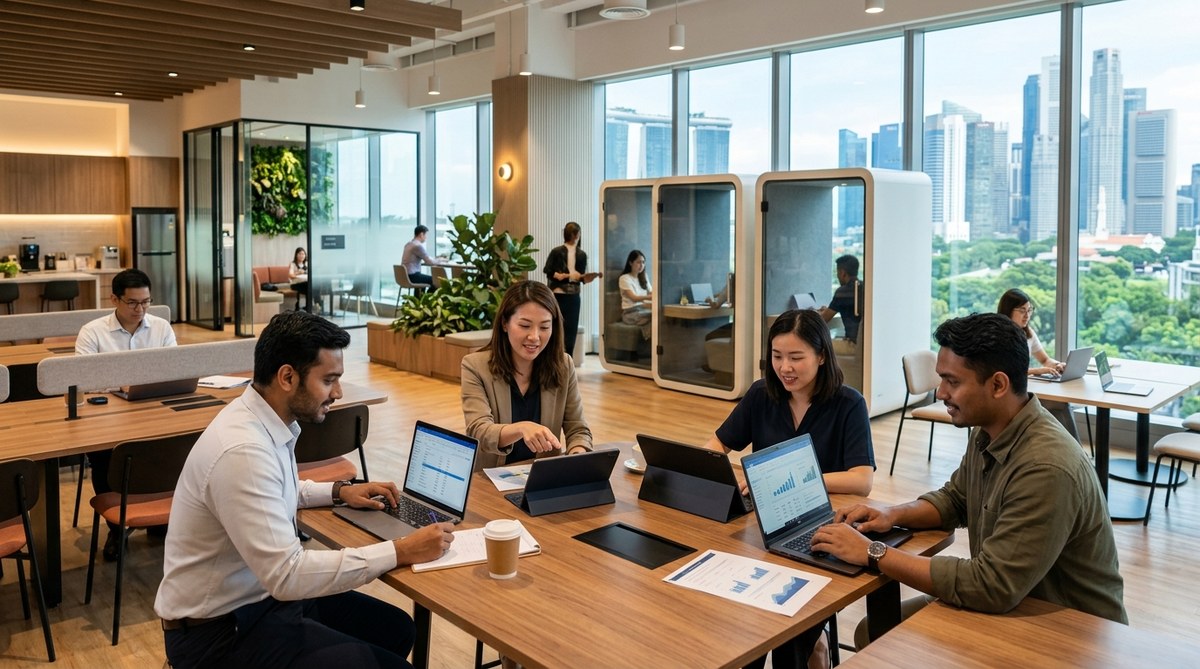
The way we work in Singapore has changed for good. The old model where everyone commuted to a central office five days a week feels like a relic from another era. In 2026, the conversation has shifted from “should we go hybrid?” to “how do we make hybrid work actually work?” And the surprising engine driving this shift is the humble coworking space. These spaces are no longer just a backup plan for freelancers. They are now the strategic backbone for some of the most progressive hybrid work policies in Singapore. For HR managers and startup founders, understanding this evolution is the key to building a flexible office policy that retains talent and controls costs.
Singapore coworking spaces in 2026 are doing more than providing desks. They are enabling companies to design flexible, data-driven hybrid work policies that reduce real estate costs, improve employee satisfaction, and offer enterprise-grade tech. By leveraging membership data, AI booking tools, and community programming, these spaces allow HR leaders to treat office space as a service rather than a fixed asset.
Why Coworking Spaces Are the New Policy Lab for Hybrid Work
Traditional offices come with rigid leases and fixed layouts. They force your team into a schedule that may not fit their lives. Coworking spaces flip that script. They offer a flexible, on-demand infrastructure that allows companies to test and refine their hybrid work policies without signing a 5-year lease.
In 2026, many Singapore companies are using coworking memberships as a pilot program. They give a portion of their team access to a coworking space for three months. They track usage data, employee feedback, and productivity metrics. Then they adjust the policy before rolling it out company-wide. This iterative approach saves money and prevents the kind of policy backlash that happens when mandates are handed down without testing.
The 3 Pillars of a Modern Hybrid Policy Built on Coworking
If you are an HR manager or a founder looking to update your hybrid policy, here is the framework that successful companies are using this year. These three pillars form the foundation of any effective policy that uses coworking spaces.
-
Choice-based attendance. Give employees the autonomy to choose where they work based on their tasks for the day. Deep focus work happens best at home or in a quiet zone. Collaborative work, brainstorming, and client meetings happen in the coworking space. The policy should not mandate a set number of days. Instead, it should provide guidelines on when the office (or coworking hub) adds the most value.
-
Budget allocation per employee. Instead of paying for a central office that sits half empty, allocate a monthly coworking budget to each team member. This can be a flat stipend or a tiered system based on role. For example, a software engineer might get a basic hot desk pass, while a sales director gets a budget that covers private meeting room bookings. This treats the office as an employee benefit, not a corporate expense.
-
Data-driven space management. Modern coworking operators in Singapore provide detailed analytics on space usage. They show you which days are busiest, which amenities are most used, and how often meeting rooms are booked. Use this data to refine your policy. If nobody books desks on Fridays, do not mandate Friday office attendance. If the phone booths are always full, add more.
What a Smart Hybrid Policy Looks Like in Practice
Let’s look at a realistic example. A mid-sized tech startup in Singapore with 50 employees uses a hybrid policy that includes a base membership at a coworking space in Tanjong Pagar. Every employee gets a monthly pass that gives them 10 days of access per month. The company also buys a block of meeting room credits that teams can use for sprint planning or client demos.
The policy works because it is not one-size-fits-all. The product team comes in on Tuesdays and Wednesdays for standups and whiteboard sessions. The customer support team works from home most days but uses the coworking space for training and team bonding. The leadership team uses the private office suites for sensitive calls. The result is a policy that feels natural, not forced.
“The best hybrid policies are invisible. They remove friction from the workday and let people focus on the work itself. Coworking spaces in Singapore are uniquely positioned to provide that frictionless experience because they are built for flexibility from the ground up.” — A regional HR director at a Fortune 500 firm based in Singapore.
Common Mistakes When Building a Hybrid Coworking Policy
Even with the best intentions, companies make errors when integrating coworking into their hybrid strategy. Here are the most common pitfalls and how to avoid them.
| Mistake | Why It Hurts | Better Approach |
|---|---|---|
| Forcing everyone to use the same space | Employees in the East may not want to commute to the CBD. | Offer a network of spaces across Singapore, not just one location. |
| Treating coworking as a “perk” instead of a tool | Employees may not take it seriously or use it strategically. | Integrate coworking access into the official work policy and set clear expectations. |
| Ignoring the social element | Remote workers feel isolated if they never see teammates. | Schedule regular “anchor days” where the whole team meets at the coworking hub. |
| Not training managers on the policy | Managers default to asking everyone to come in five days a week. | Train leaders on how to manage a distributed team and trust their employees. |
How to Choose the Right Coworking Partner for Your Policy
Not all coworking spaces are built the same. When you are selecting a partner to support your hybrid work policy in 2026, look for these features:
- Network coverage. Can your employees access spaces in multiple locations? A single space in Raffles Place might not help someone living in Tampines. Look for operators with locations across the island.
- Enterprise-grade tech. The space should offer fast, secure WiFi, reliable video conferencing equipment, and a seamless booking app. You need to be able to manage your team’s access from a central dashboard.
- Community programming. A good coworking space hosts events, workshops, and networking sessions. This adds value to your policy by giving employees a reason to come in beyond just desk work.
- Flexible billing. You need the ability to add or remove members month by month. Avoid spaces that require long-term commitments for your team members.
If you are still unsure about the difference between a coworking space and a traditional office, reading our guide on what makes a coworking space different from a traditional office can help clarify the decision.
The Tools You Need to Manage a Coworking-Based Hybrid Team
Managing a team that uses coworking spaces requires a small but essential set of tools. Here is a checklist of systems that make the policy run smoothly:
- A centralized booking platform (the coworking space’s app or a tool like Robin or Envoy)
- A team communication channel (Slack or Teams) where people post their location for the day
- A shared calendar that shows which days are “anchor days” at the coworking hub
- A clear expense policy for any additional costs like parking or guest passes
Many of these tools are covered in our article on 7 essential tools remote workers need when using coworking spaces. The key is to standardize the process so that nobody wastes time figuring out logistics.
Why Your Hybrid Policy Needs a Backup Plan
Even the best coworking spaces have occasional issues. A power outage, a network slowdown, or a full house on a popular day can disrupt your team. A good hybrid policy includes a backup plan. This could be a secondary coworking location nearby, a list of quiet cafes with reliable WiFi, or a clear policy that lets employees work from home if their primary space is unavailable.
The most resilient policies are those that trust the employee to make the right call. If you build a culture of accountability, your team will find a way to stay productive even when the plan changes.
The Future of Hybrid Work Policies in Singapore
Looking ahead, the trend is clear. Companies are moving away from owning or leasing large offices. They are moving toward a model where “office” is a service, not a place. Coworking spaces are the infrastructure that makes this possible. In 2026, we are seeing more companies offer their employees a “workspace wallet” that can be spent on coworking passes, meeting rooms, and even coffee at the in-house cafe.
This model gives employees true flexibility. It also gives HR leaders the data they need to make smart decisions. If you are still relying on an old attendance tracker and a mandatory three-day office policy, you are likely losing talent to companies that offer more freedom.
For a deeper look at how to structure your team’s schedule, check out our guide on how to build an effective hybrid work schedule in a coworking space.
Your Next Step Toward a Smarter Policy
Start small. Pick one team or one department. Give them access to a coworking space for two months. Track everything: usage, satisfaction, productivity. Then use that data to build your company-wide policy. The coworking spaces in Singapore are ready to support you. They have the technology, the locations, and the flexibility. All you need is the willingness to try something new.
The companies that thrive in 2026 will be the ones that stop treating the office as a default and start treating it as a tool. Coworking spaces are the sharpest tool in that box. Use them wisely.